

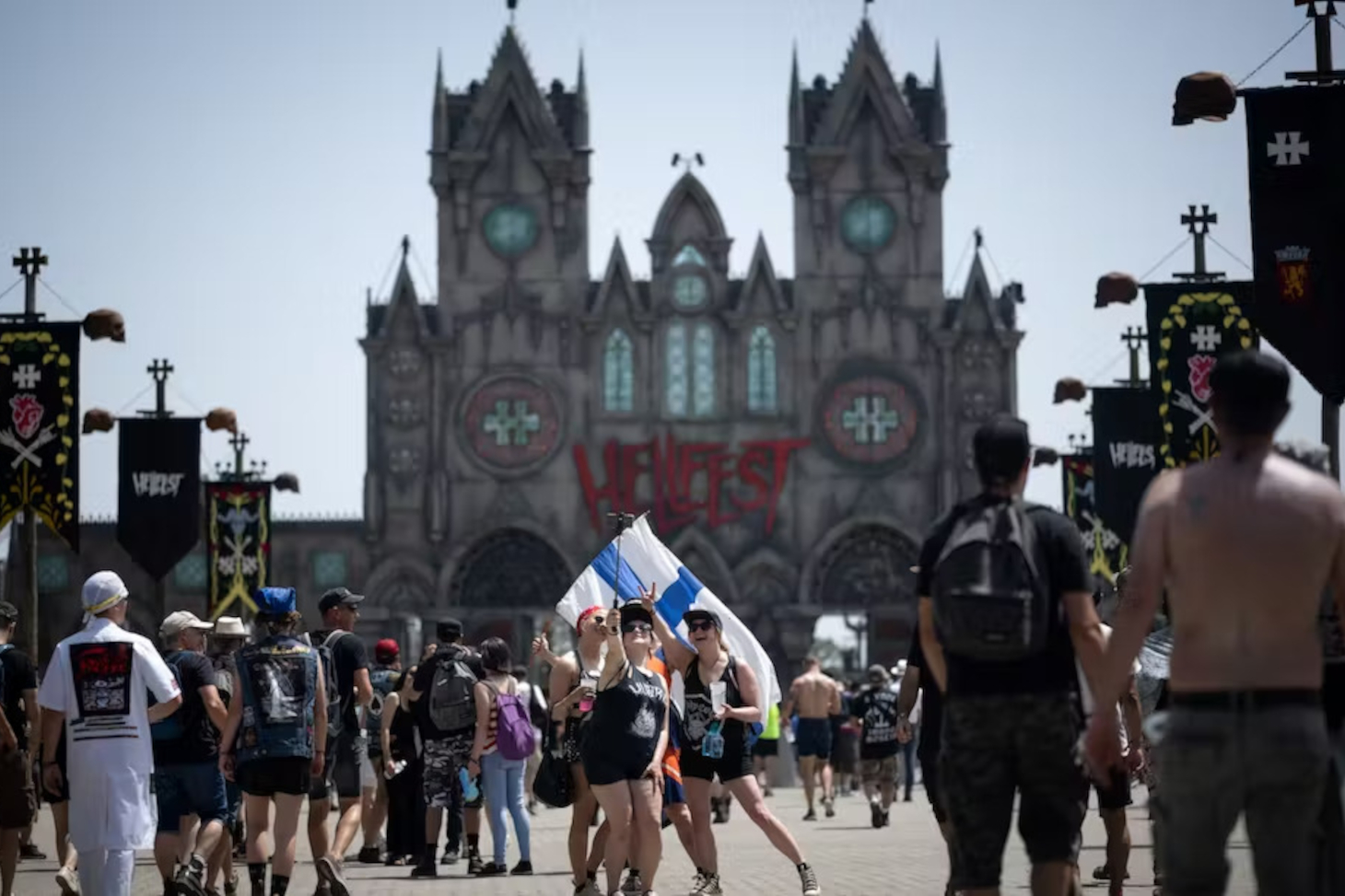
It's official: the summer festival season has begun in France.
Over the past 16 years, Hellfest Open Air has become one of Europe’s largest “metal” music festivals, welcoming nearly 200,000 festivalgoers in 2023. It is also, and above all, the annual gathering of the metal community— metalheads who meet in mid-June each year in Clisson, a few kilometers from Nantes, to see their favorite artists, including legendary bands such as Kiss, Metallica, Deep Purple, Motorhead, and others.
It’s a pilgrimage that not all fans have the chance to take part in. Tickets for the festival sell out within a few hours of going on sale in mid-October, even before the lineup has been announced. This scarcity enhances the perceived value of the festival experience—and, in turn, its exceptional, even sacred, nature.
As a result, this annual event has become something of a legend, to the point where both its reputation and its image have changed significantly in recent years. Not only does Hellfest no longer have the reputation as a gathering of Satanists that certain groups have tried to pin on it, but for some, it has even become “the place to be.”
As a result, it is attracting an increasingly broad audience, as shown by recent studies by Corentin Charbonnier and Christophe Guibert —particularly new festivalgoers who are not part of the “core” (in the sense of “core”) metal community.
However, the very strong community norms present at Hellfest make it a festival unlike any other. The social norms, standards, ways of communicating, behaving, and experiencing the event (what is known in marketing as “consumer logic”) observed during an ethnographic study at the 2022 edition show that they are significantly different from those observed at other music festivals in studies I have conducted (Musilac, Paléo Festival, Tomorrowland, Jazz à Vienne, etc.).
This raises the question of how these newcomers are assimilated into the Hellfest community—if not into the metal community at large—so as not to undermine the unique character of this festival, with its deeply rooted and widely respected norms. Although observations show that newcomers strongly embrace the social rules and norms, certain behaviors brought in by “mainstream” festivalgoers can alter the distinctive Hellfest experience.
Although differences can be observed depending on the scene (and thus the style of music), at Hellfest the expression of emotions—which is highly codified—is conveyed through the voice (guttural screams) but above all through body language.
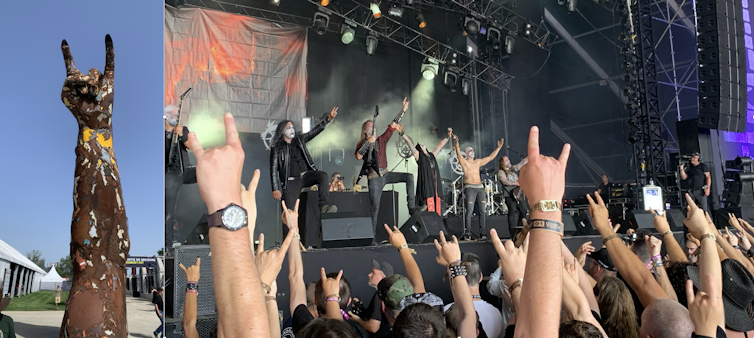
Either by raising a fist with the index and little fingers extended(the “horns up,” a symbol of belonging to the community), or by nodding one’s head more or less vigorously (“headbanging”), or by jostling others (the “pogo”). Martin, a regular at Hellfest, explains: “When I’m really into it, when I’m happy, I push others.” Generally speaking, there’s no middle ground between headbanging and pogoing: either the festivalgoer stands still and moves only their head, or they move around while jostling others. Dancing or jumping in place—with the exception of underground, hardcore, or Celtic rock scenes—is less of a cultural norm in the metal community than it is in other musical cultures.
While national and regional flags are increasingly flying and waving among the crowds at “mainstream” music festivals, you won’t find any at Hellfest. Asserting a sense of territorial belonging isn’t the norm here; it’s the metal community to which we belong.
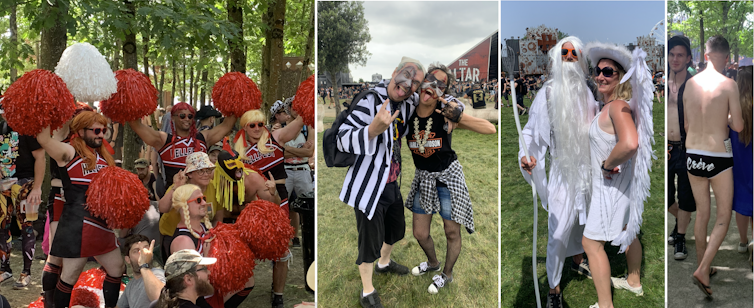
Outfits are, in fact, carefully chosen to reflect the aesthetic of their favorite music genre (hardcore, death metal, stoner, etc.). Wearing a T-shirt featuring their favorite band, a kilt, or sporting a gothic look encourages social interactions among festivalgoers who are fans of the same band, for example. Wearing a T-shirt or cap from a previous edition of Hellfest also allows fans to show their affiliation with the community by demonstrating their attachment to the “Hellfest” brand.
[More than 85,000 readers rely on The Conversation’s newsletters to better understand the world’s major issues. Subscribe today]
The merchandise booths are swamped from the very first day, and you sometimes have to wait more than 30 minutes to get a souvenir of this pilgrimage. The care taken in choosing what to wear also reflects the sacred nature of the occasion—much like putting on Sunday best for Mass. For older festivalgoers (over 40), this is taken very seriously. For younger attendees, more playful styles emerge, sometimes subverting the usual norms.
A metal concert is serious business: we're there to connect with the artist(s) on stage and enjoy the moment to the fullest.
With the exception of the “pit” (the mosh pit, which involves only a few hundred people out of the 30,000 or 40,000 in attendance at a concert on the main stage), there is little interaction among the audience members during concerts. The rich and numerous emotional exchanges among audience members take place away from the stages.
The concert is like a sermon that you listen to with religious devotion, obediently and attentively responding to the artists’ instructions (clapping, shouting, forming a “circle pit”) without taking any initiative (or very little), unlike what might happen at other concerts or festivals.
Metalheads (except for those who decide to “mosh” in front of the stage) aren’t very proactive. The study of the crowd shows that the majority of their actions are reactions to the artists’ prompts. Audience movements such as “clapping in rhythm” tend to fizzle out fairly quickly once the artists stop prompting them. This reactive—or even rather passive—attitude differs from data collected in other genres (electronic, pop, jazz, etc.).
The spatial layout of the crowd also caters to the audience member’s need to experience the moment in an almost religious way. As a result, crowd density is low, although it does increase over the 20 meters in front of the main stage. This means that audience members are not hindered by others. According to Bertrand, a regular at Hellfest: "It's super easy to get around—it's as if they'd marked spots on the ground for each festivalgoer so everyone has their own safe zone."Unlike what usually happens at pop-rock, rap, or electronic music concerts, people rarely pull out their cell phones to film the show. You experience it in the moment. This can also be explained by the fact that the average age of the audience is higher than at rap concerts, for example. But that’s not part of metal culture, and when some festivalgoers don’t follow the unwritten rules, it disrupts the others, as Rose explains during a black metal concert on the Temple stage: “I was in thesecond row in front of the stage, and the people in front of me were either chatting or filming. I knew they weren’t really into it, and it really annoyed me—it completely ruined the emotional atmosphere.”
Pogo, a practice that originated in the punk movement and involves jostling each other with one’s shoulders, can be found at every concert (except for death metal and stoner rock). It’s the festivalgoers in the “pit”—the area in front of the stage—who engage in this exchange, this sharing of emotions, which is also governed by its own set of rules. Rose, 50, who loves to pogo, explains: “Guys who don’t join in during the pogo are total jerks—it doesn’t go well, you can get hurt. There’s violence in the pogo, but there’s also kindness. But guys who are just there looking for a fight—that’s not okay—and those guys get kicked out pretty quickly.”
When someone falls or loses a shoe, the other “pogoteurs” immediately form a safety line to secure the person. More and more women are taking up this physically contact-intensive dance.
In fact, there’s no buffer zone between the mosh pit and the rest of the audience. There is a clear contrast between their frenzied movement and the stillness of the rest of the audience, whom no one disturbs. This “benevolent violence” is characteristic of metal-scene pogo pits. It sets them apart from the pogo pits—devoid of rules or benevolence—that have recently begun appearing at rock and rap concerts, with younger and almost exclusively male audiences.
With its highly codified nature, Hellfest—much like a Gallic village—is, for now, resisting the societal trends observed at mainstream or less community-oriented festivals.
Living in the present moment—by dividing activities into distinct segments (a time for sharing, a time for fellowship, etc.)—is one of its cornerstones. The key to preserving this sacred experience lies in respecting these “authentic” community norms .
Even though Hellfest isn't immune to issues related to psychological harassment or gender-based and sexual violence, the values of sharing, respect for rules and others, solidarity, and kindness are the cornerstones of the metal festival: a “sacred” dimension that makes it truly unique.