

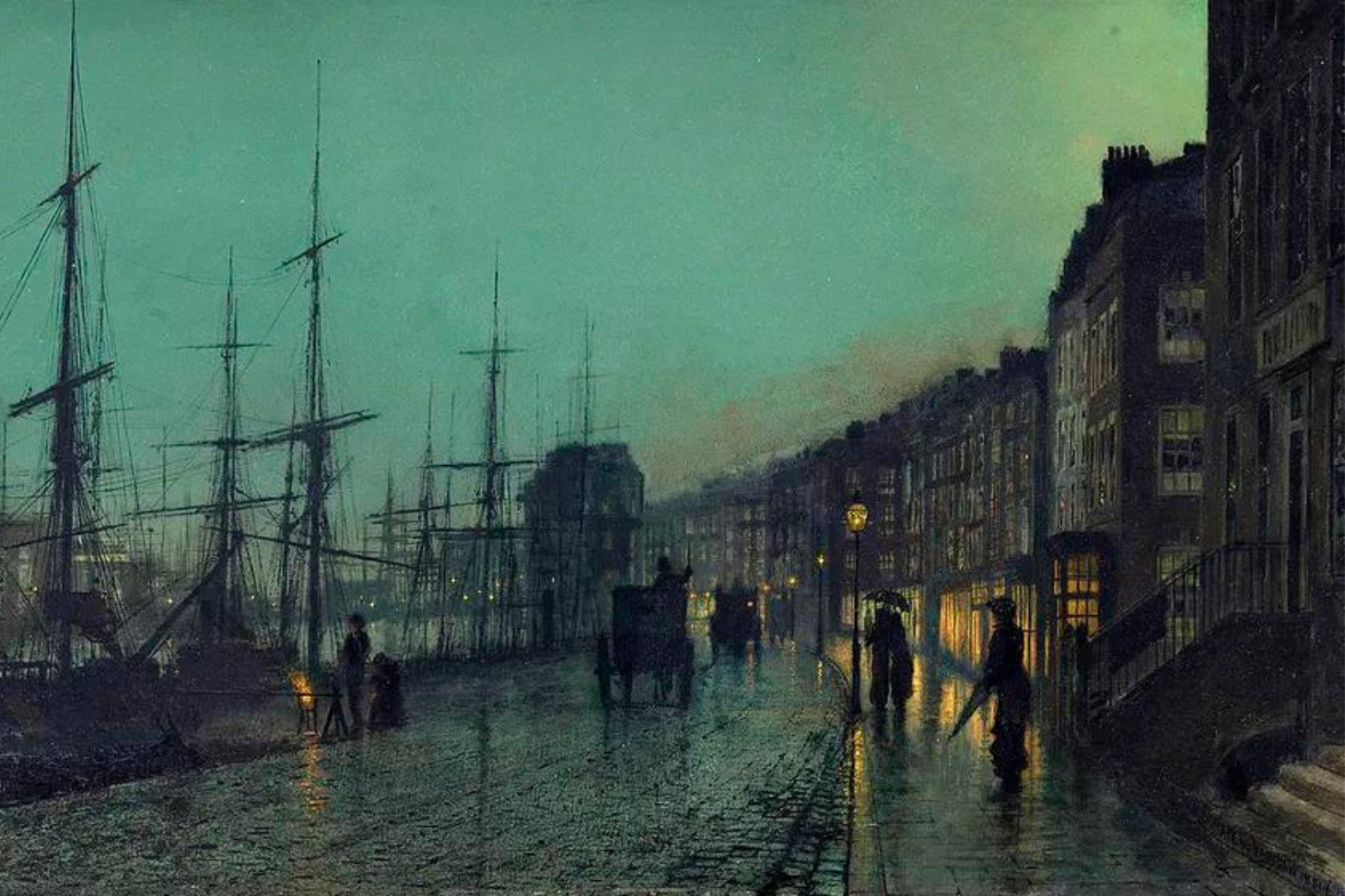
During the Victorian era (1837–1901), caught between their daily lives in the factory and their dreams of independence, these true pioneers seem to have paved the way for a struggle that would profoundly change the status of women.
To understand the status of these women workers, we must look back at the Christian and patriarchal society of Glasgow from the 1850s to 1900: femininity was viewed through a religious lens, as a gift that was at times divine and at times evil.
The ideal Victorian woman—immortalized by the poet Coventry Patmore with the phrase “the Angel of the Hearth” —is docile, submissive, delicate, and innocent. Any woman whose behavior deviates from this ideal of femininity is therefore regarded as a fallen angel, a lost girl.
She is confined to her role as a mother and wife, since access to the public sphere and the professional world is the exclusive domain of men. But in this city so deeply marked by poverty, there is one exception: the female textile worker.
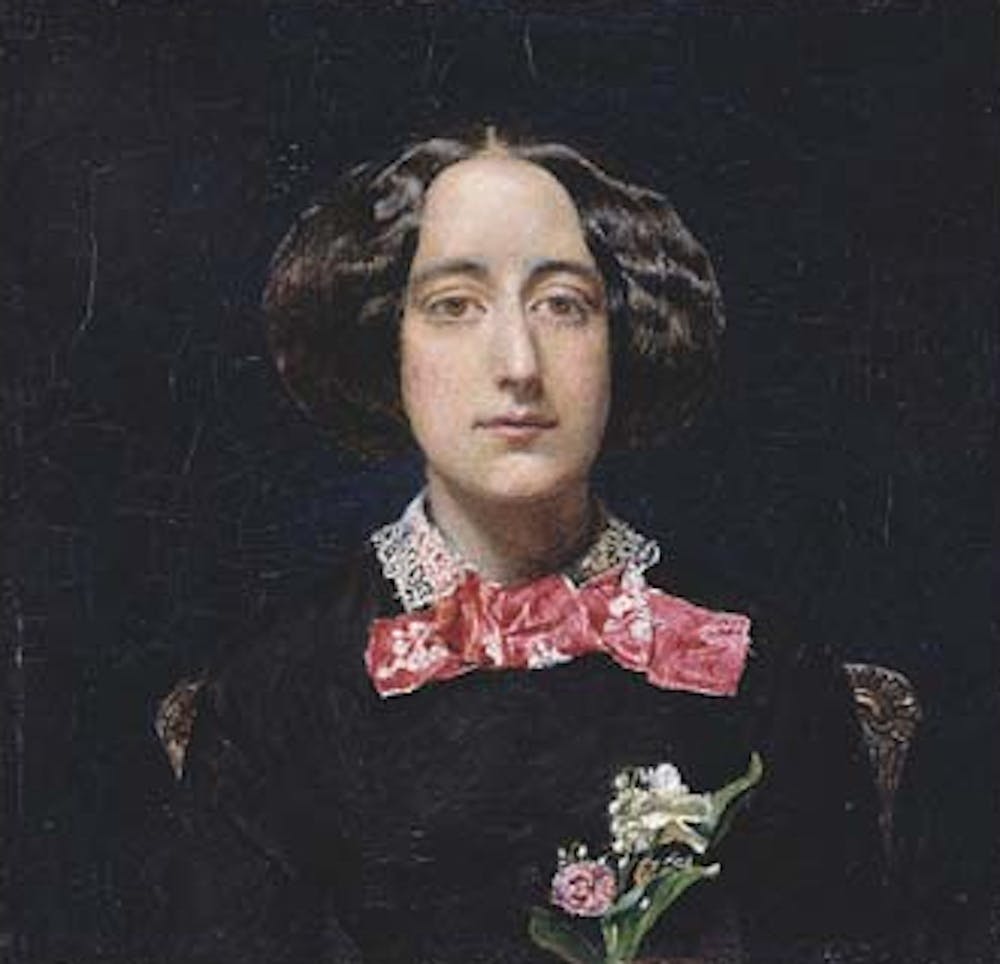
Forced to contribute to the household income, she breaks with moral conventions by going to work. In doing so, she partially frees herself from the oppressive rules imposed on her gender.
Women workers in the textile industry played a major role in the Scottish Industrial Revolution, which reached its peak during the Victorian era.
Until the 1860s, spinning mills, weaving mills, dyehouses, and garment factories dominated the urban landscape and the female labor market. Glasgow was then the industrial heart of Scotland, thanks to its resources—coal and water—and its status as a seaport, which facilitated global exports and imports.
But while the United States was the sole supplier of cotton to Glasgow’s textile industries, the American Civil War (1861–1865) led to a breakdown in trade relations and sent many of these industries into bankruptcy.
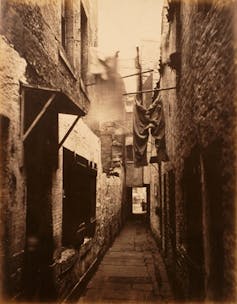
However, female workers continued to work during this period. As the municipal archives show, the city had a population of 403,120 in 1861, 58 percent of whom were women. Of these, 65 percent were employed, with three-quarters working in the textile industry, as documented in the city’s municipal archives.
Imagine the female workers engaged in unpicking, carding, stretching the cotton, winding, bobbin winding, and monitoring the light machinery. These are all terms that have been forgotten today but which referred to very precise technical tasks. As the “little hands” of the cotton era, they were involved in every stage of textile production: from natural fiber to yarn, from yarn to weaving, and from weaving to sewing garments.
But the factory is a world governed by masculine values, where the presence of women offends the men—even though they are outnumbered. Worried that their dominance is dissolving into the workings of technology, the men seek to subject the female workers to their authority by assigning them to subordinate positions.
Inthe 19th century, technology brought about a lasting transformation in the nature of work. Machines became easier and easier to use, and thus increasingly accessible to women and children. In weaving workshops, for example, the introduction of automatic looms reduced the physical strength required to operate them. Singer sewing machines arrived in the very early 1850s, and their use in the garment workshops of the Maryhill neighborhood also represented a major advance for seamstresses, who could then produce garments eight times faster than by hand.
Although mechanization improves productivity and makes women’s work easier, the combination of women and machines sparks a heated debate. While for the male worker, hand tools are an extension of the body, the machine, on the other hand , represents an “organic strangeness.” Associated with this strangeness, femininity is thus seen as a curse and instills fear in men.
Working 10 hours a day on the lightest machines, which require the most repetitive motions, the female workers look like robots. Against the coldness and hardness of the metal, their bodies keep time and instinctively repeat the same movements. In the eyes of the men—who often hold positions as supervisors and foremen—the female workers are thus transformed into “machine women,” spellbound and disembodied.
However, these automaton-like women still possess a faint glimmer of humanity: their sexuality. Among the seamstresses, it is expressed through the constant movement of their legs and feet on the pedal , which, it is said, is a source of arousal.
As suggested by French deputy Charles Benoist, an expert on the subject at the time (1861–1936), the mixing of men and women, the lack of privacy, the heat given off by coal-fired boilers, and the humidity in the weaving shops and spinning mills of France and Great Britain were said to heighten passions.
Employers then asked themselves: How can we protect men from these temptresses? To ensure discipline, it seemed that the solution lay in dividing tasks by gender and strictly supervising female workers. To prevent flirtatious or inappropriate behavior, they were not to be allowed under any circumstances to neglect their duties by engaging in distractions such as idle chatter.
This physical and psychological oppression allowed employers of the time to subdue the “woman-machine and her evil sensuality.” Men saw themselves as inquisitors; the machine became a pyre; the female worker was thus psychologically condemned to death through subordination.
Inthe 19th century, upholding the gender division of labor meant guaranteeing men a monopoly on machinery and reserving access to skilled, higher-paying jobs for them. In the Victorian era, women earned, on average, between one-third and one-half of men’s wages. Wages were calculated based on the amount of work performed and the level of skill required.
Predisposed to marriage and motherhood, they have limited access to vocational training and find themselves forced to take on unskilled jobs with little responsibility.
At the time, the scientific community believed that women lacked the imagination necessary for creative tasks and finishing work.
Furthermore, in the 1850s, it became mandatory to make the machines used by women and children safer in order to prevent accidents. As a result, women were excluded not only from the most dangerous machines, but also from the most complex and productive ones.
Although women made up the majority of the workforce in Glasgow (between 52 and 54 percent of employed women between 1850 and 1900), they faced intense competition, job insecurity, and financial hardship.
Many of them then turn to the informal economy, which is very often linked to domestic work, such as childcare and sewing. Some also enter the sex trade. This issue continues to spark debate among historians.
If the female workers were working twelve hours a day, how could they find the time for this activity? And if these incidents occurred at their workplace, then wasn’t this, in fact, sexual harassment?
Victorian society in Glasgow obviously did not recognize sexual harassment, which therefore was not subject to any legal action. In such situations, male dignity was protected: the blame fell on the female worker and her provocative nature.
Women are reluctant to come forward for fear of being fired. When sexual assaults occur, they are helpless and left to fend for themselves. Marginalized, they become society’s outcasts. As a cheap and inexhaustible labor force, the Victorian female worker embodies—as historian Judith Walkowitz so aptly puts it—“the symbol of industrial exploitation.”
In this context, who better than the women workers in Glasgow’s textile industry to speak out about women’s daily lives at work and demand their rights?
As early as the 1860s, female factory workers in Glasgow spoke out to denounce these unjust working conditions. Ellen Johnston, a poet, was one of the few female textile workers to have written about her own life experiences. In her works published in 1867, she describes factory work, sexual abuse, her out-of-wedlock pregnancy, and her suicide attempt.
A woman who has fallen from grace through no fault of her own, she describes the contrast between the coldness of her position as a victim and the romanticized warmth of the working-class world.
Others like them gradually became muses for middle-class philanthropists and feminists, such as the politician Flora Drummond.
In the late 1860s, the decline of the textile industry plunged many female workers into precarious circumstances. Victims of unemployment and social deprivation, they went on to join the ranks of activists fighting for gender equality in the workplace, alongside middle-class feminists.
Most of them are members of the Scottish Women’s Co-Operative Guild and the Glasgow and West of Scotland Association for Women’s Suffrage.
Today, the struggle for women’s emancipation in Great Britain is commonly associated with the English activist Emmeline Pankhurst, leader of the Women’s Political and Social Union, which, at the dawn ofthe 20th century, emerged as the most influential feminist movement in the United Kingdom.
Known as suffragettes starting in 1903, these women were also inspired by movements led by female workers.
Together, they contributed to the struggle to secure the right to vote in Great Britain, by 1918. In this way, they paved the way for a new perception of women: from the reclusive, demonized, and despised factory worker to the strong, independent woman.
The author is writing her dissertation under the supervision of Véronique Molinari at the ILCEA4 laboratory, LLSH doctoral school, University of Grenoble.