Accurately Predicting the Thermal Conductivity of Quantum Solids
Search
24, September 2026
Researchers from laboratories in Grenoble have developed a numerical method that allows for the precise calculation—without approximations—of the thermal behavior of solids at very low temperatures, when quantum effects influence heat diffusion.
Heat transport is a fundamental property of materials that occurs whenever there is a temperature difference, and is described by Fourier’s well-known law, which involves thermal conductivity—a coefficient that reflects a material’s greater or lesser ability to diffuse energy under the influence of a given temperature gradient. Understanding the microscopic factors that contribute to higher or lower thermal conductivity is therefore crucial for applications ranging from energy technologies to electronics and the design of high-performance insulation materials.
This research was conducted at the following CNRS units:
• Interdisciplinary Physics Laboratory (LIPhy - UGA/CNRS)
• Laboratory of Physics and Modeling of Condensed Matter (LPMMC - UGA/CNRS)
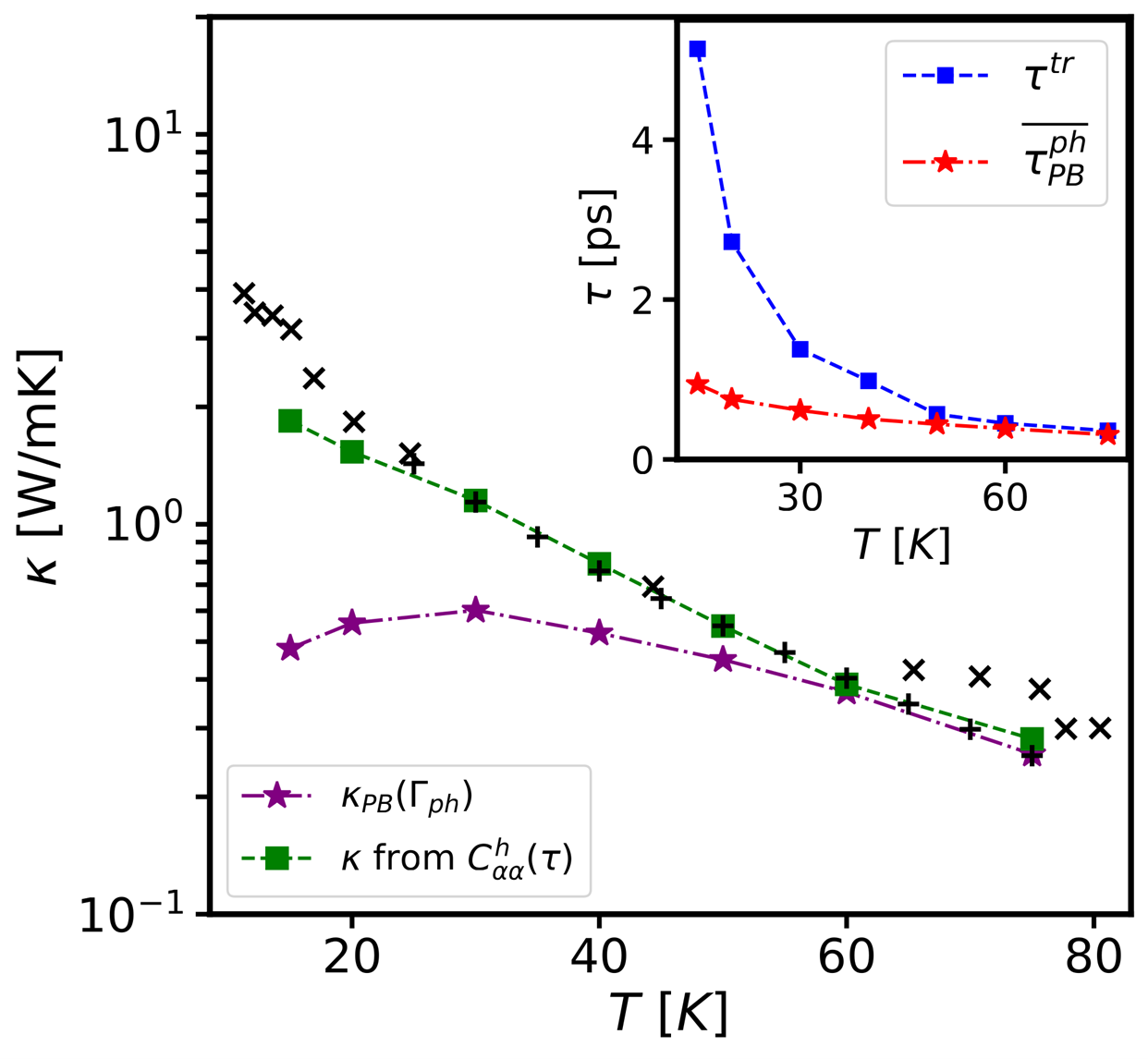
In a recent study, researchers propose a new computational method for studying thermal conduction in insulating or semiconducting solid systems, based on path integral Monte Carlo (PIMC) simulations. This complex method calculates the dynamics of the nuclei by precisely accounting for all quantum effects, which are present in all solids but are particularly pronounced at low temperatures and in crystals containing light atoms. It exploits the formal relationship that, in quantum physics, allows for the calculation—via Monte Carlo simulations at equilibrium—of time-dependent correlation functions, which are obtained in imaginary time and must then be analytically extended into real time to obtain the transport coefficients. Unlike many recently developed methods, this approach requires neither simplifying assumptions nor perturbative approximations, and it takes into account all degrees of freedom involved in heat transport. The researchers validate the method by studying crystals of noble gases—argon and neon—for which they obtain results consistent with experimental measurements. The results are obtained by constraining the spectral function associated with the heat flux to take the form of a physically relevant model, constructed from the effective phonon frequencies. They show that the qualitative change in behavior at low temperatures is associated with a transport characteristic time that diverges as T→ 0, differing from phonons, whose lifetime remains finite in this limit.
This new method, which provides a robust framework for studying heat transport beyond the capabilities of classical molecular dynamics—without resorting to perturbative or semiclassical approximations—should lead to a better understanding of the microscopic characteristics of matter that determine heat transport properties, particularly at low temperatures where quantum effects become significant. These results are published in the Physical Review Letters.
Published on 23 September 2026
Updated on 23 September 2026
References
Non-perturbative computation of thermal conductivity based on path integral Monte Carlo methods
Vladislav Efremkin, Stefano Mossa, Jean-Louis Barrat, and Markus Holzmann Physical Review Letters - Published August 25, 2026.
DOI: https://doi.org/10.1103/2f5l-scbv
Open access repository: arXiv
Share the linkCopyCopiedClose modal windowShare the URL of this pageI recommend this page:Available at this address:The page will then be accessible from your "My Favorites" menu.Stop the videoPlay the videoMutePlay audioChat: Have a question?Robo Fabrica ChatbotMatomo Traffic StatisticsX (formerly Twitter)