
Close your eyes and imagine the smell of an old library, a spice market, or a freshly painted room. These smells instantly transport us to a certain atmosphere, a memory, or a bygone era. But have you ever considered that people in the past didn’t experience the world through smell the same way we do? That a scent considered pleasant in the 18th century might have been unbearable in the 19th—and vice versa? It is precisely this little-known territory—the history of what societies have perceived, feared, or valued through their sense of smell—that Érika Wicky has chosen to map.
The history of the senses is a recent and demanding field of study. It is not a matter of recreating the smells themselves—fragrances evaporate, scents fade—but rather of reconstructing, through texts, testimonies, and archives, the ways in which people of the time perceived, described, and interpreted them. Why did this 19th-century painter complain about the smell of turpentine in his studio? Why was the varnish used in 18th-century salons both admired for its shine and feared for its toxic fumes? These questions reveal value systems, social hierarchies, and attitudes toward the body that were deeply rooted in their respective eras.
At the heart of Érika Wicky’s project: the smell of paint, in the literal sense of the word. Pigments, varnish, turpentine, tobacco smoke: the atmosphere of an 18th- and 19th-century artist’s studio was a complex olfactory cocktail with multiple meanings. Her research shows that this air quality was not insignificant: it influenced the creativity of painters, the well-being of models forced to pose for hours on end in often poorly ventilated spaces, and even the preservation of works in progress. In the 18th century, the fumes from the varnishes used to decorate the grand salons of the aristocracy were also one of the main olfactory nuisances of the time, considered not only unpleasant but also hazardous to health—long before the odors that the collective imagination readily associates with the Ancien Régime.
Smell is not just a matter of the nose: it is also a matter of class, gender, and power. In the studios of 19th-century painters, tobacco smoke, turpentine, and the biting cold from the large picture windows formed the sensory backdrop of an idealized bohemian life, and the experience of these conditions helped shape the romantic image of the impoverished but free artist. Tobacco use, in particular, played a significant social and symbolic role: it signified masculinity, a sense of belonging, and a particular relationship to time and creativity. In contrast, luxurious studios smelled of Oriental tobacco and high-end varnishes—signs of social success that the bourgeoisie could come to admire during social calls.
This research is part of a broader project focused on olfactory knowledge: How, since the 18th century, has the sense of smell been used to assess air quality, to distinguish the healthy from the unhealthy, the noble from the vulgar, and the fresh from the putrid? From chemistry to botany, from perfumery to public health, the sense of smell has proven to be an instrument of knowledge whose history remains largely to be written.
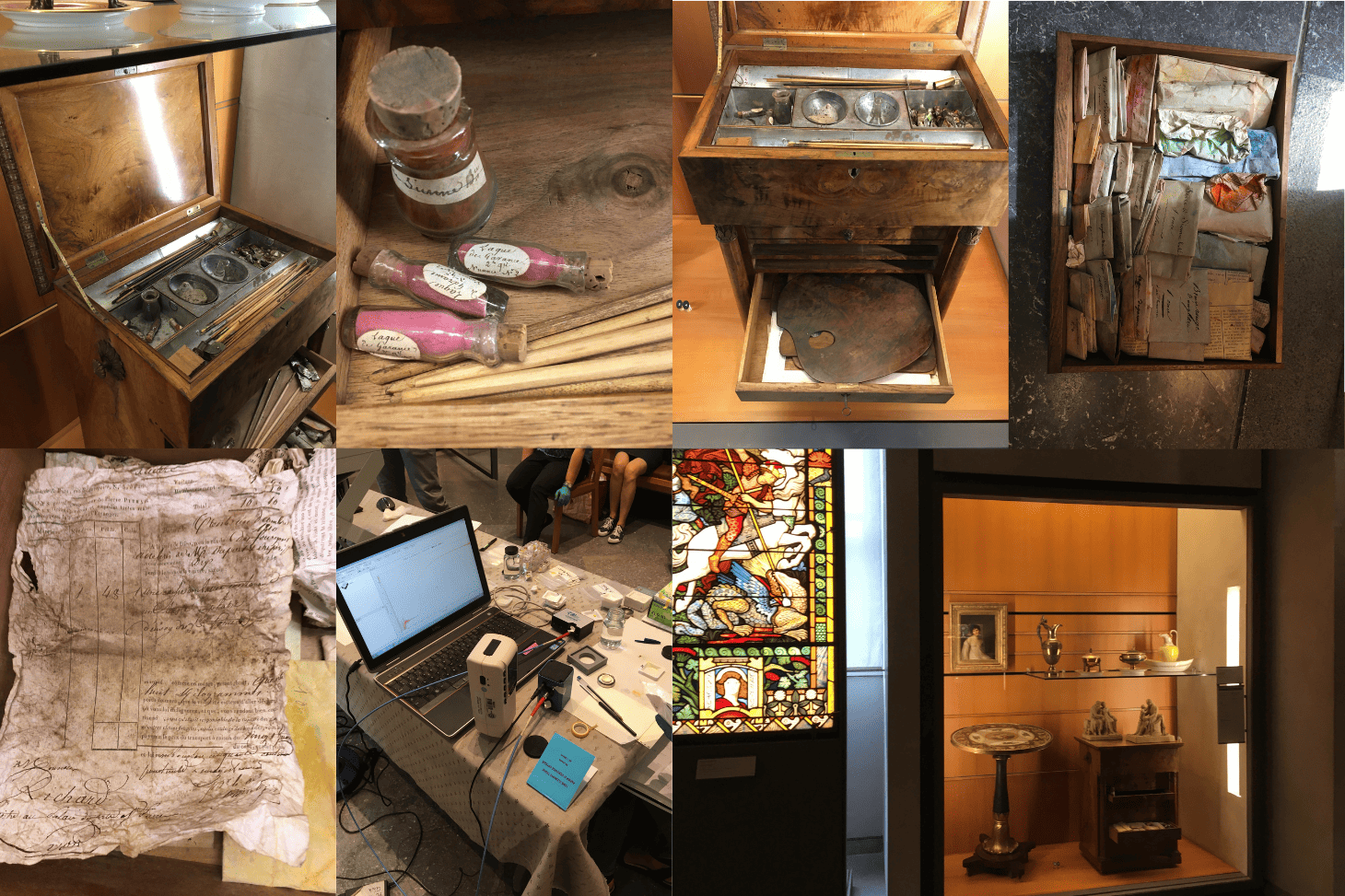
Alongside this exploration of perceptions, Érika Wicky is interested in a question that is as fascinating as it is delicate: Can we recreate the smells of the past? Not just through texts, but through the materials themselves? In collaboration with the Musée des Beaux-Arts de Lyon, she is working to create a sensory reconstruction based on a paint cabinet that belonged to the Lyon-based painter Fleury Richard—an exceptional object, preserved intact since the early 19th century, which still contains more than a hundred original pigments. Recreating the olfactory atmosphere of this painter’s studio means bringing to life a sensory experience that written archives describe but cannot convey.
This approach illustrates Érika Wicky’s desire to forge close ties between history, chemistry, and heritage preservation, fostering a dialogue between the humanities and the sciences to promote a better understanding of artistic creation.
How have societies constructed their olfactory hierarchies? How has industrialization transformed our relationship with everyday smells? How can museums and heritage sites incorporate the sensory dimension into their interpretive programs?
As part of international research networks—notably the CNRS’s GDR O3, whose annual meetings are being held this year in Grenoble—and backed by an ongoing ANR project, Érika Wicky is helping to make UGA a leading center for a discipline that breathes new life into the way we interpret the past.