

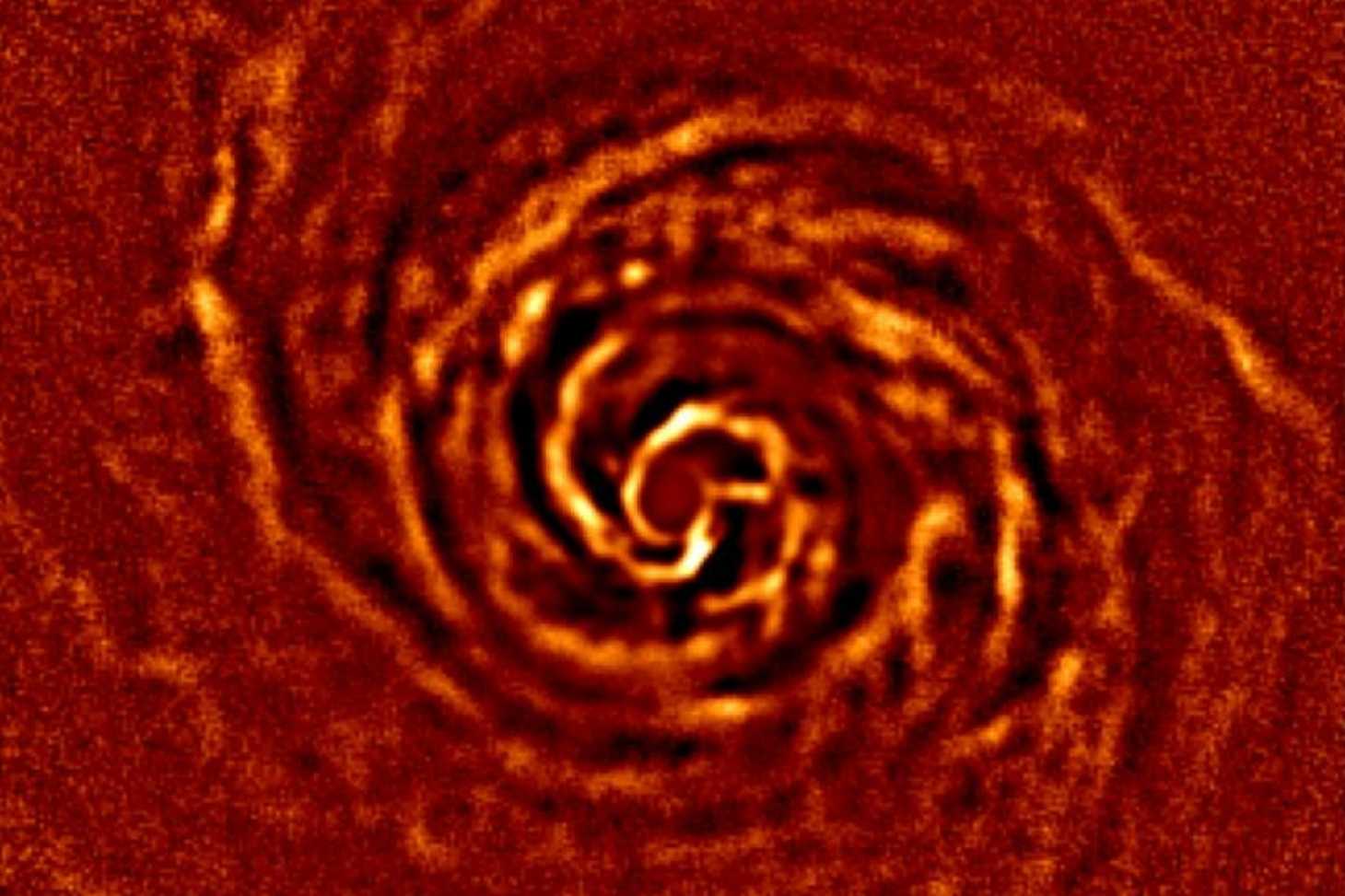
For the first time, the rotation of a disk where planets form has been directly observed by mapping the emission from its dust grains. This is the disk surrounding the young star AB Aurigae. While it appears to rotate generally in accordance with the laws of physics, certain regions close to the star exhibit an unexpected deviation.
What is the cause of this anomaly? A body of evidence suggests the presence of giant planets in the process of forming. This study, involving scientists from the Grenoble Institute of Planetology and Astrophysics (IPAG-CNRS/UGA), was published in the journal *Astronomy & Astrophysics* on June 1, 2026. It sheds new light on the mechanisms of planet formation and the complex dynamics of protoplanetary disks.
Thanks to the unique capabilities of the Sphere instrument1 in the near-infrared and its exceptional spatial resolution, the team was able to precisely track the disk’s structures and their evolution across three observations collected over a four-year period. The scientists identified a bright structure characteristic of accretion zones, where gas and dust accumulate and fall onto a forming object. This phenomenon is particularly involved in the formation of gas giant planets. Images of the AB Aurigae disk2 also reveal the rapid rotation of faint shadows cast onto the surface by invisible structures—potentially protoplanets (planets in the making) or clumps of opaque dust—orbiting close to the star.
These results, which are more complex than predicted by theoretical models, underscore the importance of continuing research to directly detect the properties of the protoplanets or clumps responsible for the structures observed in the AB Aurigae disk.

The laboratories involved
Laboratory for Instrumentation and Research in Astrophysics (CNRS/Paris Observatory – PSL/Sorbonne University/Université Paris Cité)
Bordeaux Astrophysics Laboratory (CNRS/University of Bordeaux)
Astrophysics, Instrumentation, and Modeling Laboratory (CEA/CNRS/Université Paris Cité)
Grenoble Institute of Planetology and Astrophysics (CNRS/Université Grenoble Alpes)
Joseph-Louis Lagrange Laboratory (CNRS/Observatoire de la Côte d’Azur/Université Côte d’Azur)
Lyon Astrophysics Research Center (CNRS/ENS de Lyon/Lyon 1 Claude Bernard University)
1. Developed by a European consortium, SPHERE—which has been installed on the VLT since 2014—is an instrument on ESO’s Very Large Telescope in Chile. 2. AB Aurigae is a star in the constellation Auriga.
Published on June 17, 2026
Updated on July 17, 2026
References
Destructuring of the disk around AB Aurigae: dynamics and accretion Anthony Boccaletti, Emmanuel Di Folco, Anne Dutrey, Tang Ya-Wen, Stéphane Guillotea, Thomas Collin-Dufresne, Anne-Marie Lagrange, Eric Pantin, Jeffrey S. Bary, Nuria Huelamo, Jozsef Varga, Julien Milli, Vincent Pietu, William Danchi, Bin Ren, Clément Baruteau, Mickael Bonnefoy, Tracy Beck, Maud Langlois, Sylvestre Lacour, Bruno Lopez, Alexis Matter, Julien Woillez, Florentin Millour, Matthis Houllé, Philippe Berio, Astronomy & Astrophysics, published June 1, 2026.DOI
Share the linkCopyCopiedClose the modal windowShare the URL of this pageI recommend this page:Available at this address:The page will then be accessible from your "My Favorites" menu.Stop the videoPlay the videoMutePlay audioChat: Have a question?Robo Fabrica ChatbotMatomo Traffic StatisticsX (formerly Twitter)