Astronomers have discovered the strongest evidence to date that Betelgeuse has a companion
Search
August 24, 2026
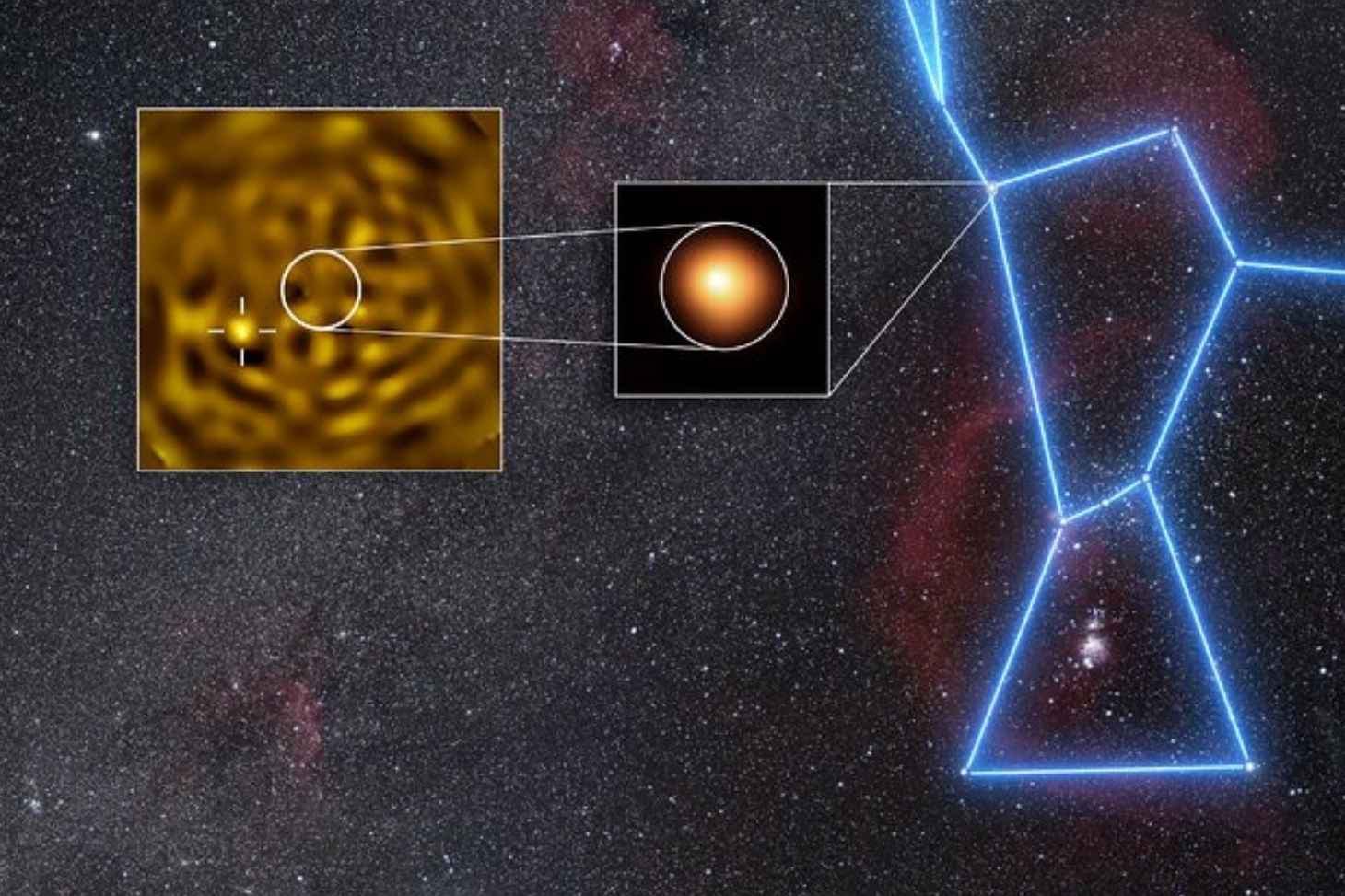
Images of Betelgeuse and its companion taken by the VLT (Credit: ESO/M. Montargès et al. Background: N. Rissinger (skysurvey.org))
Astronomers finally have irrefutable evidence that Betelgeuse, one of the most famous stars in the night sky, is not alone. Using the European Southern Observatory’s (ESO) Very Large Telescope (VLT), a team led by French researcher Miguel Montargès and involving IPAG-OSUG (UGA/CNRS) has obtained the sharpest image ever taken of what is likely Betelgeuse B, the star orbiting Betelgeuse. “This is the culmination of a century-long quest,” says Miguel Montargès.
"We have shown that Betelgeuse is not alone: it has a dim companion star.", explains Miguel Montargès, an astronomer at the Paris Observatory - PSL in France and lead author of the study published today in *Astronomy & Astrophysics*. Betelgeuse—a reddish star in the constellation Orion, easily visible to the naked eye and known for its fluctuations in brightness—has been observed for millennia. But it continues to surprise astronomers.
"I jumped out of my chair when I saw the processed images.", recalls Miguel Montargès. Astronomers had been searching for nearly a century for this possible companion—initially proposed to explain Betelgeuse’s brightness variations—but without success. Two studies published in 2024 predicted with certainty that in December of that year, the companion star would be at its farthest point from Betelgeuse and therefore easier to spot. Miguel Montargès and his team set to work, observing the star with ESO’s VLT in December 2024 and spending several months processing the data.
"Honestly, I didn't think we had the sensitivity needed to detect Betelgeuse B as it had been predicted.", explains Miguel Montargès. "It's precisely because it's more massive than expected that we can see it!" While its mass was initially estimated to be roughly equal to that of the Sun, new observations reveal that Betelgeuse B actually has a mass about two to three times that of the Sun. "The fact that we can still discover a close companion—one that is more massive and brighter than the Sun—orbiting such a well-studied star is remarkable.", adds Miguel Montargès. "These are some of the best moments in science: discovering something new and unexpected."
Betelgeuse B was observed in direct imaging, which means that light emanating from the star itself was detected using the SPHERE instrument installed on ESO’s VLT in the Atacama Desert in Chile. Although there had already been indications of the existence of this companion star—including a potential direct detection made with the Gemini North telescope in Hawaii, United States—this is the strongest evidence and the sharpest image of Betelgeuse B to date. “It is remarkable to see just how well SPHERE and advanced post-processing techniques—originally developed to detect exoplanets—also perform in detecting a companion around a massive, evolved star like Betelgeuse.”, explains co-author Anthony Boccaletti, who is also an astronomer at the Paris Observatory.
"To be sure that this companion actually exists, we'll still need to observe it a year from now, on the other side of the star, but there's practically no room for doubt left.", adds Miguel Montargès.
A few years ago, Betelgeuse caught the attention of both astronomers and the general public when it began to visibly dim. As an evolved supergiant star, Betelgeuse is expected to die in a supernova explosion, and this dimming led some to speculate that it was about to explode. A team of astronomers led by Miguel Montargès studied the star using ESO’s VLT and discovered that it was actually obscured by a dust cloud.
The possible detection of Betelgeuse B will prompt astronomers to study the influence this companion might have on Betelgeuse’s predicted supernova explosion. "The question of whether this companion will have an impact on the evolution of the red supergiant is truly up for debate."", concludes Miguel Montargès.
Published on August 24, 2026
Updated on September 1, 2026
References
VLT/SPHERE Imaging of the Candidate Companion of Betelgeuse
M. Montargès, A. Boccaletti, O. Flasseur, A. de Koter, J. Milli, P. Kervella, S. Ridgway, E. Bordier, E. Lagadec, A. K. Dupree, F. Backs, T. Calderwood, and P. Morgan Astronomy & Astrophysics manuscript no. aa61023-26
Share the linkCopyCopiedClose the modal windowShare the URL of this pageI recommend this page:Available at this address:The page will then be accessible from your "My Favorites" menu.Stop the videoPlay the videoMutePlay audioChat: Have a question?Robo Fabrica ChatbotMatomo Traffic StatisticsX (formerly Twitter)