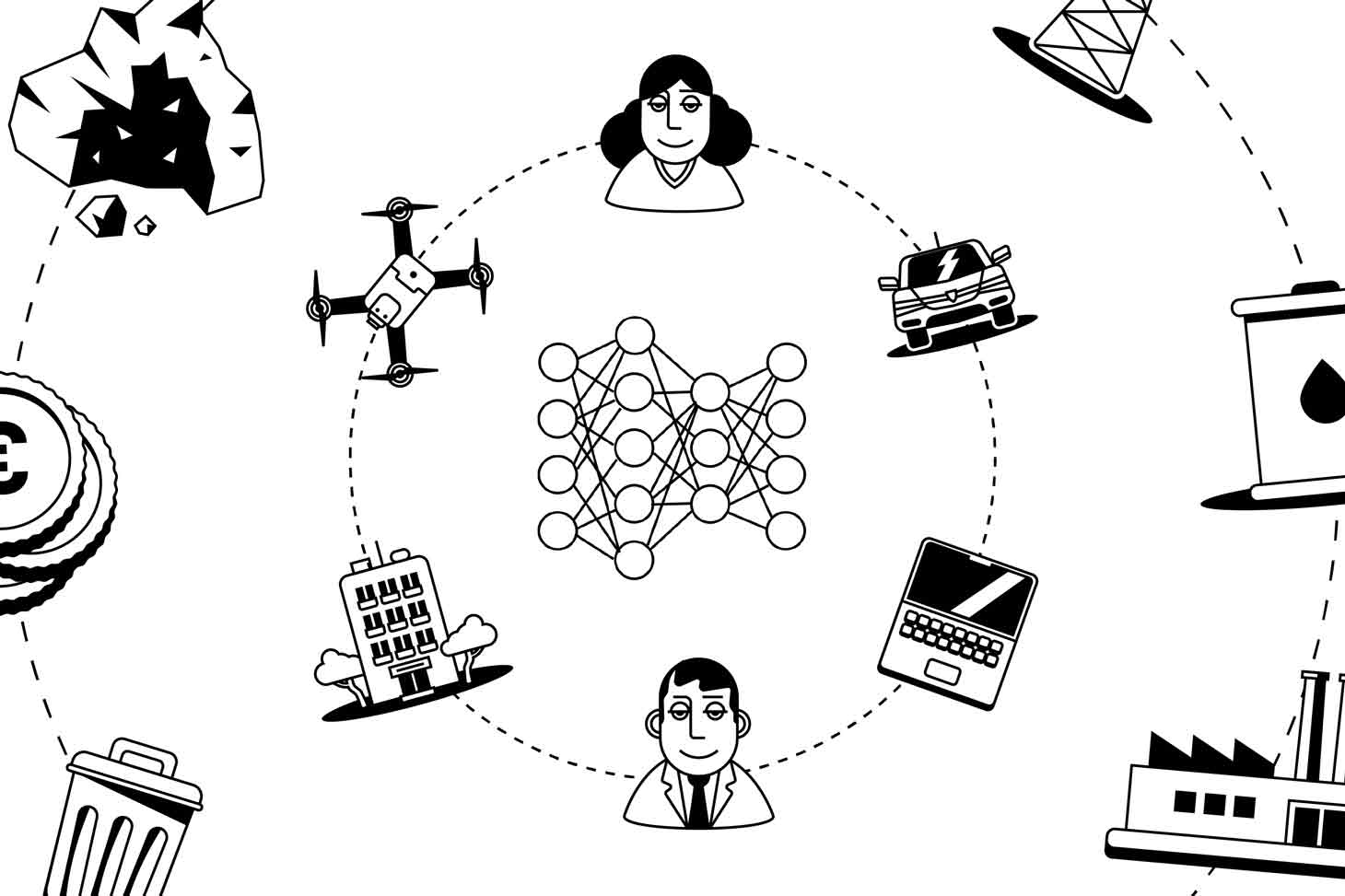
Artificial intelligence is profoundly transforming our societies and becoming increasingly prevalent in many fields. But behind its promises lie environmental and societal impacts that are still too little understood.
Can we reconcile the development of AI with digital frugality and respect for planetary boundaries?
Designed for students, scientists, and anyone who wants to better understand the challenges of artificial intelligence, the MOOC “The Challenges of Frugal AI” explores these questions through a scientific, technical, and critical lens.
Co-produced by Inria and theUniversité Grenoble Alpes as part of the
EFELIA-MIAI Project, this free online course helps participants understand and assess the environmental impacts of AI, explore ways to optimize its use, and examine the appropriateness of its applications for a more sustainable digital future that respects planetary boundaries.
Here are five good reasons to follow him!
Reason #1: Understanding the environmental impacts of AI and its blind spots
Artificial intelligence plays a major role in our digital lives,
But do you really know how it works and what resources it draws upon? Physical infrastructure, equipment, resources: its impacts are many and often overlooked.
This MOOC will help you better understand these impacts and identify them throughout the entire life cycle: from the manufacturing of equipment, through its use in data centers and its applications in businesses and society, all the way to the end of the equipment’s life.
You will discover that electricity consumption is only one aspect of AI’s environmental impacts by taking a more comprehensive view of the life cycle of AI systems.
Reason #2: Learning to assess the impacts of an AI system
Evaluation is important for maintaining some control over our actions and their consequences. How can we know if an artificial intelligence solution can be energy-efficient?
Which indicators should be taken into account? And, more importantly, what scope should be considered?
This MOOC provides you with the tools to estimate and measure the environmental impacts associated with AI, taking into account hardware, servers, computing phases, and the impacts related to the use of a service as a whole.
You'll develop the right habits for analyzing data, comparing solutions, and better understanding their environmental performance.
Reason #3: Discover practical solutions for improving AI energy efficiency
Optimizing the energy efficiency of the components in an AI system's value chain is not enough to achieve energy-efficient AI, but it is a necessary condition.
The authors, who are experts in the field, present various methodological and technical approaches for improving the efficiency of AI systems: infrastructure and computational optimization, model compression, federated machine learning, and new hardware architectures and algorithmic approaches.
Reason #4: Question the appropriateness of using AI and use it wisely
Is the most energy-efficient AI always the one with the model that consumes the least energy?
And do we always need artificial intelligence?
This MOOC invites you to look beyond technical optimization and ask yourself a fundamental question: Is the use of AI appropriate given the need it addresses and the resources it requires?
By the end of the MOOC, you will have the tools to take a critical look at the design and use of AI, taking into account the efficiency of solutions and the concept of “just need.”
Reason #5: To have objective, factual information to help us think about AI and its future applications
AI frugality is not just a computing issue. It also affects our industrial, economic, institutional, and societal choices.
By bringing together different perspectives—from scientists, industry professionals, and institutions—this MOOC invites participants to reflect on the role we want artificial intelligence to play in the years ahead.