Toward Carbon-Neutral Concrete: In-Situ 5D Tomography Reveals Carbonation and Cracking in Cement Paste
Search
May 27, 2026
To optimize CO2 sequestration in recycled concrete, researchers have shed light on the complex physicochemical mechanisms of carbonation using a unique 5D imaging technology at NeXT-Grenoble, a neutron and X-ray tomograph developed through a collaboration between the University of Grenoble Alpes and the Institut Laue-Langevin (ILL). By simultaneously combining X-rays and neutrons, this study, published in *Nature Communications*, reveals how water and microcracks dictate gas capture, thereby challenging traditional scientific models.
The Scientific Challenge: Decoding the Complexity of THCM Couplings
Concrete production accounts for approximately 8% of global CO2 emissions. While the accelerated carbonation of recycled aggregates is a promising avenue for carbon sequestration, the physics of the process remains a “black box.” Under industrial conditions (80°C, pure CO2 flow), thermo-hydro-chemical-mechanical (THCM) interactions create a complex feedback loop in which the chemical reaction alters the porous structure, which in turn controls fluid transport.
The Experimental Approach: Bimodal Synergy at NeXT-Grenoble
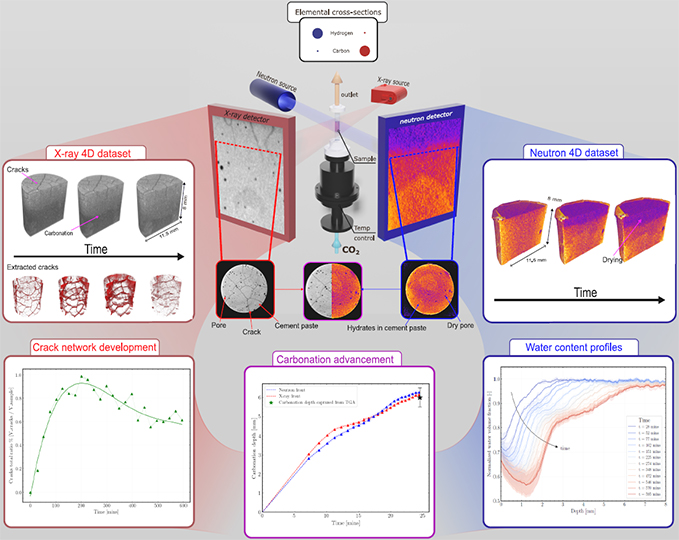
The study is based on a new carbonation cell operando (see figure) and takes advantage of the unique configuration of the NeXT (Neutron and X-ray Tomograph) instrument at the ILL, developed in collaboration with the University of Grenoble Alpes, which enables simultaneous and co-localized data acquisition. This 5D tomography approach operando is essential for quantifying phenomena that occur on the same spatiotemporal scale.
Phase Identification Using Dual Contrast
While X-rays map changes in mineral density (carbonation front; see figure at bottom left) and the kinetics of cracking, neutrons isolate the response of the liquid phase (figure at bottom right). This combination makes it possible to unambiguously distinguish between the consumption of bound water, the accumulation of free water, and changes in porosity—measurements that are impossible with conventional measurement systems.
Operando Correlation Between Transport and Damage
The strength of the instrumentation at NeXT lies in its ability to correlate, at any given moment, the formation of microcracks (visible with X-rays) with moisture fluxes (visible with neutrons). This coupling reveals how mechanical damage acts as either an accelerator or an inhibitor of transport, depending on local saturation.
Key Findings and Contributions of the Program
Water Transport Induced by Chemical Processes
The experimental results indicate that carbonation cannot be described as a simple gas diffusion phenomenon. It is accompanied by a significant release of water that was initially chemically bound, as shown in the box titled “ Water Content Profile " in the figure. Neutron imaging reveals that this water migrates toward the center of the sample. At the same time, reaction products (particularly CaCO₃) precipitate within the nanoporosity, leading to the formation of a hydraulic barrier that reduces the effective permeability and limits CO₂ penetration (see box “ Advances in Carbonation ").
Crack Propagation Dynamics
Bimodal imaging has made it possible to observe the nucleation of microcracks induced by calcite crystallization stresses. These cracks initially act as preferential transport pathways for the gas before undergoing partial sealing, a phenomenon known as “structural breathing.” This phenomenon was quantified through time-series monitoring with scans taken every 25 minutes, as shown in the box “ Crack Network Development ".
Limitations of Classical Diffusion Models
La résolution spatiale atteinte (< 25 µm), combinée à la sensibilité aux phases fluides, démontre que les modèles purement diffusifs sont inadaptés. Ces approches négligent les mécanismes couplés de transport, l’évolution de la perméabilité ainsi que les rétroactions mécaniques, pourtant déterminants dans le contrôle de la cinétique globale du processus de carbonatation.
Illustration of the experimental approach, showing the simultaneous acquisition of X-ray and neutron tomography images over time. The complementary nature of the two techniques, due to their distinct attenuation characteristics, makes it possible to study the drying of the cement paste (neutrons) and the evolution of the carbonation front and cracks (X-rays). The 3D analysis quantifies water loss (bottom right), carbonation (bottom center), and crack propagation over time (bottom left).
Published on May 27, 2026
Updated on July 17, 2026
References
Operando 5D tomography uncovers carbonation-driven water transport and cracking in hydrated cement paste.
El Faqir, C., Tengattini, A., Huet, B., M. Briffaut, S. Dal Pont. Nature Communications Materials 7, 49 (2026). DOI
Scientific Contacts
Stefano Dal Pont
Professor, UGA – 3SR Laboratory (CNRS/UGA – Grenoble INP-UGA)
Alessandro Tengattini
Associate Professor, UGA – 3SR Laboratory (CNRS/UGA – Grenoble INP-UGA)
Share the linkCopyCopiedClose the modal windowShare the URL of this pageI recommend this page:Available at this address:The page will then be accessible from your "My Favorites" menu.Stop the videoPlay the videoMutePlay audioChat: Have a question?Robo Fabrica ChatbotMatomo Traffic StatisticsX (formerly Twitter)