The MAGNET collaborative project, led by a team of four scientists from UGA, the Inria Center at Paris-Saclay University, and the CNRS, has been awarded an ERC Synergy Grant 2026, one of the most prestigious European honors in research. It aims to develop new mathematical and numerical methods for simulating complex physical phenomena, with applications ranging from engineering to cosmology.
The Project
MAGNET (Monge-Ampère Geometry and Numerical Effective Transport for Computational Physics), selected as part of the European Research Council’s (ERC) 2026 Synergy Grants, brings together four researchers with complementary expertise in the fields of computer science, numerical geometry, the calculus of variations, and theoretical physics: Bruno Lévy, Inria research director in the PARMA project team (Inria Center at Paris-Saclay University and Orsay Mathematics Laboratory), Charles Dapogny (CNRS, Jacques-Louis Lions Laboratory), Roya Mohayaee (CNRS, Paris Astrophysics Institute), and Édouard Oudet, professor at theUniversité Grenoble Alpes , within the Jean Kuntzmann Laboratory (UGA, Inria, CNRS, Grenoble INP-UGA).
What is this about?
MAGNET focuses on the simulation of physical phenomena involving mass transport or geometric evolution: fluid flow, shape optimization, and cosmology. A recurring challenge is to reconcile an accurate simulation of the phenomenon with reliable tracking of its interfaces, which can deform significantly and change topology.
The project begins with this question: How can we construct a Lagrangian representation of a complex physical system that accurately tracks its moving interfaces and is differentiable with respect to its parameters?
To address this, the team is drawing on optimal transport theory. It plans to develop a fast solver for the Monge-Ampère equation, a nonlinear equation that generalizes the Poisson equation. The principle is comparable to that of the fast Fourier transform for the latter. This solver will be released as open-source software, building on existing libraries such as Geogram.
Two flagship apps
The first application involves the design of optimal parts. Shape optimization involves calculating the best shape for an object—whether it is a mechanical part, a heat exchanger, or a pipe—based on a given criterion: withstanding a load, transferring heat, or allowing a fluid to pass through. During the calculation, the shape may change significantly—for example, with the appearance or closure of holes. MAGNET aims to make these calculations accurate and reliable in three dimensions.
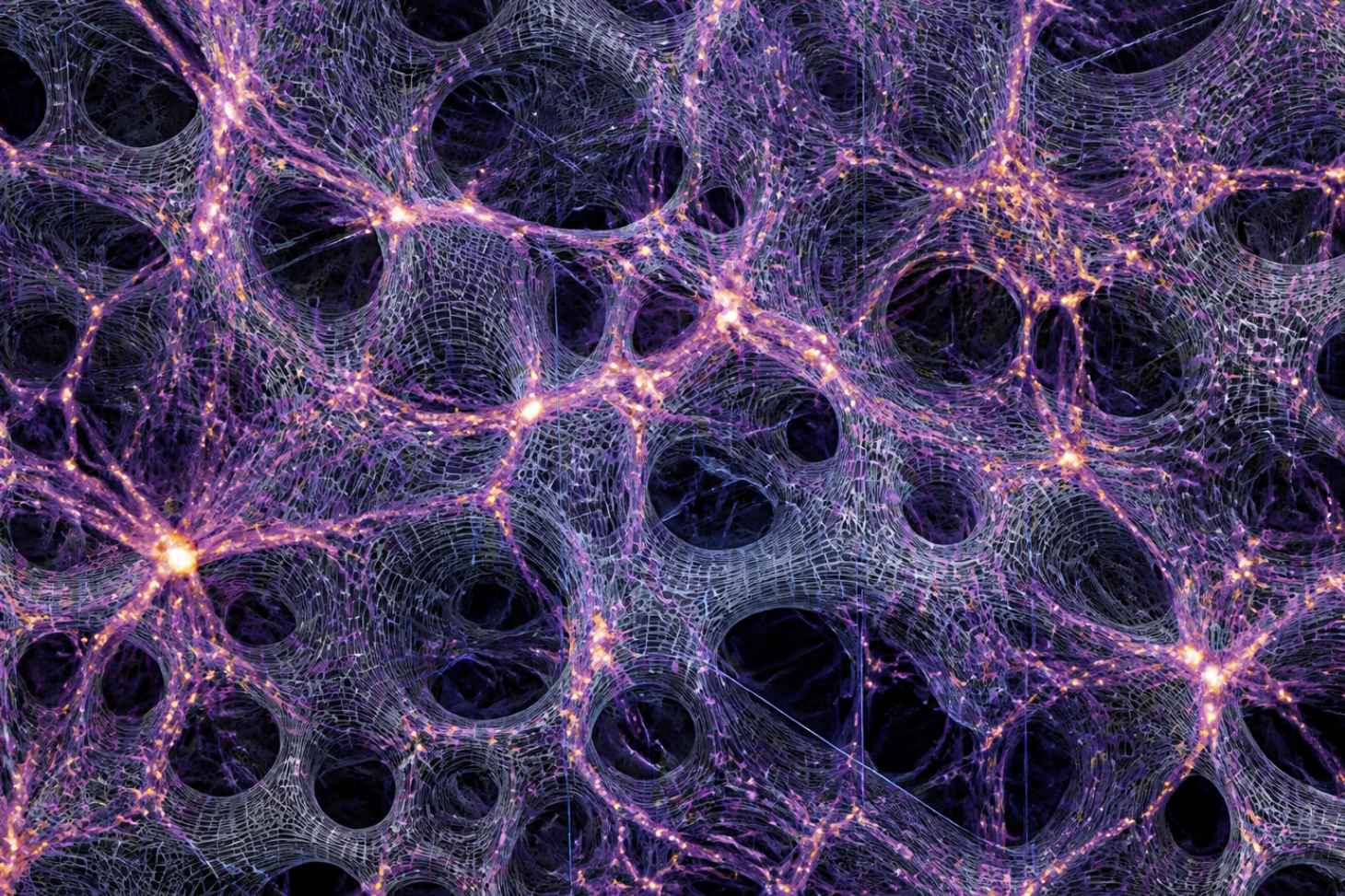
The second application is in the field of cosmology: mapping the dark matter in our galaxy. Dark matter cannot be seen; its presence is inferred from the motion of stars. The project will use the positions and velocities of tens of millions of stars, as measured by the Gaia mission, to create the first three-dimensional map of dark matter in the Milky Way.
The mathematical tools developed could also be used in machine learning, where it is often necessary to measure the difference between two datasets. This calculation is computationally expensive today, and the fast solver that MAGNET aims to develop would help speed it up.
European Funding for Ambitious and Collaborative Research
Awarded by the European Research Council, the
ERC Synergy Grants support groups of two to four researchers who combine their expertise to address ambitious scientific questions that cannot be tackled individually.
For the 2026 edition, 48 projects were selected from among 957 applications—approximately 5 percent of the proposals submitted. They will share a total budget of 500 million euros, with an average of 10.4 million euros in funding per project.
This funding, which can total up to 10 million euros over a maximum period of six years, reflects the scientific excellence of the selected teams and the ability of European research to foster leading-edge interdisciplinary collaborations.