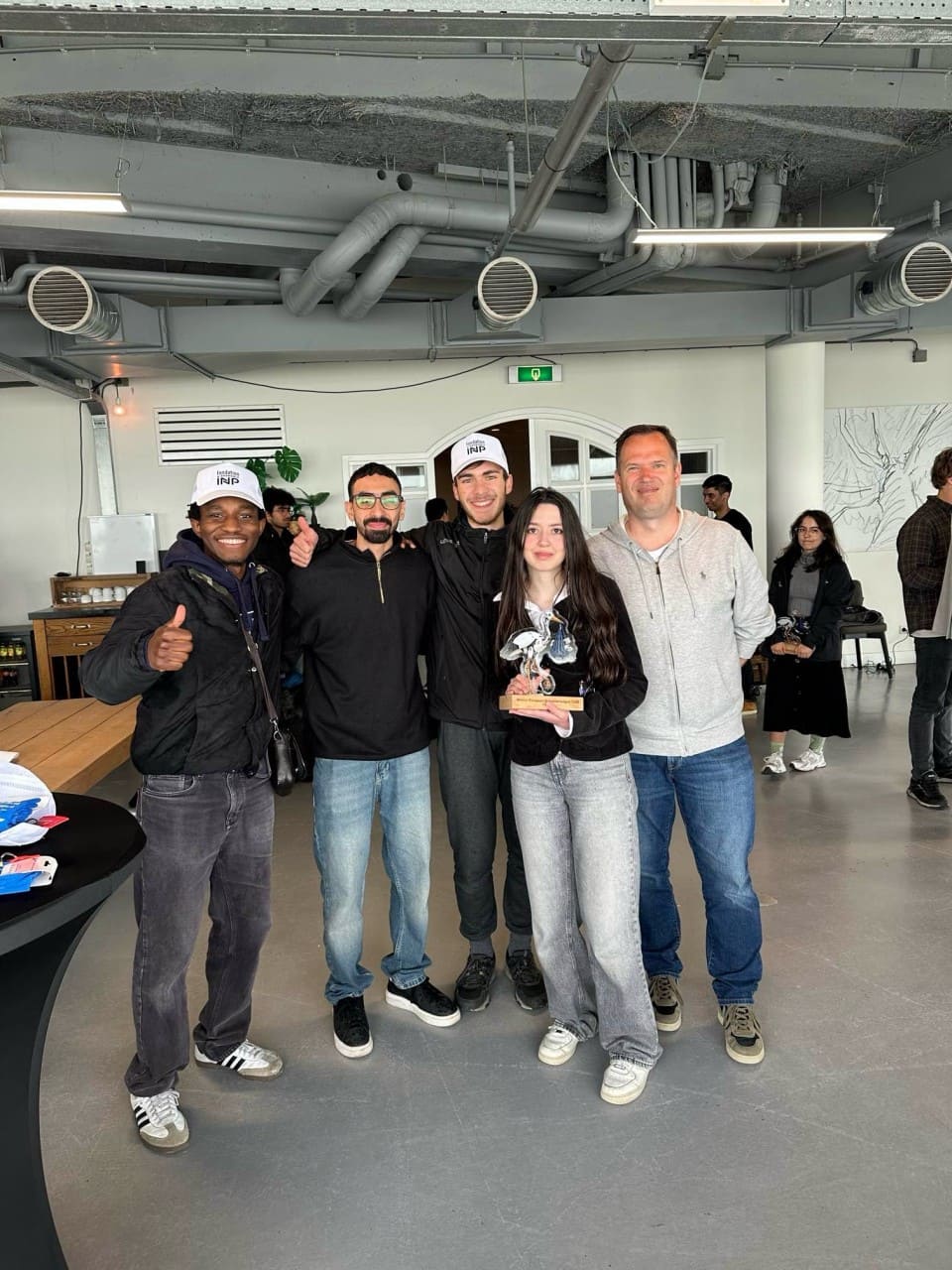

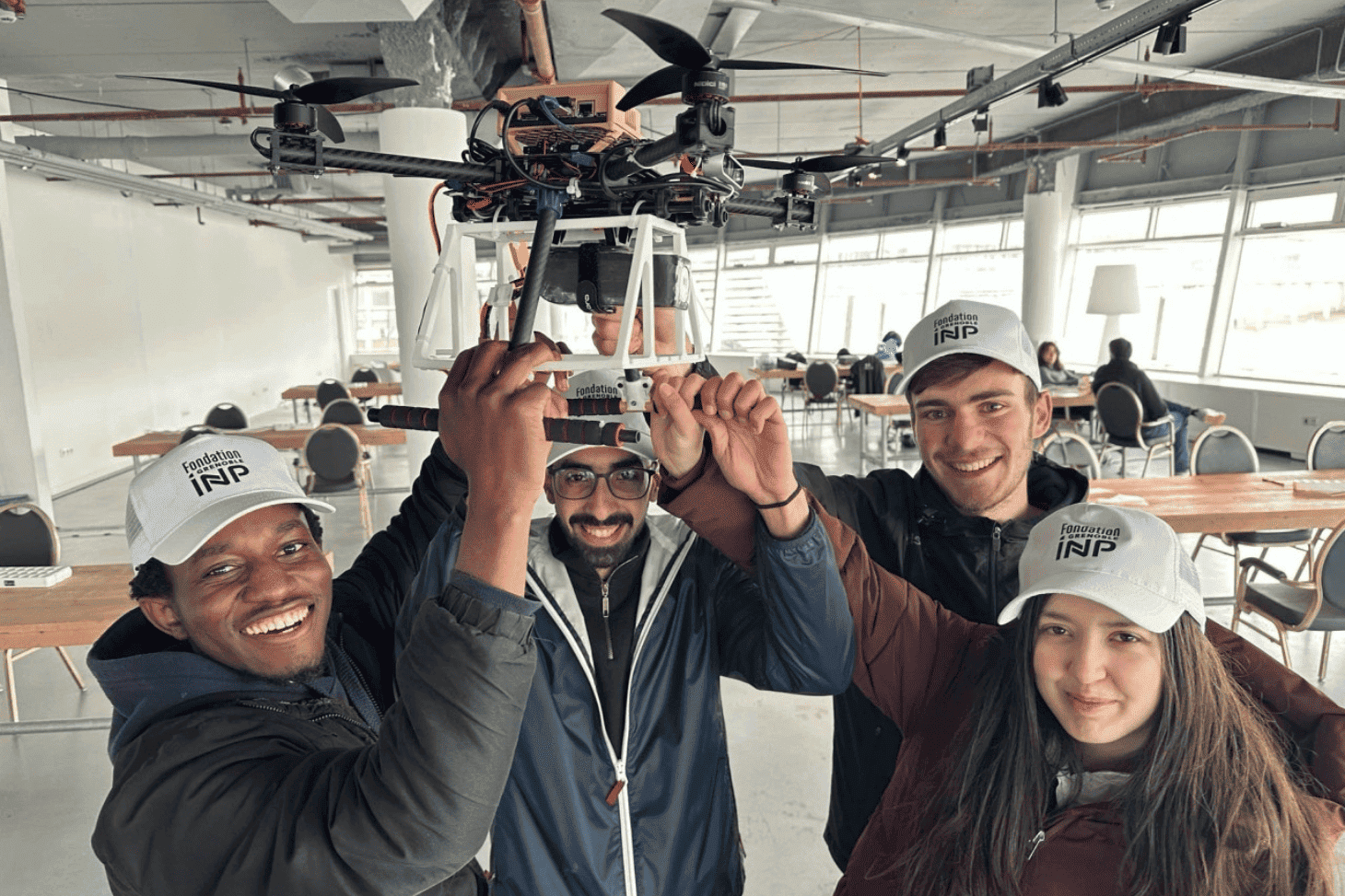
Starting from scratch just two months ago—with no funding and no established team—four students from Grenoble INP - Ense3 and the UFR PhITEM at theUniversité Grenoble Alpes took first place in the 2026 European Robotics League during the international competition organized in the Netherlands from May 12 to 15, 2026, by euRobotics. It was a truly remarkable victory, given that their journey was fraught with obstacles.
The challenge set by the competition was clear, but incredibly complex to accomplish: to design, in two months, an autonomous drone capable of locating a patient, delivering a first-aid kit to them, avoiding obstacles, and returning to its starting point—all without using GPS. GIPSA-lab (UGA, CNRS—Grenoble INP-UGA) had set an additional constraint, in keeping with its values: to maximize the use of borrowed or reused equipment in order to limit the project’s environmental footprint.
Specifically, the drone was required to incorporate: autonomous navigation in an unknown environment, a computer vision system (AI) to detect and identify the victim, a mechanism for dropping the medical kit, and the ability to return autonomously to the starting point.
When Wanangwa Nyasulu and Ziani Sarah decided to embark on this adventure, all they had going for them was their determination. The drone development experts they consulted at the time were unanimous: with a two-month deadline and no initial budget, it would be very difficult—probably impossible. The project was so risky that it was hard to convince anyone to join them.
Yet, week after week, the team is taking shape. Milo Gerard, with seven years of experience piloting drones, joins the project. Mortada Moghazy brings his expertise in computer vision. In less than two months, the students raised between 3,000 and 4,000 euros, largely thanks to support from the Grenoble INP Foundation, GIPSA-lab, and the startup Wind Fisher, which lent the drone’s carbon fiber frame, flight electronics, and motor system. The batteries, remote control, depth camera, and distance sensor came from GIPSA-lab. Only the onboard computing board had to be purchased new.
In the Netherlands, Murphy’s Law holds true with relentless regularity. On the very first flight, the drone crashes: the propellers, landing gear, and motors all need to be replaced. The computer vision model has to be reworked several times. Flight endurance remains inconsistent. The delivery mechanism was completely redesigned 24 hours before departure for the Netherlands. A critical component failed the day before the final, with no replacement part available.
Then comes the most critical moment of the competition: before the final run, the drone crashes again. The team has two hours to fix it—or lose everything.
“We stayed calm, assessed the situation, and in less than two hours we repaired the drone, completed our final flight, and accomplished our mission.” Wanangwa Nyasulu.
Calm, methodical, and a cohesive team: victory is within reach. The Grenoble team successfully completes its mission and wins first prize in the “Robotic Solutions for Emergency Response and Public Health” category.
The European Robotics League is one of the flagship tournaments organized by euRobotics aisbl, an international nonprofit association based in Brussels that brings together all stakeholders in the European robotics sector. Founded in 2012, euRobotics works to strengthen the sector’s industrial competitiveness, promote robotics research, and improve public perception of the field. The “Emergency and Public Health” category, in which the UGA team competed, focuses on technologies with a significant societal impact, particularly for emergency response scenarios in challenging environments.
Beyond the medal, the team wants to send a message to all students who are still hesitant to take the plunge: the impossible is often a matter of perspective. Starting from scratch, facing rejection, having doubts, and ultimately succeeding. Wanangwa Nyasulu and his teammates hope that this journey will inspire others to believe in their own projects, no matter how ambitious they may be.
An extraordinary human and technical adventure, led by four students, their advisors, and their partners, which proves once again that Grenoble is truly a hub of innovation and robotics.