

Feel free to write to us with your question, and we’ll find the best person to answer it.
And of course, there’s no such thing as a silly question!
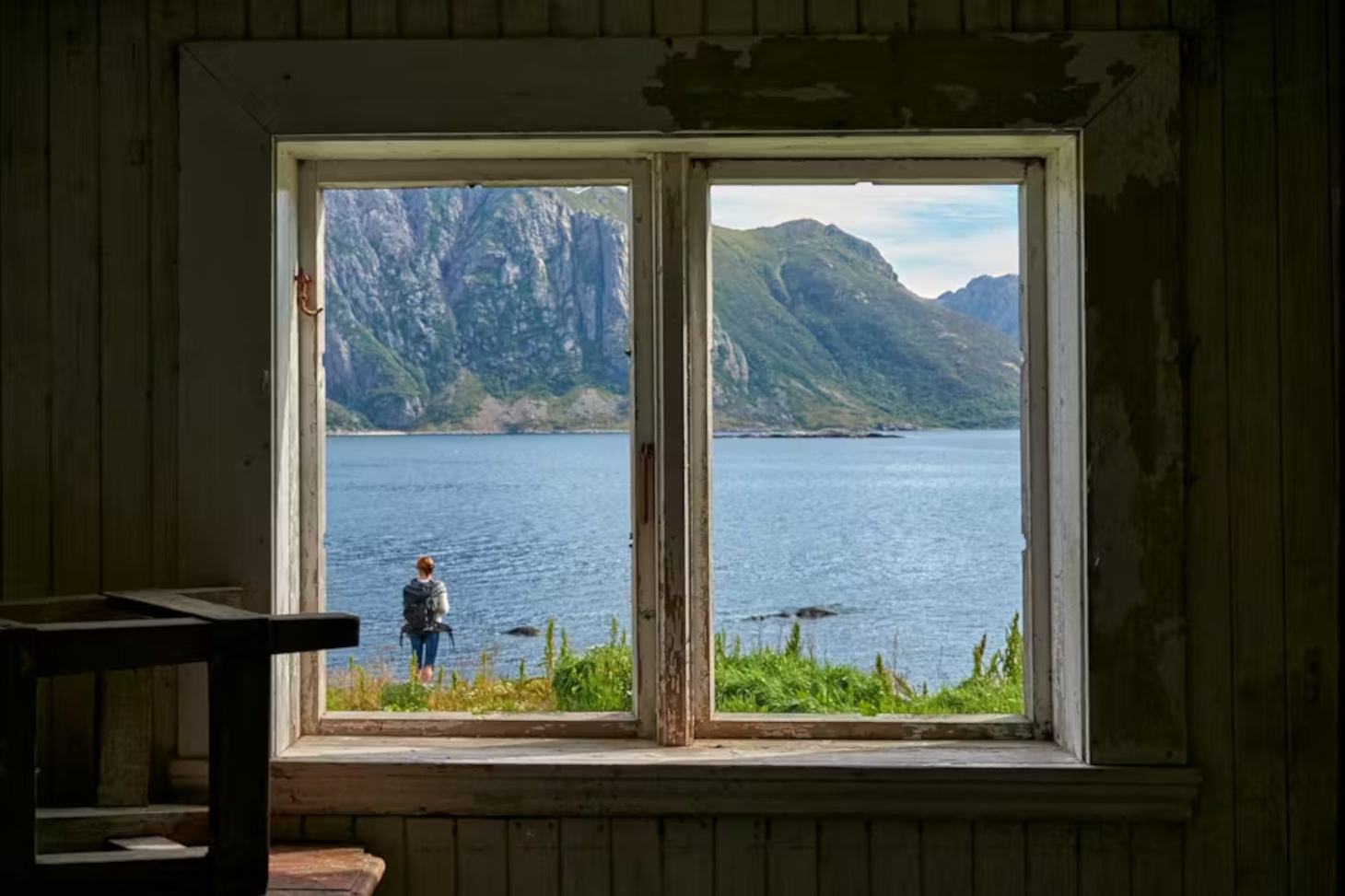
“The top student in the class doesn’t know the pleasure the dunce takes in looking out the window” (Robert Doisneau, 1986). The dreamer might wonder why he sees the butterfly through the window but loses sight of it as soon as it passes behind a wall. To understand this, let’s explore various concepts from physics.
First, what do we mean by “transparency”? It refers to the fact that a pane of glass allows light to pass through without deflecting it, unlike translucent tracing paper or opaque walls. SinceEinstein’s work, we have known that light is composed of “packets” of energy called photons. This description allows us to characterize the colors of the rainbow, which depend on the energy of the photon: red, at one end of the spectrum, corresponds to a lower energy than violet, at the other end.
In addition to the colors we see, light with energies lower than red is classified as infrared light, and radio waves are also included in this category. On the other side of the rainbow, beyond violet, light is called ultraviolet (UV). And these different types of light do not all interact in the same way with the matter around us. Glass allows photons visible to the human eye to pass through but partially blocks UV and infrared photons. Conversely, radio waves are able to pass through walls, even though they are opaque to visible light.

To satisfy your curiosity:
Let’s start by taking a closer look at a pane of glass made primarily of silica—that is, sand. At the nanoscale, glass consists of a dense array of silicon and oxygen atoms separated by a few fractions of a nanometer. Under these conditions, how can photons emerge unscathed after passing through several millimeters of glass?
Let’s zoom in even further on atoms. Atoms have a nucleus surrounded by a cloud of electrons: it is this cloud that takes up most of the atom’s volume. To get a sense of the scale, if the atom were as big as the Stade de France, its nucleus would be no bigger than a red currant in the center of the field. Thanks to quantum mechanics, we know that in a material composed of atoms, such as glass, the energy of electrons is not random: certain energy levels are allowed, while others are forbidden. Furthermore, certain electrons bind the atoms together like springs, allowing them to vibrate at specific frequencies.

When a photon strikes a window or a wall, there are three possible scenarios. If the photon has enough energy to promote an electron in the material it encounters to a higher energy level, the photon is then “absorbed” and disappears. This applies to visible photons that strike a wall. It is also the case for UV photons attempting to pass through a window, making it difficult to tan through it.
Similarly, if the photon’s energy matches the vibrational energy of the atoms in the material it encounters, the photon is also absorbed. This is the case for certain infrared photons, which makes it impossible to use a thermal camera through a window.
But if the photon’s energy is neither the energy required to excite an electron to a higher energy level nor the energy needed to interact with the vibrations of atoms, the photon passes through the material without being absorbed. This is the case with visible photons passing through a window, as well as with radio waves passing through a wall. This allows us to listen to music being played in a studio from a distance, right from our kitchen.
But then, what distinguishes grains of sand from glass? After all, they’re made up of the same atoms. Yet it’s obvious that you can’t see through a sandcastle, whereas you can see through a window. In fact, light can also be thought of as a wave that travels and can change direction when it encounters an obstacle. So, even though each drop of water is transparent, you can’t see through a cloud. This is called light scattering.
To overcome this phenomenon when making glass, glassmakers have long relied on a time-honored technique: heating sand to over 1,000 °C to melt the tiny quartz crystals that make up the sand. During controlled cooling, the sand transforms into an amorphous solid—a solid but disordered material, like a frozen liquid. This results in a material that is uniform on a microscopic scale: light can then pass through it naturally without scattering in all directions. By controlling this scattering or by shaping the surface of the glass, it’s even possible to let light through without the glass being completely transparent! This is the case with frosted glass in bathroom windows or in some classrooms, which helps keep the daydreamers’ butterflies hidden.