

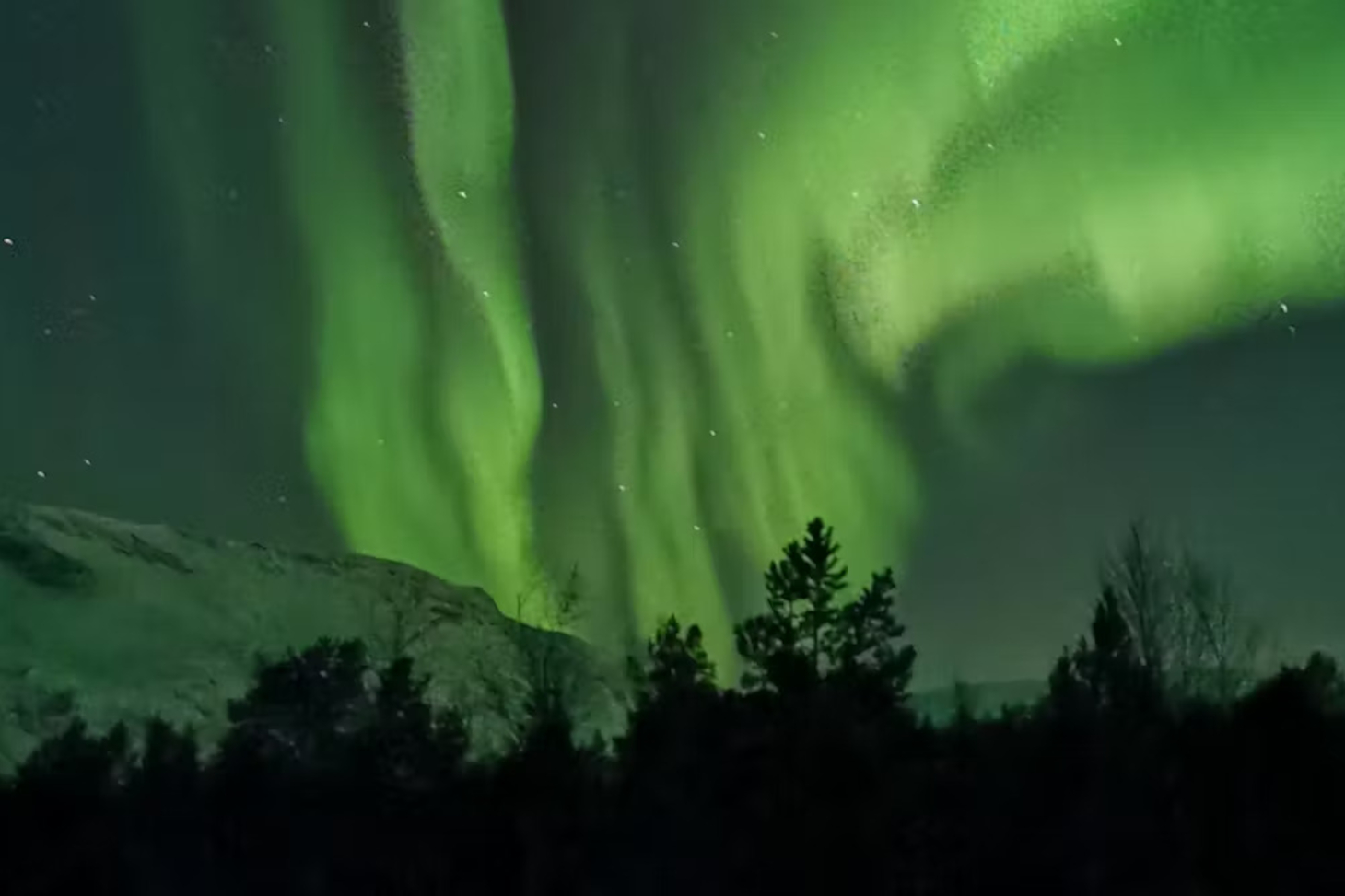
The defining event in space weather history is what is known as the “Carrington Event.” In 1859, the aurora borealis was observed at very low latitudes (as far south as Cuba), even though these phenomena are normally confined to the polar regions. At the time, technology consisted almost entirely of telegraphs, and it was these devices that recorded disruptions during the event. In fact, they continued to transmit information even while powered off: people referred to them as “celestial batteries,” since the electric fields generated by the auroras “powered” the circuits.
Other historic events are also worth mentioning, such as the one in 1989, when Quebec was left without power for several hours, or the Halloween storm of 2003, when the city of Malmö in southern Sweden suffered the same consequences. The cause: solar storms and their interactions with our planet Earth.
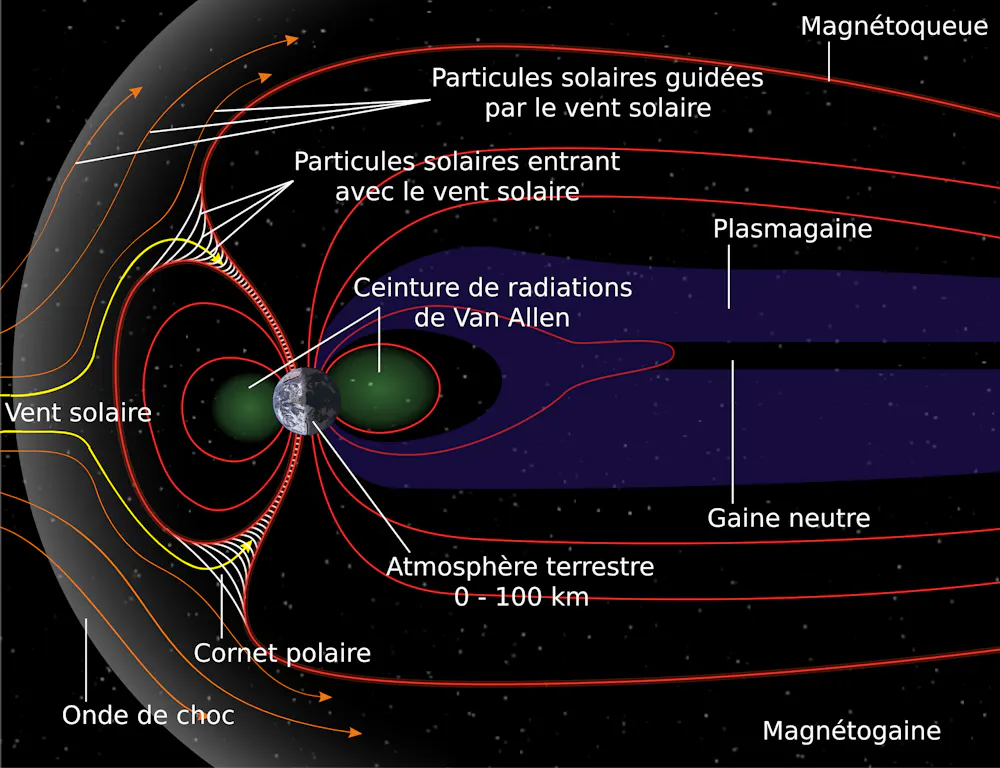
The Sun constantly sends us electromagnetic radiation, as well as particles known as the solar wind. These particles are mostly electrons and protons. When large solar flares occur, large quantities of plasma (consisting of charged particles) are ejected: these are coronal mass ejections. When these are directed toward Earth, they first encounter the Earth’s magnetic field, which acts as a shield protecting us from these particles. However, these particles sometimes manage to penetrate this protective barrier and interact with our upper atmosphere. This is what we call geomagnetic storms.
It is this interaction between charged particles and the molecules and atoms in the upper atmosphere (such as oxygen and nitrogen) that causes the luminous phenomenon known as the polar auroras. These auroras are therefore visible to the naked eye as evidence that this Sun-Earth interaction does indeed exist.
The major challenge scientists face today is that these coronal mass ejections are difficult to predict. It is therefore hard to know when they will occur and whether or not they will impact Earth. We do know, however, that the Sun’s activity follows an approximately 11-year cycle, with activity peaking in the middle of the cycle. It is during this period of peak activity that we observe the most solar flares. In fact, we are currently experiencing the peak of the current solar cycle, which is expected to reach its maximum in 2025.
Beyond this cycle, the presence of so-called “active” regions indicates the likelihood—high or low—that the Sun will emit such a particle flux. These are called sunspots because, in visible light, they appear darker than the rest of the solar disk. Such a sunspot must also be directly facing Earth for the particles it emits to reach our planet.
Solar maximum and aurora borealis sightings at low latitudes: this brings to mind recent events. On May 10, 2024, we were indeed able to observe the aurora borealis as far south as France. And it was indeed several coronal mass ejections directed toward Earth that caused these auroras.
There are several. Many different sectors are affected, and the systems are impacted in various ways. A prime example is power grids, which are affected by what are known as geomagnetically induced currents, created by geomagnetic storms. These currents add to those already present in the conductors, leading to disruptions and sometimes even blackouts in the grids.
But power grids are not the only ones affected; pipelines and the rail network are as well. Another example is aviation. This sector can be impacted by high-energy particles emitted by the Sun during coronal mass ejections. In fact, these particles can directly penetrate aircraft systems and cause temporary or permanent damage. These same particles can expose passengers and crew members to radiation in the event of a major geomagnetic event.
Another example worth mentioning here involves the devices we use every day. Cell phones, smartwatches, our cars, and many other devices all use satellite positioning systems (such as GPS or its European counterpart, Galileo) to determine their location. These systems can be disrupted by geomagnetic storms, leading to accuracy errors and position deviations ranging from a few meters to several hundred meters, which can be very problematic.

Similarly, satellite communications and high-frequency communications are also affected by geomagnetic storms, as well as by solar radiation bursts. As a result, sectors such as maritime transport, the military, and finance are also disrupted by these events.
These various disruptions can have serious economic and social consequences, triggering a chain reaction, given that all our systems are interconnected. Consequently, if a power grid goes down, all systems dependent on those grids will also be affected, with direct consequences not only for infrastructure but also for our daily lives. This raises several questions: Are we aware of this risk? How would we respond if our electronic devices stopped working for several hours or days—or, worse, if an entire region were without power for an extended period?
All of these issues are crucial and are taken seriously not only by the space weather community but also by governments, which are developing solutions to prevent these risks and minimize damage. It was notably this prevention effort and the accurate forecast by NOAA—the U.S. agency responsible for observing the atmosphere and oceans—that enabled operators to limit the damage during the event on May 10, 2024. Nevertheless, while the damage was limited on this occasion, the consequences may be different during a future solar flare that is more severe or unpredictable to scientists. This would not give operators time to implement safety measures, leading to damage that would certainly be far more significant.
All of these issues are currently being closely examined as part of a study funded by Axa Insurance. The goal is to raise awareness within the insurance industry and the rest of society about these space weather risks, in order to better understand them, predict them more accurately, quantify their consequences, and minimize them. Just as we check the weather forecast to see what the weather will be like, scientists consult specialized reports and apps that inform them of upcoming solar storms. Perhaps we’ll all soon have alerts on our phones warning us when a solar storm is approaching.
For more information, you can listen to this podcast produced by the Grenoble Observatory of Universe Sciences.

Established in 2007 to help accelerate and share scientific research on major societal challenges, the Axa Research Fund supports nearly 720 projects worldwide led by researchers from 39 countries. To learn more, visit axa-research.org or follow the Fund’s news on @AXAResearchFund on LinkedIn.
This article is republished from The Conversation under a Creative Commons license. Readthe original article.