

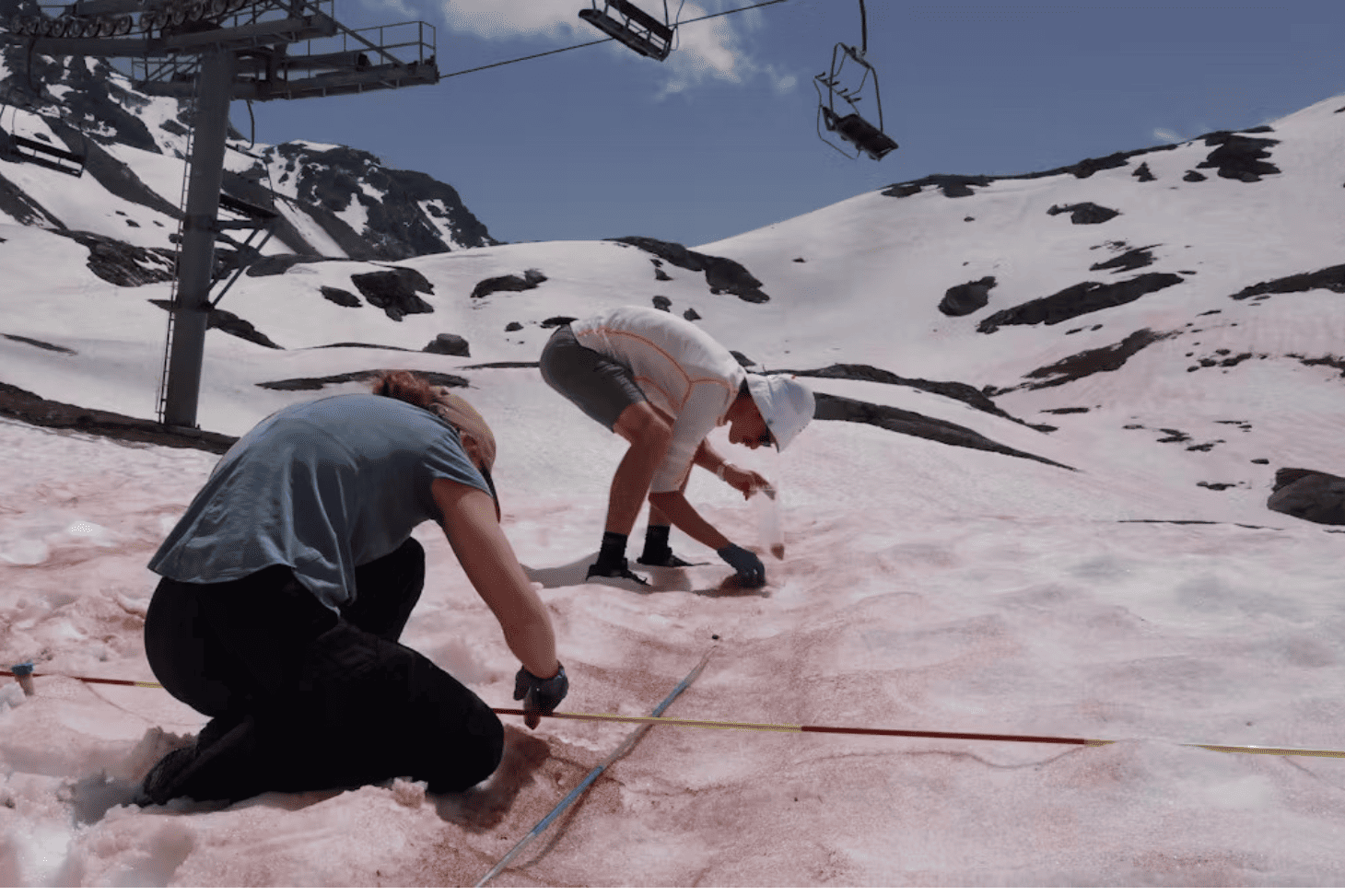
Most of the time, snow is white, but in the spring, the snowpack sometimes changes color. Gray, black, yellow, orange… and even red! Red, really? Could this color be a remnant of a bloody battle between ibex? Could the signs along the ski trails have stained the snow?
Reality can seem just as far-fetched, because the red color on the snow is actually caused by microscopic algae. These algae cells are slightly smaller than the thickness of a hair, barely visible to the naked eye. But then, what exactly are these snow algae? Where and when can you find them? Let’s head to the mountains to try to unravel these mysteries.
In late spring in the alpine meadows, skiers can no longer find enough snow, while hikers feel there’s still too much of it. So the mountains are peaceful. Marmots can emerge from their burrows and run among the gentians and anemones. The last patches of snow still linger in the mountain hollows. The surface of this old snow isn’t white, but full of microscopic particles. Orange hues are often visible, caused by deposits of Saharan sand from the previous winter. Sometimes, scattered red spots appear; these are the famous clusters of microscopic algae, also known as “algal blooms” (the term “bloom” means “flowering” or “efflorescence” in English).

These blooms appear at altitudes between 2,000 and 3,000 meters throughout the Alps—including in the Vanoise, the Swiss Valais, and the Italian Ruitor—and can be observed on nearly every continent, particularly in Greenland and Antarctica.
In the Alps, the species that predominates in these red blooms is called Sanguina nivaloides. It appears during long periods of snowmelt, which give the algae more time to grow in a snowpack saturated with liquid water at a temperature of 0 °C. Originally found in high-mountain soils—where their lifestyle remains a mystery to scientists—the algae cells are equipped with two small flagella that enable them to swim. Once the snowpack has melted, the algae leave the soil, multiply, and move through the liquid water surrounding the snow grains. At a certain point, through a cellular process that has not yet been fully understood, the algae cells undergo a metamorphosis: they lose their flagella, become completely spherical, and turn red.
In fact, while algae need water to grow, they do not necessarily need oceans, rivers, or ponds. Algae are found all over the Earth, as long as there is a little moisture—for example, on the walls of houses, the surfaces of tree trunks, rocks, animal fur, and so on. They are also found in mountain soil. Melting snow is therefore one of the habitats that algae can inhabit, and Sanguina thrives there. However, algae in lakes or seas are often green, whereas Sanguina appears red to us…
Sanguina is, by nature, a green alga. Like all green algae, Sanguina produces organic matter through photosynthesis, which uses water, carbon dioxide, and light as an energy source. The energy carried by light is captured by chlorophyll, which gives it its green color.

But when solar radiation is very intense, photosynthesis overheats. Electrons carrying the excess energy from light react with oxygen, leading to the production of toxic compounds called “ROS” ( reactive oxygen species). These ROS are unstable and disrupt cellular function: they can cause damage to biological membranes, DNA, proteins, and all kinds of cellular components—the algae cell undergoes what is known as “oxidative stress.”
However, the surface of the snowpack is very bright. To reduce oxidative stress, Sanguina therefore accumulates phenomenal amounts of red pigments that help detoxify the cell. An antidote pigment. An anti-poison pigment. This pigment accumulates and hides the chlorophyll from our view, though it remains present. The more sunlight there is, the greater the stress, the more red pigments Sanguina produces to protect itself from the effects of the sun’s most destructive rays, and the more the snowpack takes on a blood-red hue.
For us humans, the snowpack is a cold environment. Sanguina, in fact, thrives in low temperatures—below +10 °C. In the spring, the snowpack therefore offers it a cool refuge. However, when Sanguina is frozen for several hours, it can no longer perform its physiological functions, such as photosynthesis, and it dies. Fortunately, the layer of snow that covers it in winter acts as insulation; it acts as a barrier against the extreme cold and helps keep the soil at temperatures close to 0 °C.
Furthermore, in this protective environment, it is bathed in light that spreads in all directions. From above, of course, but also from the sides and below. It has its own antidote to excess light—the red pigment—and can calmly carry out photosynthesis thanks to chlorophyll. Its cellular structure differs from that of typical algae: by orienting its photosynthetic sensors in all directions, it can absorb light coming from every angle.
Finally, the membrane that encloses it is completely crumpled, to the point that it increases the surface area for exchange with the water circulating within the snow, allowing Sanguinato absorb as many nutrients as possible—such as phosphate.
Sanguina plays an important role in this environment of melting snow. First, because it is a pioneer in a “new” environment devoid of living organisms. By producing organic matter through photosynthesis, Sanguina transforms the melting snow into an environment conducive to other forms of life. An entire microbial ecosystem can then develop there, including, for example, bacteria or microscopic fungi.

Sanguina is also an architect who alters the properties of snow by coloring it. In fact, the algae cells increase the amount of solar energy absorbed by the snowpack. Locally, this helps maintain the melting snow environment she loves so much, but it also contributes to accelerating the snowmelt.
Across the Alps, algal blooms also accelerate snowpack melt, but they occur on less than 2% of the area above 1,800 meters, so this effect is limited to small areas. In contrast, in other parts of the world, snow algae have a greater impact on snow and glacier melt.
In January 2025, fresh snow has already blanketed the Alpine peaks above 2,000 meters. Sanguina, which was lying on the ground last summer, is now covered and hidden beneath the snowpack that protects it from the freezing temperatures. Next spring, when the snowpack will still be several tens of centimeters deep in some places, we’ll find Sanguina on the surface of the snow.
How did it manage to make its way back to the surface? What happens when the snow has finished melting and the water seeps into the ground? How does the colony survive from one year to the next?
Its origins and future are equally mysterious. Since when has Sanguina been growing in the mountains? With climate change underway, what does the future hold for it in the coming centuries?
For example, we We were able to show that in the European Alps, the A limiting factor for snow-related algal blooms was the duration of melting, in the future there will either be a stable number of blooms or a slight decrease. In other parts of the world, where the limiting factors for blooms are different (light, nutrients), it is conceivable that snow algal blooms could increase—this is particularly an important issue in relation to the melting of the Greenland ice sheet.