

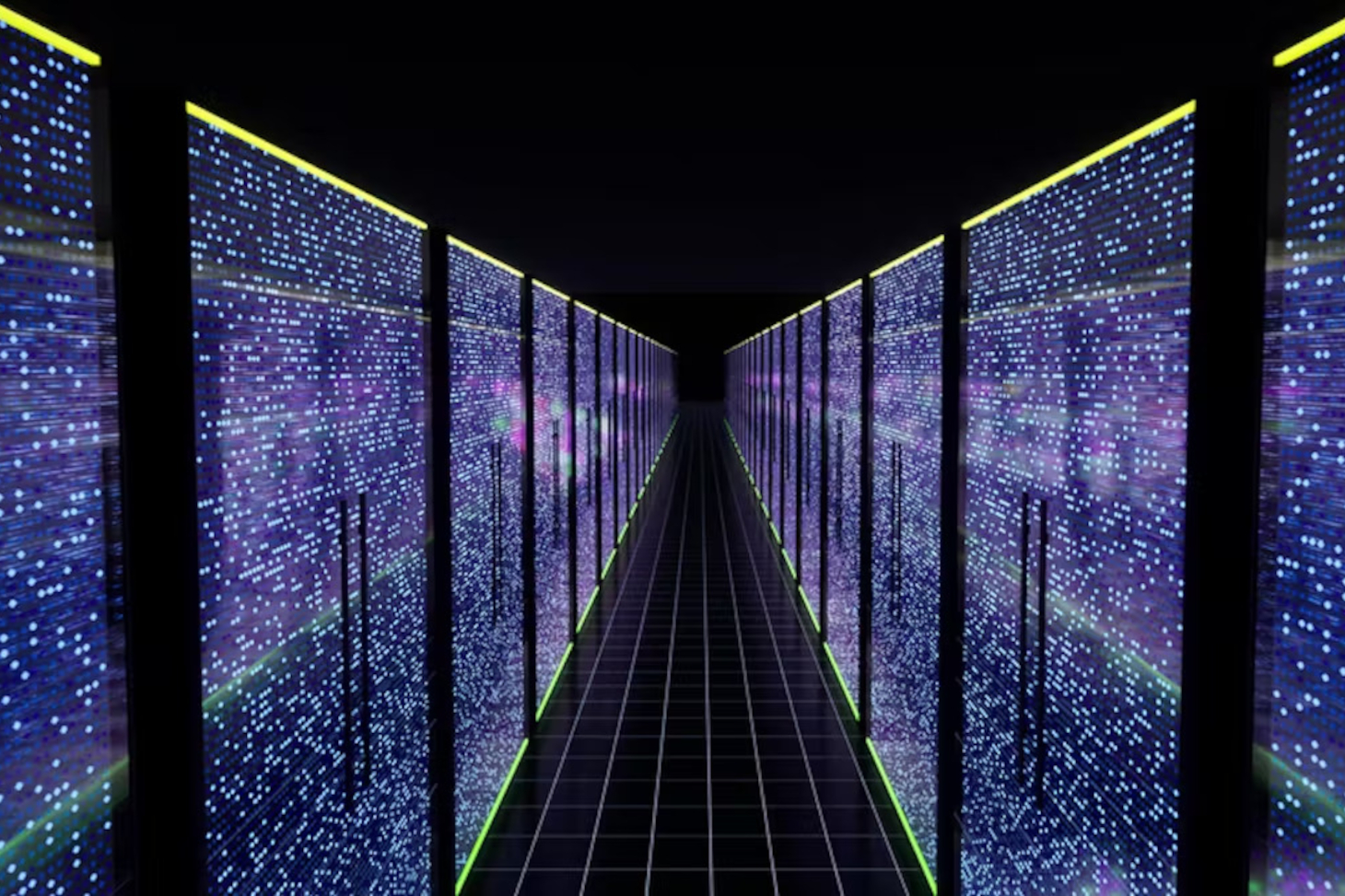
On our cell phones or personal computers, whether we’re browsing the Internet faster and faster or watching interactive videos, we’re talking about billions of operations per second (giga). On the largest machines, we’re talking about powers of 1,000. Giga is the third power (1,000³ or10⁹), followed in order by tera, peta, and exa. These prefixes in the International System of Units are derived from the Greek words tetra, penta, and hexa, making them fairly easy to remember. The exascale therefore refers to supercomputers with a computational capacity exceeding 10 to the 18th power Flops/s.
High-performance computing (HPC) aims to run scientific applications—such as nuclear simulations and meteorology—as quickly as possible. The need for computing power beyond human capabilities first arose during World War II and has continued to grow ever since, driven by the widespread digitization of society and globalization.
The history of high-performance computing has followed major technological milestones, from the invention of integrated circuits in the early 1960s to the recent 5-nanometer technologies. Vector processors emerged in the 1970s. They were designed around a reduced instruction set that operates efficiently on large collections of homogeneous data. Beginning in the 1980s, we witnessed the development of parallelism, particularly with massively parallel multiprocessors—large numbers of computing units connected by sophisticated interconnect networks.
In the mid-1990s, another type of supercomputer emerged, based on the idea of assembling general-purpose hardware. Taken to the extreme, this gave rise to peer-to-peer computing, where anyone could make their own Internet-connected machine available to contribute to an ambitious scientific experiment such as protein folding. The concept of an accelerator (a specialized coprocessor that is more efficient at certain types of operations) emerged around 2000 and took on crucial importance with GPUs (graphics processing units), which were instrumental in the development of deep learning in 2013.
[More than 85,000 readers rely on The Conversation’s newsletters to better understand the world’s major issues. Subscribe today]
Today, all recent consumer-grade processors incorporate several dedicated units. GPUs have evolved, and their high level of parallelism makes them highly efficient for matrix and tensor computations—specifically tailored for machine learning, such as Google’s TPUs.
The exascale milestone was reached in 2022 when the Frontier supercomputer topped the Top500 list. This is the ranking of the 500 most powerful systems in the world. The ranking is determined after a supercomputer undergoes meticulous preparation for standard linear algebra benchmarks. Not all of the most powerful HPC systems are included in the Top 500. Large corporations and military organizations operate HPC systems that do not appear on the list.
Just as with the space race, being among the top ranks in the Top 500 is clearly a geopolitical issue—led by the United States—aimed at asserting technological supremacy and sovereignty. France and Europe have launched programs to build their own exascale systems.
The issue of power consumption by large-scale HPC platforms has always been a concern, but it has become crucial today in the fight against carbon emissions, which are driving the climate crisis. Some believe that the race for performance can help solve today’s environmental challenges, but a growing number of voices are warning against a headlong rush that contributes to uncontrolled acceleration and are calling for a slowdown—especially since there are very few applications that truly require such power. Amid the debate over these two opposing positions, politicians and tech enthusiasts are already looking ahead to the next stage: zettascale (1,000 to the seventh power, the unit immediately following exascale, i.e., 1,000,000,000,000,000,000,000 FLOPS/s).
This article is part of the series “The Other Side of Words, ” which explores how our vocabulary expands and adapts as societal issues emerge and new challenges arise in science and technology. Terms we thought we already knew well take on new meanings, and newly coined words find their way into the dictionary. Where do they come from? How do they help us grasp the nuances of a changing world?
From “validism” to “silencing, ” from “bifurcating” to “degendering, ” our researchers examine these neologisms to help us better understand them—and thus participate more effectively in the public debate.
Also check out in this series: