

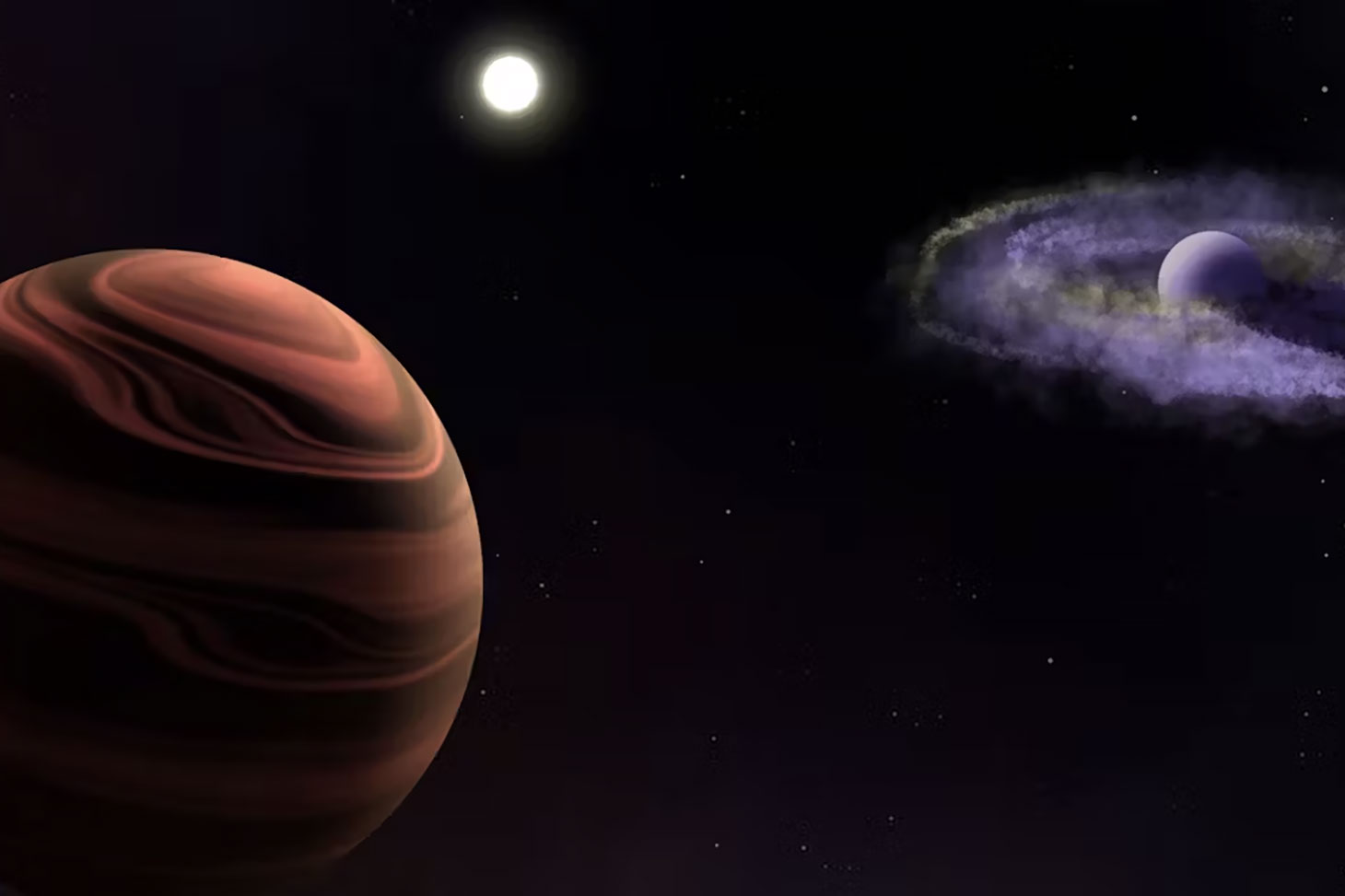
Mickaël Bonnefoy, an astrophysicist and co-author of thestudy, explains who these “exoplanet babies” are.
You’re taking us on a journey through an unusual star system, YSES-1. Why does it intrigue scientists?
M. B.: The YSES-1 system is unusual among exoplanets. Located more than 300 light-years away, this system—which is 270 times younger than our solar system—consists of a star similar to our Sun and two large planets, with masses 14 and 6 times that of Jupiter, respectively—even though Jupiter is by far the largest planet in our solar system. These exoplanets are also very far from their star—in orbits 35 and 71 times the distance between the Sun and Jupiter.
This exotic architecture puts the origin and properties of our own solar system into perspective. YSES-1 allows us to study the properties of several young Jovian exoplanets—so-called “baby exoplanets”—within a single system.
Data from the James Webb Space Telescope (JWST) reveal the intriguing nature of these two large “exoplanet babies” and show that the more massive of the two is still forming. Our international collaboration is publishing these findings today in *Nature*.
What observations do you describe in your article?
M. B.: Thanks to the James Webb Space Telescope, we have observed silicate dust suspended in the atmosphere of the least massive and most distant planet orbiting the star, YSES-1 c. This dust was predicted several decades ago by theoretical studies, but it is only now, with this space telescope, that we can observe it directly.
Our data also reveal, for the first time, a disk around the most massive planet and the one closest to the star, YSES-1 b. This type of disk is very different from Saturn’s rings. Rather, it is a “reservoir of material” that feeds the atmosphere of this planet, which is still forming.
It is also the birthplace of potential exomoons. We know that there was a similar dust disk around Jupiter in the past, which gave rise to its moons, including Europa and Ganymede.
Every two weeks, leading experts, new voices, and fresh perspectives to analyze the latest scientific news and better understand the world. Subscribe for free today!
What was your goal in pointing the James Webb Space Telescope at this already well-known star system?
M. B.: We initially wanted to study the atmospheres of these two planets and highlight their physical differences (mass, temperature) to understand how they might have formed.
By studying the YSES-1 system, which is very young (16.7 million years old), researchers hoped to gain a better understanding of the origins of our own solar system (4.5 billion years old).
But did you notice anything you hadn't initially expected to notice?
M. B.: Absolutely. Until the launch of the James Webb Space Telescope, we were unable to study the light from exoplanets beyond 5 micrometers because of the Earth’s atmosphere’s absorption of light at those wavelengths when observed from the ground.
Thanks to the new observational window provided by this space telescope, we can study the spectroscopic signatures of numerous molecules and particles suspended in the atmospheres of these exoplanets.
Here, we were able to reveal the presence of a disk around the most massive planet in the system, which causes an excess of infrared flux as shown by these observations. This disk is a potential site for the formation of exomoons similar to those formed around Jupiter. This disk also serves as a reservoir of material for the formation of the planet’s gaseous envelope.
Have you answered your initial questions? Do we now have a better understanding of how such a system could have formed, with its very massive planets so far from the star?
M. B.: No, actually, the study does not address these points in detail, but focuses more on the properties of the atmosphere of the exoplanet YSES-1 c and the disk of the exoplanet YSES-1 b.
What questions does your study raise?
M. B.: The discovery of a disk around one of the planets and its absence around the other planet in a system of a given age raises questions about the chronology of these planets’ formation. Did they form at the same time? Did a disk exist in the past around the less massive exoplanet? There remains the possibility that such a disk is still present but invisible in current observations: this would be the case if it emits light beyond the wavelengths of our observations.
Further observations with the James Webb Space Telescope in a wavelength range beyond 12 micrometers will be needed to clarify these open questions.
Furthermore, this study provides the first quantitative characterization of the properties of dust clouds in the atmosphere of a young Jovian exoplanet. New observations of the system at wavelengths beyond 12 micrometers will help determine the composition of this dust, which is likely made up of several types of grains.
The FRAME and MIRAGES projects are supported by the French National Research Agency (ANR), which funds project-based research in France. The ANR’s mission is to support and promote the development of basic and applied research across all disciplines, and to strengthen the dialogue between science and society. For more information, visit theANR website.