

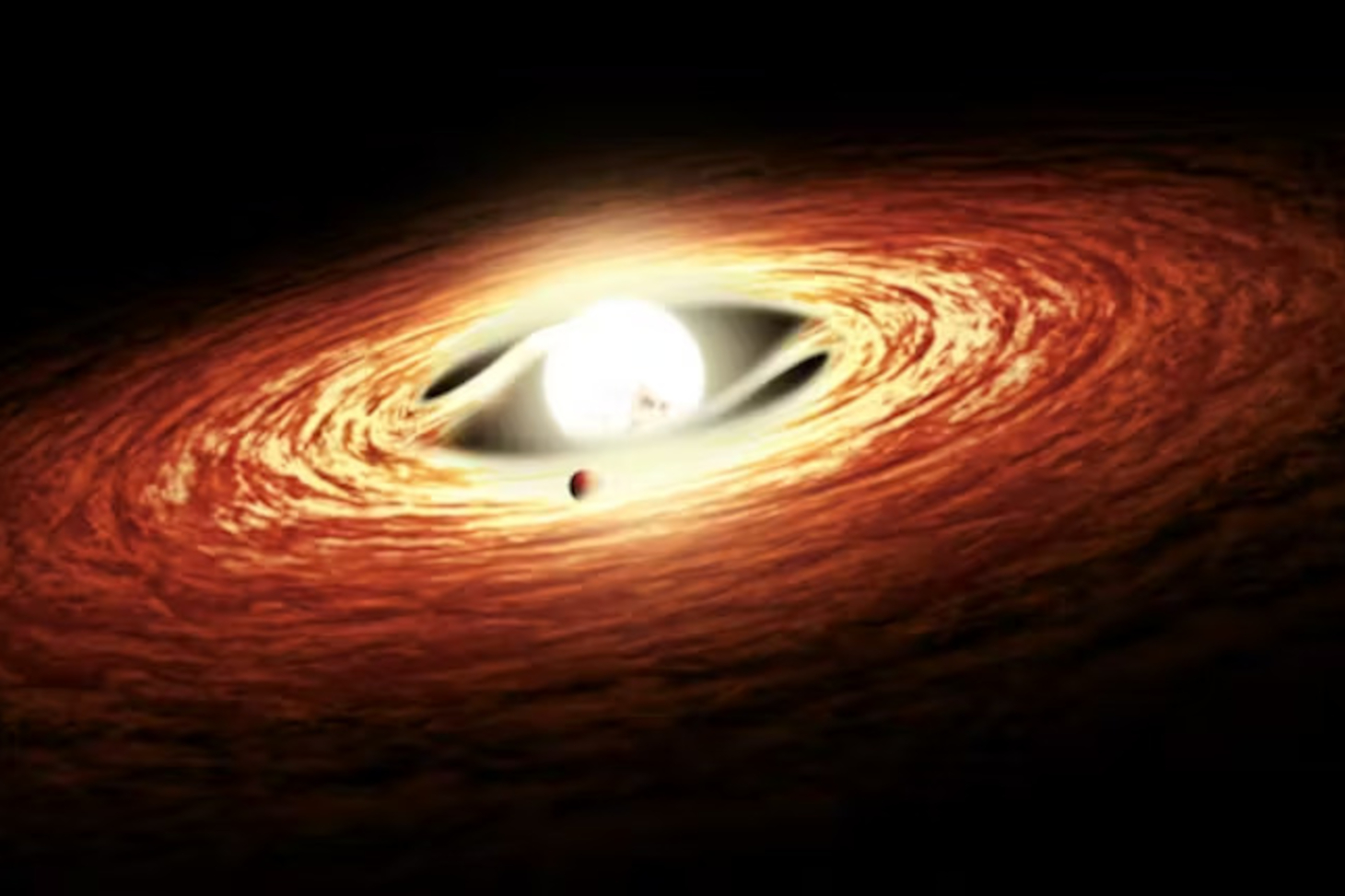
The search forexoplanets—planets that orbit stars other than our Sun—is one of the major challenges in contemporary astrophysics. A new milestone has just been reached with the detection of a nascent planet in close orbit around a young star. To date, this is the youngest and most compact system ever detected at the very moment of its formation, opening a new window into the origin of exoplanetary systems.
In 1995, Michel Mayor and Didier Queloz detected the first exoplanet orbiting a Sun-like star—51 Pegasi b—at the Haute-Provence Observatory. The Nobel Prize awarded to the two Swiss astronomers in 2019 underscores the significance of this discovery, which offers new insights into our origins and the possibility of life elsewhere. Since then, a whole field of astrophysical research has been devoted to the search for exoplanets. Nearly 7,000 exoplanets have now been cataloged around stars located in our region of the Galaxy. By extrapolation, it is estimated that nearly all stars in the Galaxy have one or more planets.

Over the past decade, NASA’s Kepler space telescope has exceeded all expectations in fulfilling its mission: on its own, it has detected several thousand planets, revealing the structure of exoplanetary systems. Compared to our solar system, which consists of four inner rocky planets and four outer gas giants, most exoplanetary systems appear to be much more compact.
Exoplanetary systems generally host super-Earths (between 1.2 and 3.5 times the size of Earth) and mini-Neptunes (up to 7 or 8 times the size of Earth), orbiting very close to their star, often closer than Mercury’s orbit around the Sun (on the order of 60 million kilometers). This is the case for the Trappist-1 exoplanets. To better understand the origin of these systems, we need to try to detect them at the very moment of their formation.
The goal of the European SPIDI project, which we are conducting atthe Grenoble Institute of Planetology and Astrophysics (IPAG), is precisely to detect exoplanets forming around young stars. In particular, we are looking for exoplanets in close orbits—the precursors to the compact systems that Kepler has revealed around already mature stars. However, several challenges remain. Due to their distance—several hundred light-years away—their tight orbits around the star, and their low luminosity, we are not yet able to directly detect the light coming from these compact systems.
We must therefore resort to indirect methods, such as looking for disturbances in the star’s motion or radiation caused by the planets. The main difficulty lies in the high activity of young stars, which are the site of eruptive phenomena a thousand times more violent than those on the surface of our Sun. Attempting to detect a planetary signal buried in the star’s “noise” is therefore like trying to listen to a symphony while standing next to a jackhammer.
It was only by using the most advanced instruments available today that we were able to detect a signal indicating the presence of a new exoplanet. In particular, we used the Canada-France-Hawaii Telescope, located at an altitude of 4,200 meters in the middle of the Pacific Ocean, combined with data from the Kepler satellite and a network of telescopes spread around the globe, the Las Cumbres Observatory. All of this data allowed us to determine that this planet orbits a young star named CI Tau in less than a month. The signal detected takes the form of periodic variations in the system’s brightness and speed that recur every 25.2 days. Since the star rotates on its axis in just 9 days, that alone was not enough to explain the observations.

Located in the constellation Taurus, this star—which is only 2 million years old, the equivalent of a few days on a stellar timescale—is still surrounded by its protoplanetary disk, a disk of gas and dust around the star in which planets form. The structure of this disk is segmented, suggesting the possible presence of other planets. So far, however, we have detected only one. Since each technique has its own detection biases, it is often necessary to use several of them to complete the description of the system.
This is a hot proto-Jupiter, with an estimated mass of 3.6 times that of Jupiter, which follows a highly eccentric orbit around its host star. It is during this period that the architecture of these systems is determined, as a result of the star’s interaction with its disk. This first discovery of an exoplanet orbiting less than 25 million kilometers from its star and interacting with its disk complements the direct detection of nascent planets that orbit their host stars at distances of several billion kilometers.
Still buried within the disk that gave rise to it, this planet demonstrates the possibility of studying the formation stages of compact exoplanetary systems that appear to populate the Galaxy. In conclusion, studying these types of systems will help us shed light on the initial conditions that govern the formation of exoplanets through rich and complex processes, some of which may lead to the emergence of life.