
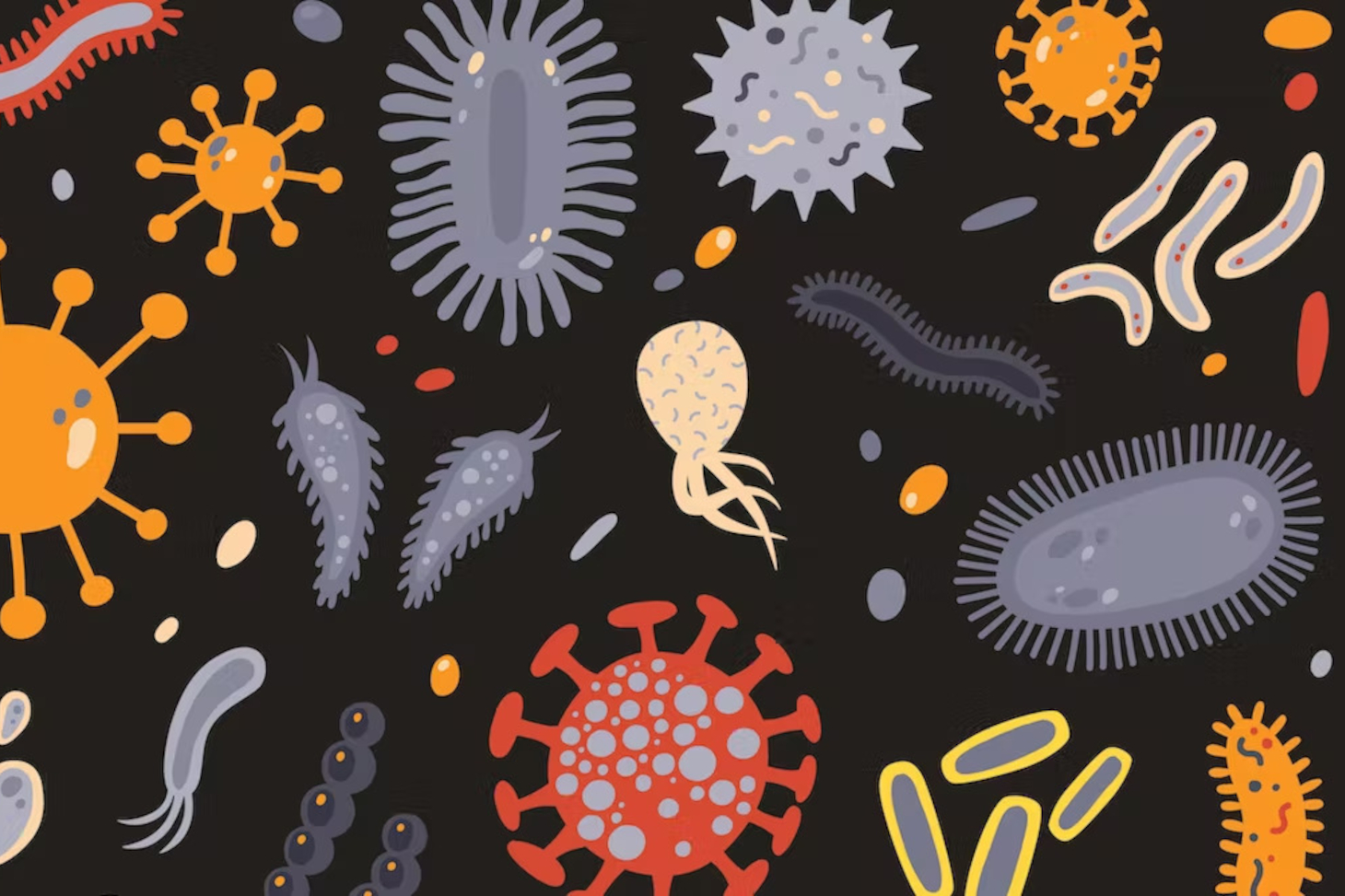
A very, very long time ago, on our planet, Earth, there was no life yet. But little by little, microbes capable of feeding and reproducing began to appear. They were truly tiny—like droplets much less than a millimeter long.
Back then, there wasn’t much for them to eat. But there was already an inexhaustible source of energy: our Sun. That’s when an extraordinary invention took place among certain marine microbes called cyanobacteria: they became capable of using sunlight to produce energy-rich foods such as sugars and fats; this process is called photosynthesis. The production of large quantities of nutrients by cyanobacteria encouraged the emergence of other microbes, which took advantage of this windfall, and life became increasingly diverse.
Photosynthesis also had a huge impact on the composition of the atmosphere, as it enabled the production of large amounts of oxygen from water. The oxygen released later played a fundamental role in the evolution of animals. Through respiration, this gas allows animals to extract, from digested food, the large amount of energy needed to survive and reproduce. Bacteria and other microbes, such as amoebas and viruses, are still present on Earth today.
Still, we might ask ourselves the following question: How do we know that microbes exist, given that they are too small to see with the naked eye? Long ago, scientists suspected that diseases were transmitted by invisible germs, but it wasn’t until the invention of the microscope 400 years ago that their existence could be confirmed.
Now we know that germs can make us sick and even kill us (which is why it’s important to get vaccinated and practice good hygiene).
But we have also recently learned that they can help us in various ways. In fact, each type of animal is home to a different collection of bacteria (there are even more bacteria in an animal’s body than there are cells that actually belong to it); these bacteria are found mainly in the digestive system (mouth, stomach, intestines), where they can provide vitamins and help digest food.
We are different from other animals because what we eat depends largely on our culture. For example, because of fast food, there are generally far fewer different—and healthy—bacteria in the stool of a person in North America than in sub-Saharan Africa, where people eat far more natural, unprocessed foods (Europe, including France, falls between these two extremes).
The effect of what we eat on our gut bacteria has been clearly demonstrated by Tim Spector, a professor in London, who, in 2015, asked his son Tom to eat at fast-food restaurants for 10 days. Daily analysis of his stool samples revealed that during that period, he lost nearly half of his gut bacteria and that their diversity had significantly decreased.
This finding demonstrates that the bacterial population can change rapidly depending on our diet. It has also been shown, using laboratory mice, that eating too much fat increases the amount of a type of bacteria that promotes fat absorption in the intestine. In reality, the situation is more complex because, on the one hand, bacteria can influence what we eat—pushing us toward foods they prefer—and, on the other hand, our gut can select the bacteria that are best for us.
Fortunately, it is possible to correct an unhealthy bacterial composition by transferring stool from a healthy person to the patient. This type of transplant has also been used to treat infections caused by antibiotic-resistant bacteria and to improve the condition of children with autism. In short, microbes can be our enemies, but they can also be our friends.