


It is undoubtedly because of this unique characteristic that the question of the emergence of speech in human evolution has remained, throughout the ages, at the heart of research in the fields of philosophy, linguistics, and—more recently—ethology, psychology, and the neurosciences. This question pertains both to the existence of cognitive capacities suited to the emergence of language—whether spoken or not—and to the existence of physical capacities of the mouth and lips to structure and articulate the sound units that will serve as the acoustic vehicles of language through speech.
Cognitively, language is fundamentally linked to the capacity for abstraction. This is why toolmaking, the use of fire, cave paintings, and the structuring of dwellings are all stages of human evolution that have frequently been cited as potential markers of the emergence of language ability. There is no consensus on the emergence of speech. Our research aims to contribute to these debates by investigating whether the capabilities of fossil hominins (Neanderthals, who are closely related to us; their ancestors, Homo heidelbergensis, dating back 500,000 years; and even the Australopithecines, who are much older and belong to a different genus) allowed them to articulate enough distinctive sounds to form the basis of spoken language.
At what age can a child start speaking?
From a physical standpoint, the use of the mouth is central to the ability to speak. The renowned French ethnologist André Leroi-Gourhan (1911–1986) saw the transition from quadrupedalism to bipedalism as an essential step in the emergence of spoken language: by freeing the hands to perform grasping gestures that had previously been carried out by the mouth, bipedalism “freed” the jaw, lips, and tongue, enabling them to perform a rich and structured repertoire of gestures capable of conveying language through sound.
When did the physical ability to articulate distinctive sounds first emerge? It was when the cluster of cartilage marked by the Adam’s apple—known as the larynx—had descended far enough down the neck, replied American researcher Philip Lieberman (1934–2022) in the journal *Science* in 1969. According to him, this descent of the larynx would have provided the tongue with a new vertical space, wide enough for it to change shape—curving upward or flattening—to generate a variety of forms and sounds appropriate to the combinatorial richness of language.
This hypothesis, which held sway for several decades—and to some extent stifled research in this field—has since been strongly contested. Researcher Louis-Jean Boë and his colleagues have in fact shown that the calls of baboons—which have a high larynx and a flat tongue—contain sounds similar to “a,” “o,” and “i,” the three vowels that form the fundamental basis of the vowel systems of the world’s languages.
Similarly, Fitch—though a disciple of Lieberman—and his colleagues, in a 2016 article published in *Science Advances*, demonstrated, based on X-rays of macaques’ mouths during swallowing, that despite their high-set larynx, these primates could produce tongue positions compatible with the generation of vowels varied and distinct enough to form the phonetic basis of a spoken language. The descent of the larynx therefore does not appear to be a reliable marker of the emergence of the physical capacity for speech during human evolution, and the mystery remains unsolved.
In an effort to unravel this mystery, our “Origins of Speech” project set out to develop biomechanical models of the tongues of fossil humans.
A biomechanical model is a computer-based digital model that represents a part of the human body—including its anatomy, bone structures, soft tissues, and muscles—and is capable of accounting for the physical mechanisms that govern their movements and deformations in response to muscle activation. For the tongue, such models make it possible to study how the tongue muscles influence the shape and position of the tongue in the mouth. Thus, for fossils, these models would offer the possibility of studying, quantitatively and systematically, their ability to produce speech sounds.
Predicting the language of fossil humans based on skull bones
But what can we rely on to develop such models? No anatomical data exists. In fact, the soft tissues of the tongue, the walls of the mouth, and the face do not fossilize. Only the bones remain, more or less damaged by the ravages of time.
This is the original idea behind our project, presented in our recent article published in the journal *PLoS Computational Biology* and authored by the young researchers on our team: Pablo Alvarez, Marouane El Mouss, and Maxime Calka.
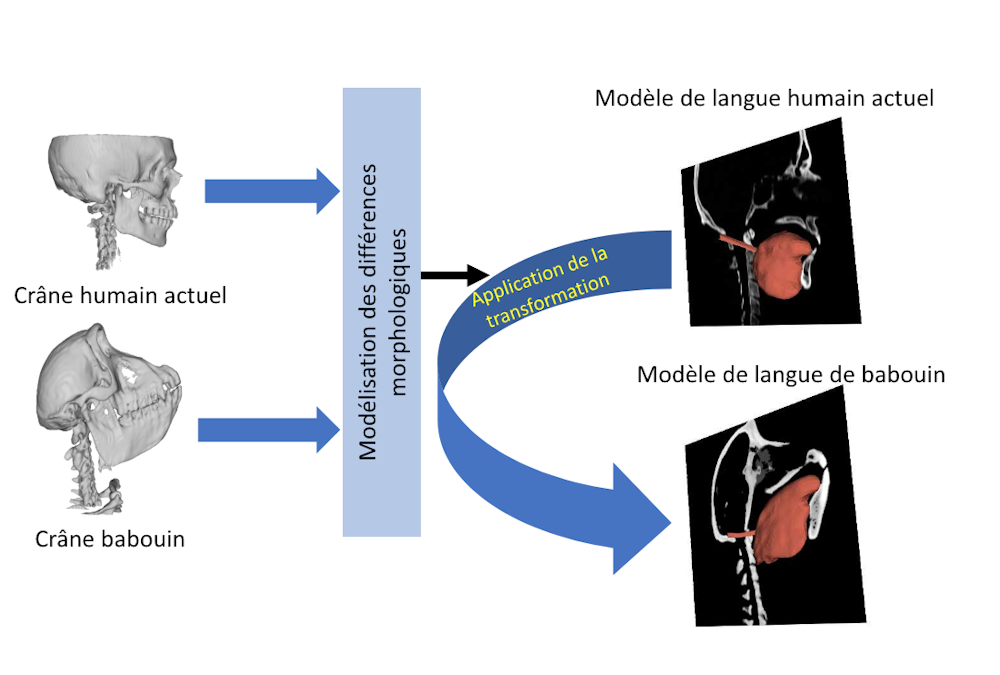
It involves analyzing fossilized bone structures to predict the shape and anatomy of the tongues of these extinct humans. To do this, we use as a reference the biomechanical model of a living human’s tongue, which we have carefully developed in our Grenoble-based laboratories, GIPSA-lab and TIMC, over nearly three decades of coordinated research.
This model accurately depicts the morphology of the tongue, its muscular structures, the mechanical characteristics of its soft tissues, and its mechanical interactions with the mandible, the palate, and the hyoid bone—a small, movable bone that connects the tongue… to the larynx.
By modifying the geometry of the reference model, we will generate biomechanical models for fossil tongues. To do this, using mathematical tools that combine complex geometric transformations, we first determine the optimal geometric transformation that allows us to move from the geometry of the skull and mandible of modern humans to that of the skull and mandible of fossil humans.
Then we apply this geometric transformation to the first person’s tongue model to reshape it and turn it into a tongue model for the second person, with its specific shape, muscular structures, and interactions with the mandible, the palate, and the hyoid bone…
But to what extent can we trust a geometric transformation based on bone structures to predict the soft tissues of the tongue? To answer this question—which is crucial for validating the method—we chose to evaluate their method by generating a biomechanical model of a baboon’s tongue, a non-human primate whose head morphology is very different from that of Homo sapiens.
Our hypothesis in this regard is that if this method works for such a primate, then it is likely to be reliable for predicting the tongue of all fossil humans whose skulls differ less from that of a Homo sapiens than a baboon’s skull does. We then generated two baboon tongue models. The first was designed using an optimal geometric transformation determined by taking into account the bony structures and soft tissues of the head. As might be expected, the comprehensiveness of the morphological information taken into account results in a model that describes the morphology of the baboon’s tongue with great precision.
We then generated a second model by determining the optimal geometric transformation based solely on information about bone structures, disregarding information about soft tissues. This second model turned out to be very similar to the first, and the reliability of this prediction was validated using statistical tools for quantifying uncertainties developed by Anca Belme at the Jean Le Rond d’Alembert Institute at Sorbonne University. We were therefore able to conclude that our method is reliable for generating, based solely on bone structures, realistic biomechanical models for primate tongues—whether human or non-human, living or (soon, as analyses are currently underway) fossilized.
Using this method, we are currently working on generating biomechanical models of the tongues of fossil humans, such as Homo heidelbergensis —known to have lived in Europe as early as 600,000 years ago—and Neanderthals from 70,000 to 50,000 years ago, based respectively on the bones from Arago 21 (a cave near Perpignan) and La Ferrassie 1 in the Dordogne. Our goal is to systematically explore the consequences of tongue muscle activations in these models, to observe the range of mouth shapes that can thus be generated, and to analyze the characteristics of the sounds that would have been produced by the fossils, assuming that they possessed vocal cords and lung capacities similar to those of Homo sapiens. It will also be possible to conduct quantitative tests by adjusting the position of the hyoid bone—which is connected to the larynx—to determine the extent to which a higher or lower laryngeal position might influence the variety of mouth shapes and sounds produced.
This is the research methodology we have chosen to unravel the mystery of how, during human evolution, the ability to produce sounds with the mouth that are varied enough to form the basis of a language—one that uses sound to convey ideas among fellow humans—came about…