

Euclid, a mission of the European Space Agency (ESA), launched from Earth onJuly 1, 2023, and will focus in particular on detecting galactic dark matter.
It wasn’t until the 1970s that the question of the existence of dark matter began to attract interest. In this regard, “Matière Noire” is a mistranslation of the English term “Dark Matter,” which actually refers to “invisible” or “unobserved/hidden” matter. If the matter had been “black,” the English term would have been “black.”
American astronomer Vera Rubin, a doctoral student in the 1970s, studied the rotation of spiral galaxies (there are three types of galaxies: spiral, elliptical, and irregular; our galaxy, the Milky Way, is a spiral galaxy). Vera Rubin’s study focused on the question of whether the “luminous mass”—that is, the visible mass, which is inferred from the presence of stars—is indeed equal to the dynamical mass (the total mass determined by studying the distribution of velocities).
By plotting the rotational velocity of a galaxy as a function of distance from its center, we obtain a direct measurement of the overall distribution of matter within the galaxy. The maximum rotational speed of a spiral galaxy occurs a few kiloparsecs from the center (a parsec is an astronomical unit of length equivalent to 3.26 light-years, 206,265 astronomical units, or approximately 30,900 billion kilometers), after which it is expected to decrease. In fact, the stars at the galaxy’s periphery orbit the center, just as planets orbit the Sun. Stars at the galaxy’s periphery have a lower orbital velocity than those located closer to its center.
However, Vera Rubin observed that stars located on the outskirts of the Andromeda Galaxy—as in other spiral galaxies—seemed to be rotating too fast (the velocities remained virtually constant as one moved farther from the center). She concluded that there was not enough mass to account for these rotational velocities. Many other similar observations were made in the 1980s, reinforcing Vera Rubin’s findings. The search for dark matter has since become a major focus of research in astrophysics, astroparticle physics, and particle physics.
Since the observation of the cosmic microwave background—or fossil radiation (the remnant of radiation emitted by the Universe when it was in a very hot and dense phase, at the very beginning, just 380,000 years after the Big Bang)—by satellites such as Planck, dark matter appears to account for a mass approximately six times greater than that of visible matter; it is estimated to make up about 26% of the Universe, meaning that the matter we are familiar with—which comprises all the stars and galaxies—accounts for only 5% of the Universe’s content. Dark matter interacts not at all, or only very minimally, with “ordinary” matter (our known world), making its detection and characterization very difficult. Its presence is detected only through its gravitational influence.
Much of the research also takes place on Earth—or, to be more precise, underground, for example at CERN’s LHC accelerator.
The advantage of underground experiments is that they combine direct detection with indirect detection of dark matter based on astronomical observations. Consequently, the strong synergy between astrophysical probes (indirect) and underground laboratories (direct probes) can make it possible to jointly measure and constrain the effect of dark matter. Eleven underground laboratories for the search for dark matter and other astrophysical objects are operational in the Northern Hemisphere.

In France, for example, there is the Modane underground laboratory, near the Italian border, where the EDELWEISS experiment has been investigating the hypothesis that dark matter exists beneath the mountain for the past fifteen years.
Underground laboratories vary in depth. The deepest ones are located in former mines, such as SNOLAB in Canada (2,000 m) and CJPL in China (2,400 m). The underground laboratories in Modane (LSM, France) and Gran Sasso (LNGS, Italy) are located approximately 1,700 m and 1,400 m below the mountain rock and inside a tunnel (Frejus/Gran Sasso), respectively.
The underground location naturally ensures a high degree of removal of cosmic-ray particles produced in the atmosphere and, consequently, of cosmogenic byproducts (such as radioactive nuclei)
This dark matter, which is present in our galaxy, is thought of as a kind of gas made up of “exotic” particles in which we are immersed. As the Earth moves through the galaxy, it comes into direct contact with these particles, so there is no need to look very far for them. But in order to observe it directly, it must interact with ordinary matter.
When a dark matter particle strikes an ordinary matter nucleus, it could cause the nucleus to recoil. Detecting this minute movement would provide evidence of its passage.
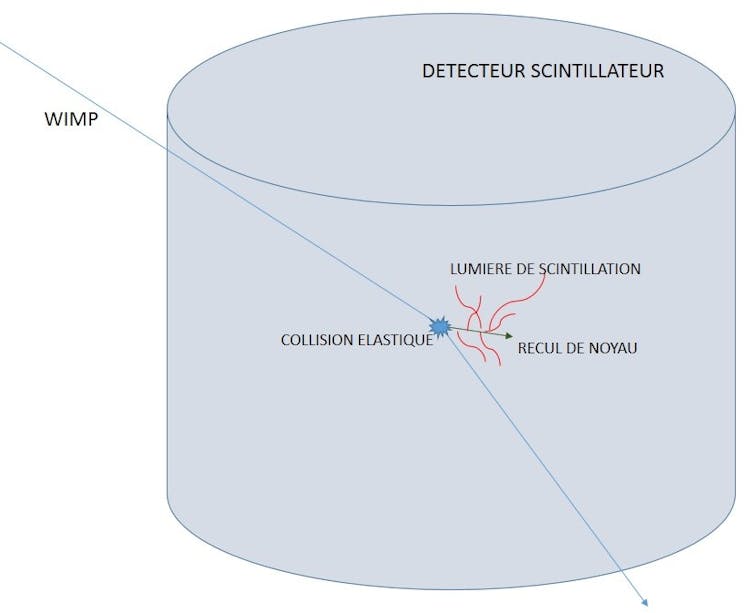
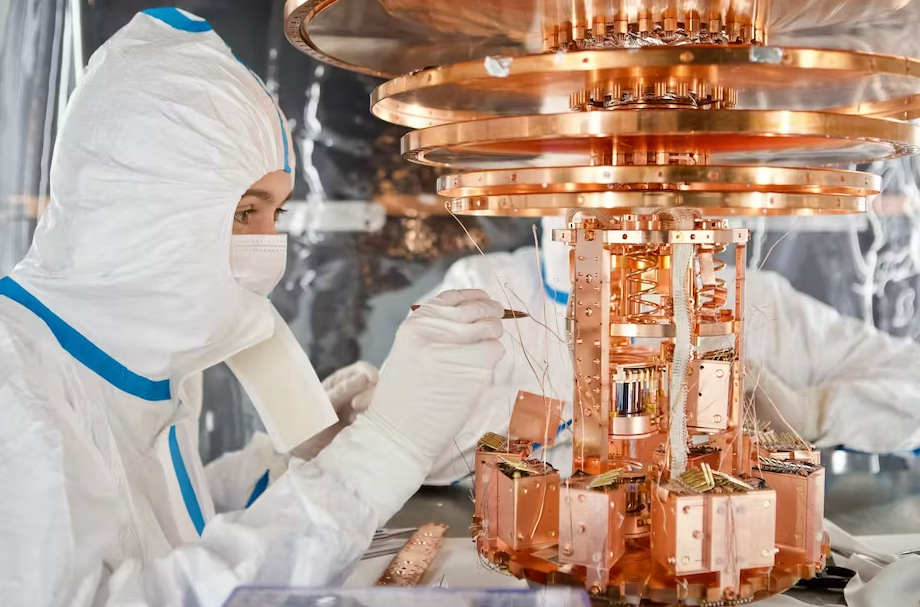
To ensure that such rare and faint events are detected, the detectors must be made of a material with very low radioactivity and shielded from background radiation in order to minimize the background noise that would mask the desired signal. This is why it is important to install observatories in underground laboratories—to avoid, as previously mentioned, as much radiation (cosmic and radioactive) as possible that could interfere with the measurements.
The research conducted in the underground laboratories built in the 1980s and 1990s was undertaken to study phenomena related to high-energy physics and astroparticle physics (proton lifetime, neutrino physics, etc.). The21stcentury has seen the launch of more ambitious experiments to explore dark matter in the cosmos.
However, with technological advances and the underlying expertise, underground laboratories quickly proved to be very useful to other disciplines. This explains why emerging countries are now eager to get involved in developing this infrastructure, as seen in projects such as ANDES (Argentina/Chile) and PAUL (South Africa). These laboratories are at the forefront of astroparticle research as well as other activities related to low-level radioactivity measurements for biology.
There are also immense opportunities for research in seismology, climatology, glaciology, and astrobiology. The ability to control lighting conditions and other environmental parameters makes underground laboratories ideal places for experimenting with hydroponic agriculture and mushroom cultivation. They also offer other opportunities, such as determining the feasibility of using the subsurface as a work environment and even converting tunnels into habitable spaces.
Other alternative hypotheses offer explanations for the phenomenon observed by Vera Rubin. Dark matter may not exist, and the hypothesis of its existence may stem from a partial misunderstanding of the laws of gravity. Other theories postulate the existence of antigravity or even negative masses in our universe, just as there are positive and negative electric charges. This makes it possible to envision a universe without dark matter.
While we wait for the research results, we can enjoy a few trips into the world of science fiction, such as with the TV series Dark in which a ball of dark matter created by a nuclear power plant makes it possible to travel through time. More relaxing, the series Futurama where, when "The Nibblonians", mischievous little creatures, digest their food in the form of dense black balls made of dark matter—poop balls that also serve as fuel for spaceships.