


If two atoms are together in this state of partial distraction and, despite being confined, one of the two chatty atoms receives a call from its boss, then they’ll suddenly have to stop talking. For the neglected atom, there are two possibilities: either it receives a signal from its friend—who has decided to get back to work more seriously or to recount the entire conversation to it—in which case it will do the same; or its friend says nothing more to it, and it may, with some probability, choose to get back to work on its own or head to the coffee machine to find other people to talk to. In any case, after one of the two atoms interacts with its hierarchy, neither atom will remain in its initial “distracted” superposition state.
So what? Well, in the event that the boss managed to re-motivate the first worker and the second worker, upon receiving this information, also refocused, the overall motivation of these two workers was boosted by their interaction with that external and unchanging factor—their manager.
What’s fascinating is that in quantum physics, instead of this sudden surge in motivation, we observe a sudden surge in energy. Note that the energy doesn’t come from some mysterious reservoir. Just as a boss sometimes sparks her own motivation by encouraging her employees, energy, too, is transferred from one system to another.
By harnessing this phenomenon—transferring energy to a quantum system through measurement—we are directing our research toward new “quantum engines” that would be capable, for example, of amplifying laser light.
Energy can take various forms: chemical, as in the case of batteries; thermal, such as when taking a very hot bath; or, for example, kinetic, such as when throwing a pétanque ball. Just as with two magnets—which require energy to be pulled apart—it is also possible to store energy through the interaction between two systems.
For quantum systems, it’s not that different. This makes sense, since a quantum system is nothing more than a system like any other… but so small that its behavior reveals its different energy levels; we refer to the ground state when the energy is at its minimum. Of course, quantum physics—as counterintuitive as it may be—does indeed adhere to the principle of energy conservation. If an atom transitions from a higher energy state to a lower one, it emits a photon that compensates for this energy difference.
So far, we understand that our “chatty” atoms can indeed have varying amounts of energy and that they are sensitive to disturbance, but one question remains: How is it possible to transfer energy to a quantum system by measuring it?
To understand this, you have to remember that every measurement requires an interaction. Even when you measure the temperature in your home, it requires the molecules in the surrounding air to collide with your thermometer so that the liquid inside it expands, and then for photons to be reflected from the thermometer to your eye so that you can see what it reads. Thus, if you can read the result of a measurement on a microscopic scale, it is because that measurement is encoded in a system large enough to obey the rules of classical physics.
Quantum systems are no exception to this rule.
The difference, however, is that in quantum physics, the measuring device is larger—not smaller—than the object being measured. Thus, the interaction between the measuring device and the system is no longer negligible. It’s as if the boss of our two atoms couldn’t observe her employees’ motivation levels without them noticing. The atoms’ privacy is therefore well protected.
In other words, in quantum physics, measurement acts as a disruptive factor. It can therefore sometimes increase the energy of our pair of atoms. However, following their boss’s intervention, the atoms’ motivation (or their energy) may decrease. Thus, if this interruption becomes a daily occurrence, on average it will result in neither a gain nor a loss of motivation.
Not all interactions have the same effects, and some interventions are, on average, much more effective. Let’s imagine, for example, that a boss notices that one of her employees works faster than the other but has trouble motivating themselves. So, even if their interaction causes them to work for a shorter time, since the better employee is more motivated, the amount of work done remains constant during that interaction (just as energy is conserved when two atoms interact). Thus, once the faster worker is motivated, all that remains is to interrupt the interaction between the employees so that they work longer and increase the total amount of work.
By choosing an appropriate type of measurement (one that says nothing about their energy, or, in technical terms, one that does not commute with the system’s Hamiltonian), it is also possible in quantum physics to transfer energy to the measured systems, even on average.
To better understand this phenomenon, let’s consider two magnets placed side by side. The energy associated with their interaction is negative because energy would have to be expended to separate them. Furthermore, since each magnet has a mass, both possess potential energy. To measure the mass of the second magnet, we must attach a spring scale (our measuring instrument, a type of scale on which we hang the object whose mass we want to determine) and pull on the spring until the reading stops changing. Under these conditions, the magnets are so far apart that the magnetic interaction between them becomes negligible. It is then possible to rotate the first magnet without changing its energy. By then placing the second magnet back near the first, their like poles will face each other. The magnets will therefore repel each other, and it is now possible to extract energy from the system.
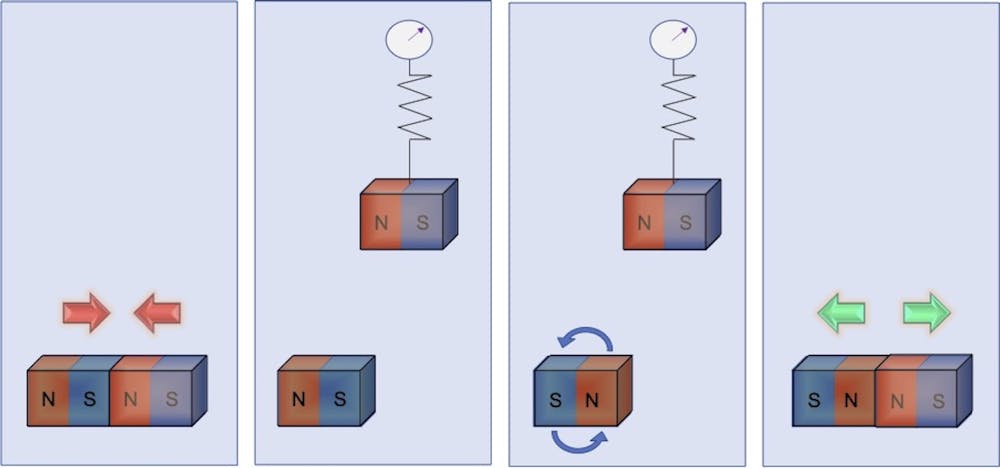
In quantum physics, there’s no need to treat the interaction between atoms as negligible; the measurement itself can change the state of the atoms, much as if it were causing the first magnet to spin directly.
Using this type of mechanism, we at the Néel Institute in Grenoble are working to design “quantum engines” that would not require “thermal baths”—that is, hot and cold energy reservoirs—but would simply involve measuring the state of our system in order to extract more energy from it.
Be careful not to view these engines as the technology of the future for our electric cars and cell phones. It is simply a transfer of energy from our measuring device to a quantum system: the measuring device is so large that the energy it loses is very small compared to its total energy.
The value of these “quantum engines” is twofold. On the one hand, it lies in their ability to modify the energy of quantum systems—for example, to amplify laser light. On the other hand, they enable the study of the quantum measurement process, which remains one of the major mysteries for physicists, because when we measure a quantum system, we select a particular state, but At this time, there is still no consensus on the equation that describes this trend. A better understanding of these fundamental phenomena is essential for designing and optimizing the energy consumption of quantum processors, which are key components of quantum computers.