Our night sky is disappearing: one of the key issues at the 2026 International Space Summit
Search
September 9, 2026
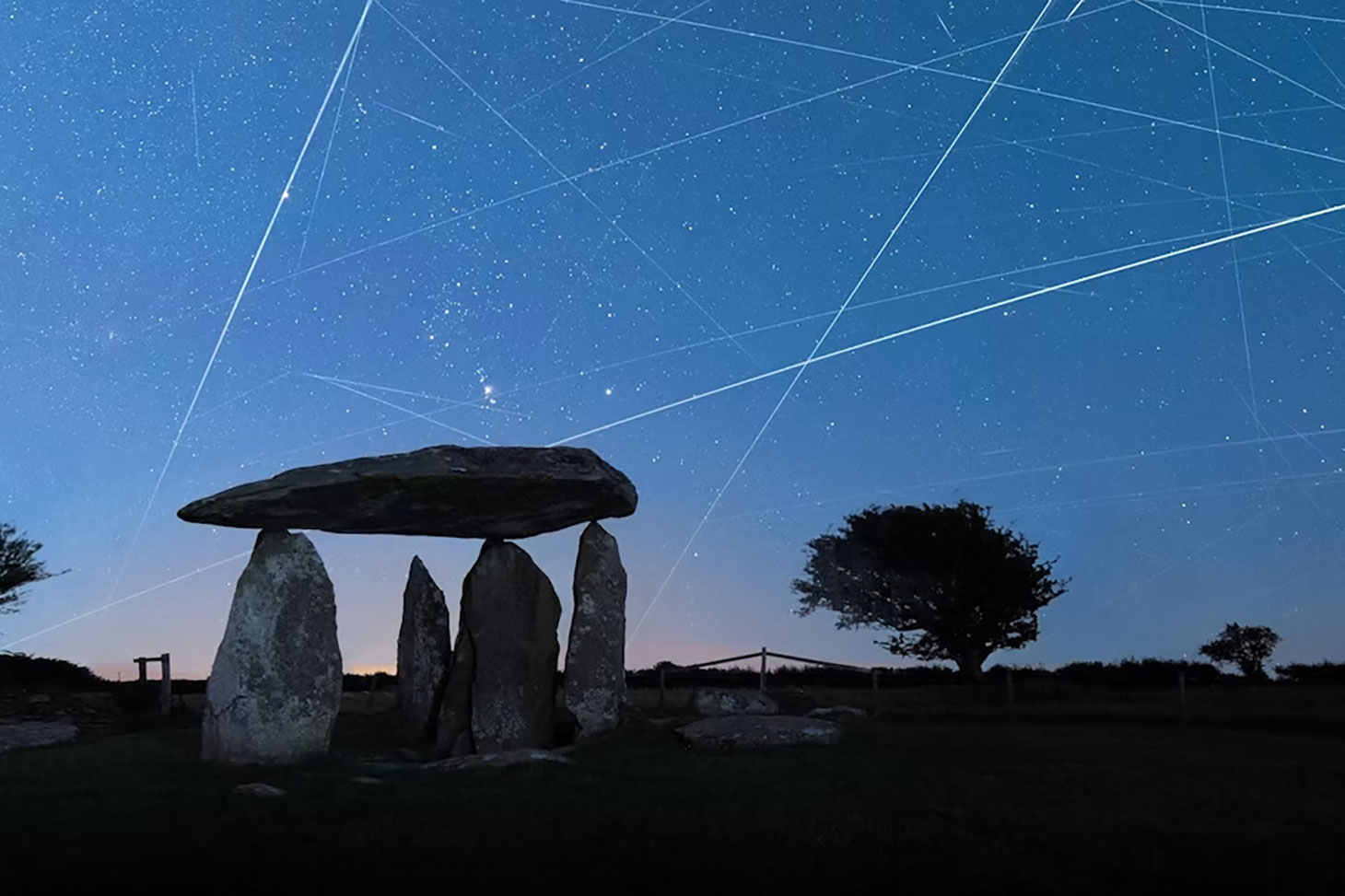
This photo shows not only the constellations of Orion and Taurus, as well as the Milky Way, but also the trails left by numerous satellites crossing the sky. Among them are the International Space Station, satellites from the Starlink megaconstellation, and a myriad of other satellites and rocket stages. These trails, illuminated by the Sun, were captured in separate one-minute exposures taken over approximately two hours before dawn and then digitally stitched together into a single image. Above the burial chamber at Pentre Ifan in Pembrokeshire, Wales. Max Alexander/ESA, CC BY
Among the challenges on the agenda, one of the most urgent—and least publicized—is the preservation of the night sky, which is now threatened by the proliferation of satellites.
Among the challenges on the agenda, one of the most urgent—and least covered by the media—is the preservation of the night sky, which is now threatened by the proliferation of satellites.
Without swift action, our nights could soon look like a video game screen, withconstantly moving satellitesobscuring the stars.
Tomorrow's night sky? The child asks, "What's that bright spot that isn't moving?"Kelsey Johnson/University of Virginia, Courtesy of the author
During a stargazing evening with students and their parents in Chilly, in Haute-Savoie, one of us was teaching them how to distinguish planets from stars among the constellations. In the twilight, the flashing lights of airplanes approaching Geneva—and others with steady glows—moved among the fixed points in the night sky. “Those points of light that glide across the sky without blinking are neither shooting stars nor comets, but low-orbit satellites illuminated by the Sun,” they learned. However, the magic of the sky we were admiring that evening might well mark the end of an era. In less than five years, the night sky may be unrecognizable.
In fact, in 2019, there were 2,200 active satellites in orbit before the first launches of the Starlink constellation, but today there are more than 18,000 (according toOrbital Radar). These satellites, most of which are not designed to deliberately reflect light back toward Earth, nevertheless already contribute to light pollution in the sky due to sunlight reflected off their surfaces, particularly their solar panels. By 2030, this number could reach 30,000 to 60,000 if all projects filed with the International Telecommunication Union (ITU) and the U.S. Federal Communications Commission (FCC) are implemented.
Another category of projects could further increase the number of objects in orbit. Space data centers, such as those envisioned by Orbital Compute, could add 100,000 additional satellites, each equipped with solar panels that reflect sunlight, resulting in unprecedented space light pollution, in the form of points as bright as the brightest stars, moving at high speed across the night sky and visible to the naked eye from anywhere on Earth.
Added to this growth could be a new category of objects: satellites designed to deliberately reflect sunlight toward regions of Earth shrouded in darkness. The Reflect Orbital project, which plans to illuminate areas of Earth at night using giant mirrors in orbit (50,000 are planned), could result in satellites that are up to four times brighter than the full moon in their direct beam, or as bright as Venus outside of it, according to a recent study by the European Southern Observatory (ESO). They would thus join the thousands of satellites already visible crisscrossing the night sky. Due to the scattering of sunlight redirected toward nighttime areas on Earth, these sources would also contribute to making the sky background brighter in regions previously free from light pollution.
The image shows how light scattered by the Reflect Orbital mirrors would increase the brightness of the sky above ESO’s Very Large Telescope in the Atacama Desert in northern Chile. The image on the left, which shows the Milky Way, was taken on May 16, 2026, under moonless conditions using a panoramic camera. The image on the right shows a sky that has become three to four times brighter due to the 50,000 satellites, even though they are not pointing toward the observatory.Olivier Hainaut/ESO, CC BY
Impacts that extend far beyond astronomy
Indeed, this trend also threatens biodiversity. Nocturnal species (bats, migratory birds, insects, pollinators, etc.) depend on darkness to navigate, hunt, or reproduce. A series of recent studies shows that light pollution disrupts complex ecosystems by altering predation, reproduction, and migration behaviors. Preserving nighttime darkness is therefore a major challenge for biodiversity, just as much as limiting artificial lighting at ground level.
With tens of thousands of satellites in low Earth orbit, the risk of cascading collisions—known as the Kessler syndrome—is becoming a reality, if not imminent. Each collision generates thousands of pieces of debris, rendering certain orbits unusable for decades. By 2026, more than 28,000 objects larger than 10 centimeters will already be cataloged in orbit (Orbital Radar).
Space debris is not only a threat to satellites: by reflecting sunlight, the thousands of small fragments in orbit can also increase the diffuse brightness of the night sky. A recent study estimates that by 2035, this contribution could account for between 3 and 20 percent of the sky’s natural brightness, regardless of the observation location—including even the darkest astronomical sites. Unlike individual satellite trails, this diffuse light would constantly affect astronomical observations by increasing the sky’s background noise.
From a cultural perspective, this signals the impending disappearance of the starry sky, a shared heritage of humanity. Today, one-third of the Hubble Space Telescope’s images are already marred by satellite trails. By 2030, more than 90% of the observations from missions such as SPHEREx, ARRAKIHS, and Xuntian—three major space telescopes dedicated to studying the universe—could be unusable. SPHEREx alone represents an investment of approximately $500 million for NASA, while ARRAKIHS has a budget of approximately 200 million euros from the ESA.
The ITU manages radio frequencies and orbits, but does not address environmental or astronomical impacts. What has worked for the management of electromagnetic frequency bands used for communications is the fact that unregulated management of these bands would have directly impacted operators. Unfortunately, what is happening with megaconstellations will not have an immediate impact on the core business activities of the companies involved—at least not initially. Light pollution and disruptions to astronomy mainly involve indirect effects that do not directly challenge their business model; operators therefore have little incentive to voluntarily limit these nuisances as long as no regulations require them to do so.
COPUOS (Committee on the Peaceful Uses of Outer Space) is the United Nations committee on the peaceful uses of outer space. It has established a group of stakeholders whose recommendations are not binding.
As such, the International Astronomical Union’s Center for the Protection of the Dark and Quiet Sky (CPS) coordinates efforts among astronomers, space agencies, and industry. It works with operators to measure and reduce the brightness of their satellites by encouraging the use of less reflective surface coatings and the sharing of best practices. However, its influence depends on the goodwill of private operators.
In a report titled “Large Satellite Constellations: Perspectives and Challenges, ” the national academies of sciences of the G7 countries proposed creating a permanent governing body, modeled after the ITU but with expanded responsibilities. This body would be tasked with managing satellite orbits, monitoring environmental impacts, protecting astronomy, and regulating space traffic to prevent collisions. Without this strict and binding international framework, the situation in low Earth orbit could become unmanageable, with an increased risk of the Kessler syndrome, in which millions of pieces of debris would render space unusable.
On September 9 and 10, France will host the 2026 International Space Summit in Paris, an event that will bring together policymakers, scientists, and industry leaders. In preparation for this summit, the G7 national academies of sciences have sounded the alarm. In a joint statement, they are calling for limits on the number of satellites in low Earth orbit, the creation of an international regulatory body, and the implementation of strict standards to reduce their impact.
What can citizens do?
Citizens can raise awareness among those around them that the night sky is a universal heritage worth protecting, just like the oceans or forests. They can also participate in programs, such as Globe at Night, to measure light pollution or support initiatives, such as those by DarkSky International, to limit the impact of megaconstellations and preserve dark skies.
Policymakers, for their part, have a responsibility to act quickly. The 2026 International Space Summit must serve as an opportunity to establish a binding international framework to limit the number of satellites and their impact, to prioritize low-carbon ground-based infrastructure and communication technologies that are less dependent on satellite constellations, and to protect sites from light pollution on a global scale, as is the case with “international dark sky reserves .”
Tomorrow’s sky is decided today! Ten years from now, will our children still be able to see the Milky Way, or will they see nothing but a network of moving artificial lights?
The choice is in our hands, because the night sky is not an infinite resource. It is a shared asset, a cultural and ecological heritage that we have a responsibility to preserve for future generations. The 2026 International Space Summit is a unique opportunity to take action.
TheUniversité Grenoble Alpes is a founding partner of the online media outlet The Conversation. This website aims to combine academic expertise with journalistic know-how to provide the general public with free, independent, and high-quality information. The short-form articles cover current events and social issues. They are written by researchers and academics in collaboration with a team of experienced journalists.
Share the linkCopyCopiedClose the modal windowShare the URL of this pageI recommend this page:Available at this address:The page will then be accessible from your "My Favorites" menu.Stop the videoPlay the videoMutePlay audioChat: Have a question?Robo Fabrica ChatbotMatomo Traffic StatisticsX (formerly Twitter)