


But are there really two distinct Frances when it comes to voting patterns? If so, is the root cause of this fragmentation primarily linked to the local economic context or to the demographic makeup of these regions?
It is true that maps and data on urbanity gradients seem to support this hypothesis. However, other geographers, on the contrary, downplay the predictive power of this geographical contrast. In their view, behind these living spaces lies a more complex social reality that is likely to influence voting behavior.
In fact, some political scientists and geographers have been emphasizing for years the role of sociodemographic composition at a very local level in explaining voting behavior.
The variation in voting patterns based on place of residence in recent elections appears to stem primarily from the dispersion of populations sharing certain characteristics, such as socio-professional category, age, educational attainment, or income. Place of residence, then, is merely the tree that hides the forest.
[More than 80,000 readers rely on The Conversation’s newsletter to better understand the world’s major issues. Subscribe today]
To contribute to this discussion, we are using a new classification system from INSEE (2020) that divides municipalities into six regions.
It classifies rural municipalities—which account for 33% of the population—into four categories based on their population density and their dependence on an employment hub corresponding to an area with more than 50,000 residents. This dependence is measured by commuting patterns. Two of the rural categories correspond to peri-urban areas (dependent on an employment hub) and two to rural areas (self-sufficient).
For example, in the Paris region, in the Yvelines department, Versailles is classified as “dense urban,” Rambouillet as “intermediate urban,” Montfort-l’Amaury as “rural under strong influence from a major urban center” (i.e., peri-urban), and you have to go further west, into the Eure-et-Loir department, to find rural municipalities under weak influence from a major urban center or that are self-sufficient.
By cross-referencing this classification with the first-round presidential election results for the leading candidates at the municipal level, we find that there are two distinct areas of electoral competition in France: predominantly urban municipalities and the rest—rural and suburban areas (see Figure 1).
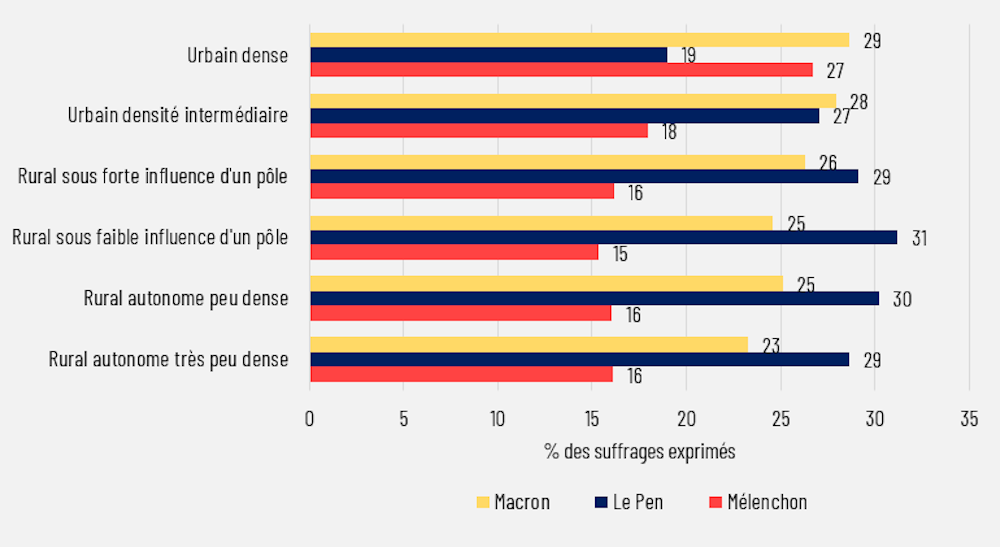
In major cities and their immediate suburbs, the race was between Emmanuel Macron—who achieved his strongest results there—and Jean-Luc Mélenchon. Marine Le Pen trailed far behind the top two candidates in these areas. The race took a different form in suburban and rural areas, where the first round was contested between Emmanuel Macron and Marine Le Pen.
The incumbent president received fewer votes outside densely populated municipalities, while maintaining a relatively high level of support—though lower than that of his rival. The RN candidate achieved her best results in rural municipalities with little influence from urban centers. Jean-Luc Mélenchon, for his part, saw his support drop dramatically by 10 percentage points outside densely populated urban municipalities.
This electoral divide between densely populated urban areas—where 37.9% of the French population lives—and the rest of the country is often attributed to socioeconomic factors.
According to several theories, certain areas have been neglected by public authorities and private investors, who reportedly prefer “global cities.” Behind what is sometimes presented as an individual choice to live in peri-urban areas lies, in reality, a dual social and cultural decline: these residents are said to live in peri-urban areas due to economic constraints imposed by rising rents in major cities and a strategy of avoiding certain immigrant populations. All of this would generate social discontent that would translate at the polls into a greater propensity to vote for protest parties.
However, the limitations of these explanations were highlighted by economist Laurent Davezies in 2021. According to him, France, a centralized state, invests heavily in its regions and ensures functional solidarity. Metropolitan areas contribute more to the state budget than they receive, while rural areas are net recipients of public funds.
Although globalization—and subsequently the 2008 economic crisis—have disproportionately affected areas far from major urban centers, it seems to us an exaggeration to speak of “abandonment” or to use a few instances of corporate relocations to generalize a binary opposition between a “happy” France and an “unhappy” France.
Analyzing economic and social data by housing category also prompts us to view with skepticism the theory that posits the existence of two distinct Frances (see Table 1 below).
In fact, we find that median income is highest in large cities (densely populated urban areas), but that it does not differ significantly from that in municipalities in peri-urban areas. Nevertheless, there is a relatively large gap—3,000 euros per year—between rural areas far from major urban centers and densely populated urban areas.
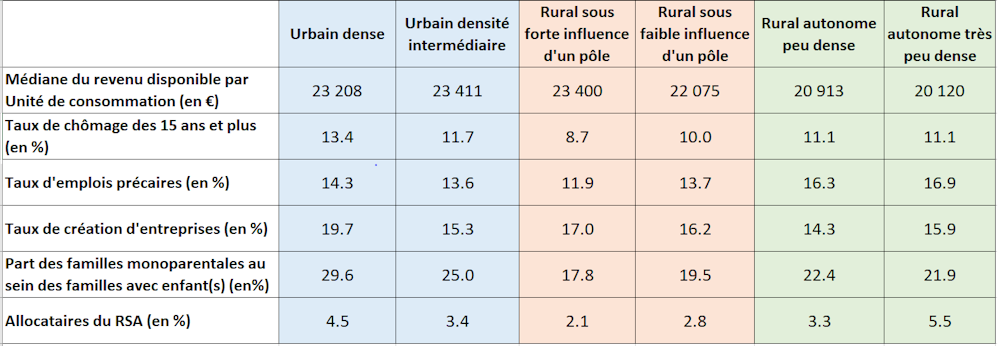
Similarly, the unemployment rate is higher in urban areas than in suburban or rural areas. The rate of precarious employment is lowest in suburban areas and highest in rural areas, but the gap with cities is not huge (two to three percentage points). There is some variation in the rate of business creation, but again, no significant regional divide. The proportion of single-parent families—an indicator sometimes used to measure social exclusion—is higher in large cities than in rural communities. Finally, the number of people receiving the RSA (Income Support Allowance) is higher in large cities than in suburban or rural communities, except in sparsely populated communities far from employment centers.
The regional divide observed at the polls does not appear to be reflected in economic and social terms, based on the data above. Generally speaking, it is not in the areas where the RN achieved its highest vote share (peri-urban areas) that the economic and social situation is the most dire (see Table 1 above).
For example, in the Nord department, Marine Le Pen receives significantly higher support in suburban areas (37% in rural areas with little influence from urban centers), where the median income is higher and unemployment is lower than in the department’s major cities (22,100 euros vs. 20,800). In fact, her support is lower in the department’s major cities, such as Lille (12%), Dunkirk (30%), Douai (28%), and Valenciennes (25%).
The presentation of this set of indicators therefore invites us to view with caution the narrative that pits a well-off, urban France on one side against a neglected France in rural and peri-urban areas on the other. A pilot survey conducted as part of the “Rural Urban Divide in Europe” (RUDE) project, of which we are a part, also indicates that rural and suburban residents are more satisfied with where they live than urban residents (87% of rural residents agree with the statement “where I live makes me happy,” compared to 72% of urban residents).
So, if the difference in voting behavior among citizens from different geographic areas is not primarily based on economic and social factors, what could be the cause?
It seems to us that the “Yellow Vests” crisis —whose initial protests were concentrated in France’s suburban areas and medium-sized cities—has highlighted among this population a sense of being left behind and excluded from decision-making.
A pilot survey conducted on a small sample as part of the “RUDE” project prompts us to explore this hypothesis further (see Figure 2).
Even though there are no glaring sociodemographic disparities between cities on the one hand and suburban and rural communities on the other in terms of standard of living, there is a gap in perception regarding these populations’ resentment toward urban dwellers. In line with Katherine Cramer’s pioneering work on the polarization between rural and urban voters in Wisconsin, one could describe the French situation as what she calls a “politics of resentment.”
This takes four forms: the awareness of belonging to a specific community that is distinct from others; the feeling of having fewer public resources than others; the perception of receiving less attention from policymakers; and the sense that one’s way of life is not respected by urban elites. The second graph presents the opinions of respondents to a pilot survey based on their self-identification with a place of residence.
The responses reveal that people from rural areas have a stronger sense of belonging to their geographic region: seven out of ten rural residents say they share similar values with other rural residents, compared to only five out of ten urban residents. Three-quarters of rural residents believe that the issues affecting their community are ignored by policymakers—50 percent more than urban residents. The gap is even more pronounced when it comes to public resources: 84% of rural residents believe they are the last to benefit from public spending, compared to 31% of urban residents. Finally, there is a strong feeling among rural residents that their way of life is not respected by urban residents. The reverse is not true: only one-quarter of urban residents feel that rural residents do not respect the specific aspects of their way of life.
This brief analysis of descriptive data by no means settles the debate on the link between places of residence and voting behavior, nor does it provide “proof” that the socioeconomic composition of regions has no influence whatsoever on voters’ political behavior at a more localized level. It encourages us to consider other possible explanations. It demonstrates the value—in addition to maps—of using data provided by INSEE at the municipal level, as well as opinion surveys that take into account both objective and subjective ties to a place, in order to understand electoral dynamics.
Above all, it also invites us to take seriously the divide between urban life on the one hand and rural and suburban life on the other, by incorporating a highly subjective dimension: the way individuals perceive their own interests and local circumstances in relation to those of others.
Highlighting this divide in perceptions may not only serve as an explanatory variable for electoral behavior, but also potentially offer an explanation for the crisis of confidence in liberal democracy that we have been observing for years now.
Marion Mattos, a master’s student in the “Progis” program at Sciences Po Grenoble ( Université Grenoble Alpes), made a significant contribution to this article.