
Figure 1 below shows the percentage of respondents who reported having confidence in political parties in the most recent wave of the transnational European Values Survey research program conducted between 2017 and 2020.
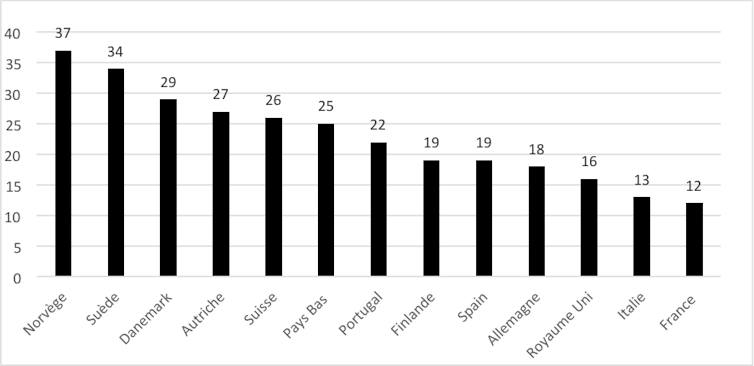
Based on this data, we can draw three conclusions.
First observation: Trust in political parties is generally very low. The country with the highest level of trust is Norway, where it barely reaches 37 percent. By way of comparison, trust in the police ranges from 67% in Spain to 95% in Finland. In other words, the population that is most distrustful of its police still trusts them nearly twice as much as the population that is most trusting of political parties trusts those parties.
Second observation: Europe’s five most populous countries are at the bottom of the list. There are, in fact, five countries in Western Europe with populations significantly larger than those of the others: Germany, France, Italy, the United Kingdom, and Spain. These are the five countries where trust in political parties is lowest.
Third finding: The French are the most distrustful. France is the country where this phenomenon is most pronounced, with only 12% trust in political parties—a drop of 6 percentage points over the past ten years. It is therefore likely the country that best illustrates what is happening across Western democracies.
The political systems of representative democracies are based on a simple principle: competition among political parties, which is enshrined in France in Article 4 of the Constitution. This principle allows our systems to define themselves as “democratic” in the sense that citizens can influence policies by choosing the best option from a variety of choices. If there were only one political party, as in China, the regime would no longer be democratic. Similarly, with a small number of parties that cooperate with one another rather than compete, we would have an oligarchic system. This is the case in countries such as Cameroon, where elections are used to co-opt members of the few parties that run for office.
This competition works exactly as it does in economics. In theory, competition among businesses benefits consumers, and competition among political parties benefits voters. When companies stop competing with one another, we run the risk of seeing the emergence of an oligopoly, in which a limited number of providers collectively set prices and sales policies. Similarly, when political parties stop competing with one another, we face the risk of an oligarchy, in which the major parties collectively set rules that benefit them.
But the optimism of the early competition theorists has long since been abandoned. Competition is not a stable equilibrium, and firms tend to cooperate. This is why we have seen the development of antitrust laws that prohibit firms from “abusing a dominant position in the internal market or in a substantial part thereof,” to quote Article 102 of the Treaty on the Functioning of the European Union.
In politics, the rules governing competition among political parties are far less developed. Representatives of the largest parties regularly rub shoulders in the halls of Parliament and are tasked, among other things, with establishing the rules governing competition among parties. Let’s apply this model to the economy: imagine that Microsoft and Apple held the majority of seats on a board tasked with establishing the rules of competition among digital companies. They would have no trouble forming a coalition to create rules that would benefit them at the expense of their smaller competitors.
The concept of the cartel party, developed by political scientists Richard S. Katz and Peter Mair, is based on this idea: our political systems foster cooperation among dominant parties, which establish rules to protect themselves from potential rival parties and from activists who might introduce competition of ideas within the parties. This theory can be applied to the European Union: several parties abuse a dominant position in domestic politics or in a substantial part of it.
One of the main mechanisms driving the cartelization of political systems in Europe lies in the rules governing public funding of political parties. It hinges on two points: first, it makes parties independent of their activists. Whereas in the past no party could function without the volunteer work of its members, this is no longer the case: major parties now have access to public funds that allow them to hire professionals, rather than relying on the time and money of their members. As a result, members are no longer welcomed as warmly as before, and membership numbers have dropped dramatically in many democracies.
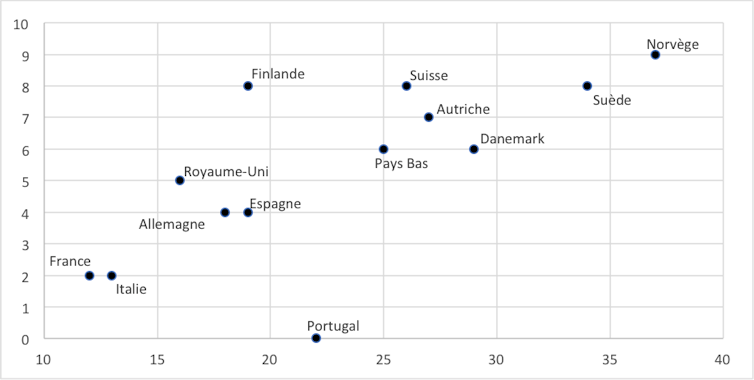
Furthermore, while party activism used to allow members to influence the selection of party leaders, since the introduction of open primaries, activists no longer have a decisive say in choosing candidates and leaders, since their vote carries no more weight than that of any other voter. As shown in Figure 2 below, the level of party activism is closely correlated with trust in political parties.
The way political campaigns are funded also acts as a barrier to the emergence of new parties. Securing funding depends on past results, and reimbursements depend on the number of votes received. This pushes smaller parties to spend less. For example, in France, election reimbursements are ten times higher for candidates who receive at least 5% of the vote. Candidates who are most likely to achieve this will therefore spend much more, thereby reinforcing their advantage. This is how established parties protect their position, even as they lose their activists. This has repercussions for society as a whole: the number of people who interact with enthusiastic activists is shrinking, as is the number of people from whom political parties seek support. This lack of contact between citizens and parties breeds mistrust. It also leads to a negative connotation associated with the term “party,” which some try to mask by using the word “movement.”
This trend explains, on the one hand, the rise in voter abstention—since more and more citizens have very little influence on political life—and, on the other hand, the rise of “populist” parties that denounce a conflict between “elites” and “the people,” such as the Five Star Movement in Italy. Their success is no coincidence: anti-elite rhetoric works because it is rooted in the reality of the parties’ growing independence from voters.
The rules governing political party financing in France and the rise of primary elections perfectly illustrate the theory of cartelization. However, beyond the issue of financing and when compared with other countries, the trend toward reducing partisan competition is very strong in France.
Let’s consider the procedures for nominating candidates for the presidency of the Republic. France is the only European country with an elected president where there is no provision for “citizen endorsements” and where only elected officials—whether local, national, or European—have this right. Austria, Finland, Ireland, Iceland, and Portugal—to name just a few in Western Europe—use this mechanism to validate candidacies in their presidential elections and have elected “independent” presidents.
Restricting the field to elected officials alone might result in candidates coming only from parties that already have elected representatives. However, the typically French phenomenon of a large number of mayors in small municipalities allows other candidates to run. In 2017, without these mayors, only four candidates would have been on the ballot. However, the 2015 NOTRE Act increased municipalities’ dependence on levels of government more tightly controlled by political parties, since municipalities now have virtually no means of raising taxes. The 2016 law on endorsements, for its part, made all endorsements public. The combination of these two laws has made mayors of small municipalities more vulnerable to potential retaliation in the event of an unwelcome endorsement, since their names are known and their municipalities are heavily dependent on higher levels of government. In 2017, three-quarters of them did not endorse any candidates, and this percentage is likely to rise further.
Another example: during an election, each party or candidate must pay for the printing of its own ballots. In Germany, there is a single ballot, funded by the state, which lists all the candidates or parties competing in the election. Voters indicate their choice by placing a check mark on the ballot. The French system, aside from its financial and environmental costs, limits competition among parties to those that can afford to pay for their own ballots. There are bills proposing a shift toward a German-style system, but they remain in the minority.
These examples illustrate how restrictions on partisan competition are embedded in our laws in the form of technical and largely invisible decisions. In France, over the past two decades, laws that restrict electoral competition have led to a particularly critical situation—one with which we are all too familiar—characterized by high abstention rates and widespread protests.
Apart from the traditional parties, which lack activists and voters, there are numerous new political movements, but those that manage to run in elections are inevitably backed by considerable wealth—such as those led by Emmanuel Macron in 2017 or Éric Zemmour today—the only way to overcome the obstacles to partisan competition. In France, the cartel party has been particularly successful, and low trust in political parties is one consequence among others.
This article is republished from The Conversation under a Creative Commons license. Readthe original article.