

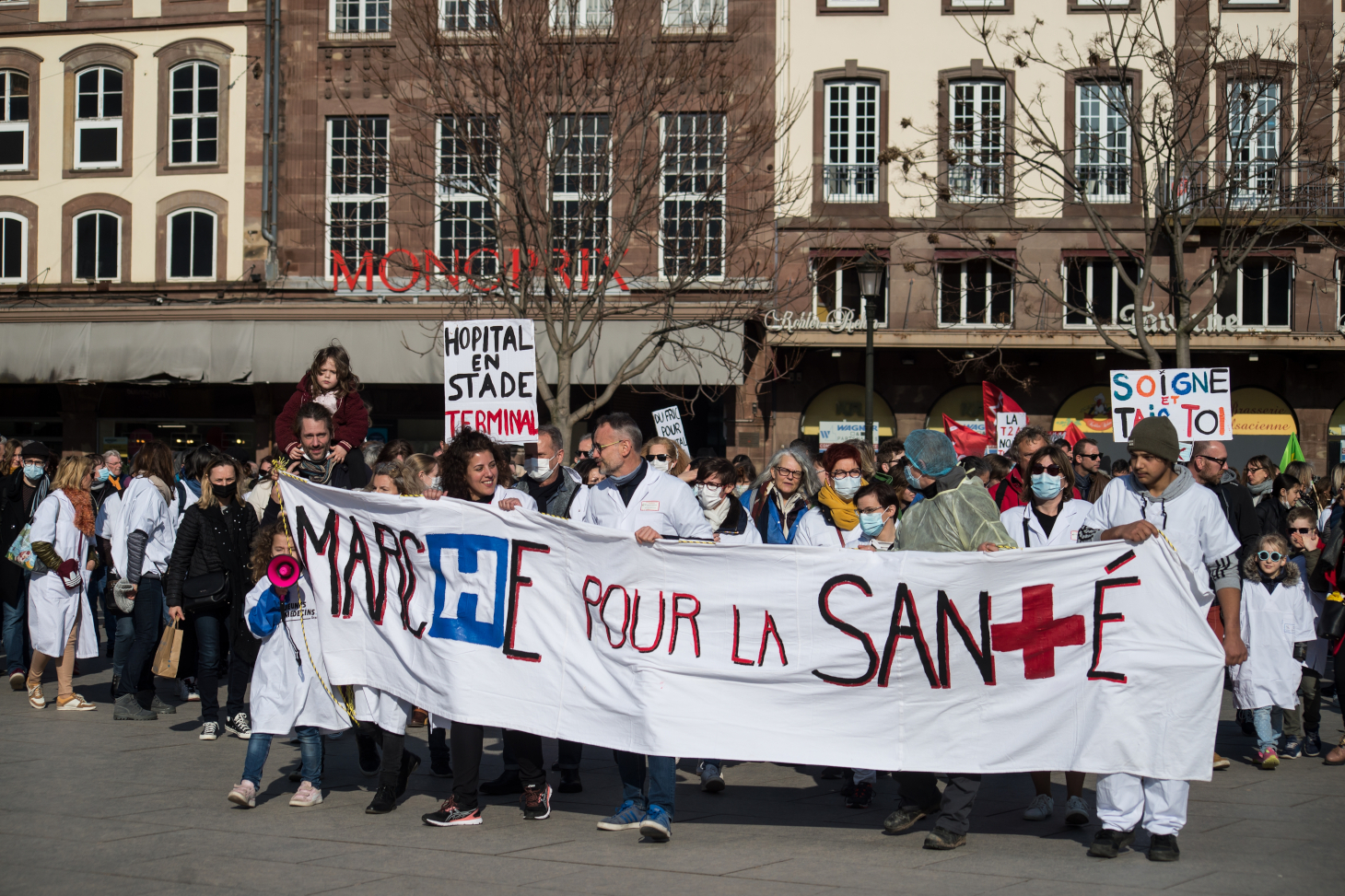
The traditional May1 demonstrations should have echoed this sentiment. However, in the wake of Emmanuel Macron’s reelection, this symbolic day of protest did not draw much more of a crowd than in 2021 (117,000 demonstrators compared to 105,000) and even fewer than in 2019 (166,000 demonstrators according to the Interior Ministry’s count) in a country with 25.9 million wage earners.
The 2020–2022 period certainly saw unions express their opposition to any new pension reform, despite deep disagreements among them on the issue. Recent conventions of unions such as Force Ouvrière and the CFDT have, in fact, highlighted the difficulties in reaching a common vision and course of action.
First, pension reform is indeed “the mother of all battles” to come. At the CFDT, delegates even strictly limited the scope for negotiation on the issue (debate 9).
Does this mean we’re in for a turbulent fall? Certainly, the current political impasse—due to the lack of a parliamentary majority—jeopardizes this reform. But many other issues—rising prices, wages, purchasing power, and a work environment transformed by the COVID-19 pandemic—could lead to this “social upheaval”… and the public might, in its own way, try to break the political deadlock.
In fact, considering such a scenario raises questions about the state of the labor movement. Have the many changes that have taken place since the COVID-19 crisis revived unionization among workers after 40 years of decline? Has the crisis—or rather, the crises, since there was also the “Yellow Vests” movement—enabled labor unions to reconnect with workers?
Official data (2019) show that only 10.1% of employees (in mainland France) belong to a union. Officially, this represents a decline of one percentage point since 2013. However, we have shown that these figures are overestimated, with the actual unionization rate being closer to 7%— one of the lowest among OECD countries. In the absence of an accurate and transparent measure of union membership, we have gathered several accounts that suggest the continued—and even accelerated—decline in union membership.
FO teams report a 15% decline in their membership, a result of remote work, which has widened the gap between employees and union representatives. Recent confederal conventions—those of FO and CFDT—confirm this trend.
Yves Veyrier, the outgoing general secretary of FO, reported last May that his organization had 400,000 members (his predecessors had reported 100,000 more). According to the CFDT’s activity report published for its June 2022 convention, the confederation has lost 3% of its membership dues over the past five years.
We also note, in Anatomy of Trade Unionism that these figures do not always correspond to actual members but rather to “accounting members” resulting from complex internal resource allocation mechanisms. This leads to an overestimation of actual membership by the respective organizations. The human reality of unionization therefore continues to decline.
There are veritable union deserts in most economic sectors—the vast majority of the private sector is now affected, with the exception of the largest companies—and the logical consequence of this is a decline in participation in workplace elections
Admittedly, union membership may hold steady in some companies or government agencies, but the overall trend is toward rising abstention rates. This is all the more serious given that union representation has been restructured—since the 2008 law “on the renewal of social democracy”—based on the results of workplace elections.
But what is the value of this representation when fewer than one in two employees vote—as is the case in the civil service—or even one in twenty, as in elections involving very small businesses?
In May 2022, the elections—which involved platform workers, or some 123,000 employees—saw a voter turnout of 3.9% for the first voting group (drivers) and 1.8% for the second (delivery workers). Clearly, these figures illustrate the difficulty of reconciling the (new) “Uberized” economy with traditional unionism.
These national results are highly problematic because, although they have been published in the press, it is unfortunately still not possible—as of this writing—to access the complete election minutes. This is despite all the government’s publicity surrounding their launch, not to mention the unions, which had welcomed the new “mechanism for representation and social dialogue” that had been put in place.
Fewer union members and fewer voters point to a “social round” that will be difficult, to say the least—if not entirely illusory—and raise questions about a massive collective disengagement that also fuels voter abstention in political elections.
As early as the beginning of 2020, following significant successes, the social movement against pension reform had begun to fray, as evidenced by the smaller turnout of protesters during the days of action called by the unions. And, ultimately, the reform was highly likely to be passed by Parliament—in March 2020—when a virus intervened, putting the reform on hold…
In fact, instead of searching for the philosopher’s stone of social dialogue or representation, of reinventing themselves as an “intermediary body” to participate in the shaping of public policy, of promoting “restructurings” that never come to fruition, shouldn’t unions instead return to the workplace—companies and government agencies—contribute first and foremost to socialization, and once again become social forces capable of listening to, organizing, and mobilizing workers? And in doing so, act in stark contrast to the social engineering or overly general—even political—union messaging that currently predominates?
The emergence of the concept of “intermediary bodies” in public debate is emblematic of this situation and tends to highlight certain dead ends into which contemporary labor unionism has driven itself.
He seems to hold it against the government that it neglects him as an “intermediary body.” And to counter this criticism, the government recently proposed creating a national council for renewal—still shrouded in mystery and with an uncertain future—that would restore this “body” to its rightful place in the face of the “major challenges [France must] address,” as proposed by the President of the Republic.
Yet there is no shortage of forums in which this “body” already has a voice: numerous departmental and regional commissions, economic, social, and environmental councils—not to mention institutionalized meetings at every level of collective bargaining—as well as meetings with the prefect, the minister, and even the President of the Republic. Thus, a new “union power” is being staged… while employees look the other way or sometimes prefer other forms of collective action.
According to this line of reasoning, the “Yellow Vests” movement is the result of “an overly top-down exercise of power” that has weakened intermediary bodies, explains the CFDT in its activity report presented at its June 2022 convention. Incidentally, the CFDT fully identifies with this notion of “bodies” and intends to participate fully in “policy making” and, in a sense, to find or reclaim its rightful place among policymakers.
This would also involve “lobbying lawmakers” (according to the same report), which would include, in particular, “drafting amendments to bills and legislative proposals.”
On the contrary, FO rejects this approach, according to its general secretary, who spoke at the organization’s convention on May 30, a few days before the CFDT’s convention: “We are not an intermediary body… because we are not strangers to or outside the working class [but rather] an organization of the working class.”
This argument reflects a more sociological perspective that, in practice, does not preclude a form of unionism led by professional representatives, comparable to that of the CFDT.
This tension, which many observers fail to recognize, highlights the challenges facing the contemporary labor movement. It must either continue down a technological or political path, refining and standardizing mechanisms of representation and dialogue toward which employees are increasingly indifferent; or it must reconnect—without nostalgia—with forms of expression that invigorate the world of work and restore it to its rightful place.
Isn't that what a 2019 study by the European Trade Union Confederation recommended in light of the "bleak outlook" for union membership decline?
While unions must innovate, they must also rediscover the traditional strategies that have contributed to their success: a presence in the workplace, listening to employees, services for members, and a refusal to enter into “partnerships” with employers and the government. The political crisis makes this new grounding even more necessary for rebuilding society.