

Decades of research in social psychology have consistently shown that the more right-wing people are, the more intolerant they are (for example, racism, sexism, homophobia, and anti-Semitism). Conversely, the more left-wing people are, the more tolerant they are.
This difference between people on the left and those on the right extends to the phenomenon of dehumanization, a psychological mechanism through which people are perceived as less “human” and, as a result, are not fully considered from a moral standpoint.
Nour Kteily (a researcher in social psychology at Northwestern University) and his colleagues developed a measure of dehumanization based on the popular depiction of human evolution (i.e., a hunched primate moving to the right and gradually straightening up to “end up” as an upright Homo sapiens). Participants are asked to place different groups on this depiction.
The results of initial studies conducted in the United States (2,293 participants), England, and Hungary (1,181 participants) show that people tend to view dominant groups as “fully evolved ” (notably Americans, French, and Australians) and subordinate groups as “less evolved” (notably Arabs, Muslims, and migrants). These results have been replicated in more than a dozen countries among tens of thousands of people.
This hierarchical distinction between groups is not only refuted by scientific research, but it also explains a wide rangeof hostile attitudes, including racist prejudice, refusal to support migrants, justification of injustices, militarism, support for torture, support for violent retaliation following an attack, and a lower level of concern for civilian victims of conflict when they belong to a low-status group.
Authoritarian attitudes—specifically, right-wing authoritarianism and a tendency toward social dominance—are the most robust predictors of dehumanization: the higher people’s scores on the scales measuring these attitudes, the greater their propensity for dehumanization, their preference for the political right, and their inclination toward intergroup violence.
The scientific consensus that authoritarianism and intolerance are more prevalent on the right than on the left appears to have been eroding since the 2010s. Researchers have recently argued that people on the left are just as authoritarian and intolerant toward those who do not share their values as people on the right.
This “hypothesis of ideological symmetry” has since been refuted, notably by Vivienne Badaan and John T. Jost.
Vivienne Badaan (a social psychology researcher at the American University of Beirut) and John T. Jost (a social psychology researcher at New York University) have pointed out two problems. First, asymmetries in the strength of prejudices are frequently observed even in studies that claim to provide evidence of symmetry. A recent study shows that hostility from people on the right toward those on the left is greater than hostility from people on the left toward those on the right. The strongest hostility is observed among people on the far right.
Second, studies that claim to provide evidence of symmetry rely on a procedure in which participants are asked to rate on a symbolic thermometer the degree of “coldness” or “warmth” they feel toward certain groups. People on the left generally express “lukewarm” attitudes toward those on the right, rarely “cold” ones. However, having “lukewarm” attitudes toward certain groups of people—or not being enthusiastic about their political activities—is far from expressing prejudice, at least according to the definition of prejudice that prevails in social psychology.
In 1954, Gordon Allport defined prejudice as unwarranted hostility that manifests itself in discrimination, exploitation, and hate crimes. There is no such thing as “harmless” prejudice; prejudice consists of visceral, negative emotional responses that lead to hostile behavior.
Vivienne Badaan and John T. Jost point out that, within this tradition of social psychology, “prejudice is a serious social problem that must be analyzed and addressed—with real victims, such as the victims of hate crimes—and it is not a concept to be used lightly nor a phenomenon to be trivialized […] It is not a concept that can be equated, for example, with lukewarm attitudes or critical discernment.”
These researchers believe it is important to ground the study of prejudice in its roots in social psychology—as an effort to understand and mitigate the social problems associated with hostility, aggression, and violence directed at members of a group. This implies that any serious study of prejudice must take into account its real-world consequences, particularly hate crimes.
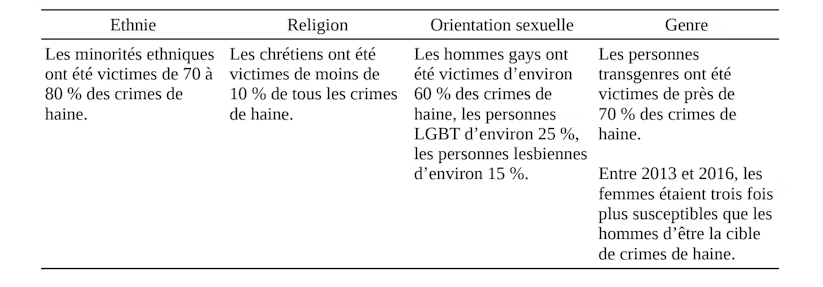
Hate crimes are violent acts committed against individuals because of their (actual or perceived) membership in a particular social group. If the intensity of prejudice is equivalent on both the left and right of the political spectrum, hate crimes committed against ethnic, religious, and sexual minorities (who are disproportionately targeted by people on the right) should be just as common as hate crimes committed against privileged groups (which people on the left are supposed to disproportionately target). Vivienne Badaan and John T. Jost analyzed statistics on hate crimes committed in the United States from 1996 to 2018:
However, the data show that hate crimes against minorities are much more common than hate crimes against privileged groups. If we assume that hate crimes are the direct consequence of extreme prejudice, it appears that people on the right are much more prone to extreme forms of prejudice (such assubhumanization, animalistic dehumanization, and blatant dehumanization ) than people on the left.
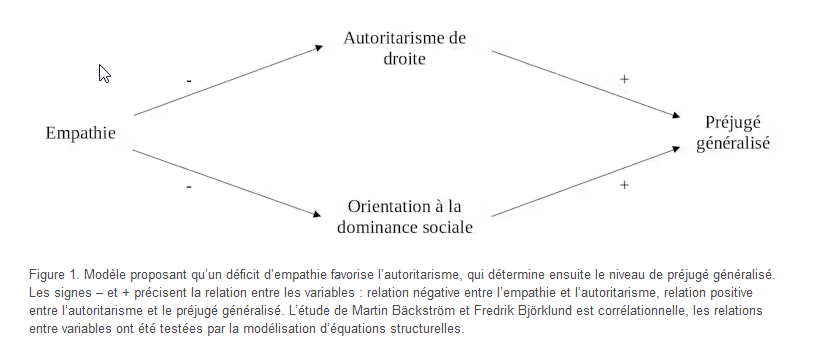
Martin Bäckström and Fredrik Björklund (social psychology researchers at Lund University) examined the relationship between empathy, right-wing authoritarianism, social dominance orientation, and generalized prejudice.
Empathy refers to the ability to feel and understand the emotions of others. This skill is central to caring for others, perspective-taking, moral emotions (such as compassion and guilt), helping behavior, altruism, and cooperation. Generalized prejudice refers to the tendency to hold a negative attitude toward people perceived as different from oneself (racism, sexism, homophobia, etc.).
Participants completed a questionnaire that included the Interpersonal Reactivity Index—a scale often used to assess people’s spontaneous tendency toward empathy—as well as the Right-Wing Authoritarianism Scale, the Social Dominance Orientation Scale, and several prejudice scales (e.g., racism, sexism, ableism).
The results show that the less empathy people have, the higher their level of authoritarianism, and the higher their level of generalized prejudice.
Consistent findings from neuroscience research show that neurophysiological responses to empathy are weaker in right-wing individuals than in left-wing individuals.
Other studies support the idea that empathy has a causal influence on authoritarian attitudes, conservatism, and intergroup prejudice. In particular, researchers have observed that brain lesions in areas important for empathy lead to an increase in the level of authoritarianism in individuals. Note, however, that this finding does not mean that authoritarianism is the result of brain damage: lesion studies help supplement the available data and clarify the causal relationships between variables.
Social psychology research on intergroup relations (prejudice, stereotypes, discrimination) began in the 1930s. Studies have often focused on Western countries; however, research shows that the phenomena discussed here (orientation toward social dominance, right-wing authoritarianism, conservatism, prejudice, and dehumanization) are universal.
Taken as a whole, the studies presented in this article show that there is no equivalence between “the extremes.” The more people exhibit a lack of empathy, high levels of authoritarianism, prejudice, dehumanization, and intergroup violence, the further to the right they fall on the political spectrum; the more people exhibit empathy, low levels of authoritarianism, prejudice, dehumanization, and intergroup violence, the further to the left they fall. “The extremes” are opposed in their conceptions of social justice, their concern for others, non-humans, andthe environment.
These characteristics are reflected in the overrepresentation of the far right in hate crimes and terrorism (from the “Years of Lead” to the present); and in the overrepresentation of the far left in initiatives to fight for social justice, to show solidarity with the most vulnerable (such as migrants), and to defend rights, freedoms, and the environment.
One criticism points to the atrocities committed in the20thcentury in the name of certain left-wing ideologies. However, research in social psychology suggests that this violence is perpetrated by “right-wing” individuals. For example, a series of studies conducted in the Soviet Union shows that the higher a person’s score on the right-wing authoritarianism scale, the more they support the Soviet regime, reject political dissidents, and exhibit intolerance (particularly sexism, racism, and anti-Semitism). The results also show that members of the Russian Communist Party score higher on the right-wing authoritarianism scale than members of other political organizations.
According to Bob Altemeyer (a social psychology researcher at the University of Manitoba), the alliance between leaders with a strong orientation toward social dominance and right-wing authoritarian subordinates represents a "deadly union" because it greatly increases the risk of political violence, with the former calling for violent action and the latter carrying it out. The rise of the RN directly confronts us with this threat, in addition to growing social inequalities and a worsening environmental crisis.
The research presented in this article was conducted by researchers in social psychology, as well as in political science, neuroscience, behavioral genetics, and primatology. They all share the conviction that political behavior cannot be explained by a single field of research.