


In recent years, political unrest in France has intensified, affecting all segments of the population. In 2018, a brief and violent grassroots movement emerged, with the yellow vest serving as its rallying symbol and featuring a unique demographic composition. The winter of 2023 saw one of the largest protest and strike movements in France’s recent history in response to a new pension system reform. In June of that same year, a series of urban riots broke out across the country following the death of Nahel Merzouk. Finally, in 2024, France witnessed the dissolution of the National Assembly and a vote of no confidence in the government, leading to three changes in government in that single year—an unprecedented occurrence under the Fifth Republic.
Distinguishing between the usual ups and downs of a country’s political life and the early warning signs of more profound institutional changes is crucial to determining the appropriate response. However, in a political world where the agenda is dominated by rapid electoral cycles and a media system focused on breaking news, public attention tends to fixate on isolated events. As a result, responses remain largely symptomatic—such as the withdrawal of reforms or changes in government—without addressing the underlying structural conditions that may be the cause.
The Structural-Demographic Theory
The structural-demographic theory proposed by Goldstone (1991) and later developed by Peter Turchin and his colleagues analyzes periods of major institutional change through three factors: the impoverishment of the populace, the polarization of elites, and the state’s fiscal distress. In particular, this theory enabled Peter Turchin, in a 2010 prospective study published in *Nature*, to predict a period prone to political instability in the United States around 2020.
This theory helps us understand periods of political instability as the result of tensions arising from the growing mismatch between existing institutions and long-term demographic and economic changes. These changes then lead to a growing inability to maintain a socioeconomic environment that enables individuals to pursue their aspirations.
At the heart of the mechanisms described by this theory lies the “wealth pump”:the concentration of economic and political power among a minority, whether through favorable land and tax systems or downward pressure on wages. This mechanism widens inequalities with the poorest members of society, but particularly affects lower-tier elites and those aspiring to join them, creating a growing divide within their ranks.
After a few decades, as the majority sees its living conditions deteriorate while a minority prospers, the social contract erodes. The concentration of power then closes the door to an ever-growing number of aspirants; competition among elites intensifies, their cohesion disappears, and factions emerge. These aspirants, deprived of the resources to fulfill their ambitions, begin to question their allegiance to the system, mobilize the impoverished masses, and transform themselves into counter-elites seeking to change the rules of the game.
In contemporary societies, the pressure placed on institutions by the overproduction of elites and the impoverishment of the population can, in theory, be mitigated through appropriate investments and reforms, provided that sound public finances allow for this.
Conversely, when the government is burdened by debt and perceived as illegitimate, its regulatory capacity erodes. At that point, the impoverishment of the people, factionalism among the elites, and fiscal strain create a context in which even relatively minor shocks can trigger disproportionate crises.
Signs of an institutional crisis in France?
In a recent study, we applied this theory to France’s recent history. According to the authors, France appears to be on a trajectory similar to that described for the United States. Although income inequality remains contained thanks to redistributive mechanisms, difficulties in accessing employment, homeownership, and public services have, on the other hand, increased significantly since 1980. At the same time, national statistics underestimate the impact of these challenges on specific populations: young people and those in the suburbs regarding access to employment; urban residents regarding homeownership (as shown in the graph below); and rural residents regarding access to public services.
Competition among elites—whether economic or political—has also intensified significantly over the same period. This is evidenced by the rise in wealth inequality within the top 1 percent, showing that the share held by the top 0.001 percent increased by 520 percent, in contrast to that held by the members at the bottom of this percentile (shown in green in Fig. 2), which increased by “only” 60 percent.
Politically speaking, the number of candidates running in legislative and presidential elections has doubled since 1980. The threshold for forming a parliamentary caucus was lowered from 30 to 15 between 1958 and 2023, under pressure from members of Congress to form new caucuses, reflecting a growing division among the elites in Congress.
At the same time, public finances are under pressure on a historic scale. Debt has reached a high level (110% of GDP in 2023), driven by the combined effects of an aging population and the gradual obsolescence of the tax system, against a backdrop of legislative gridlock linked to the growing fragmentation of the elites.
Compounding these budgetary pressures is a marked erosion of trust in institutions, as evidenced by the rise in voter abstention rates. The result is a form of institutional rigidity, at a time when the ability to adapt seems more necessary than ever.
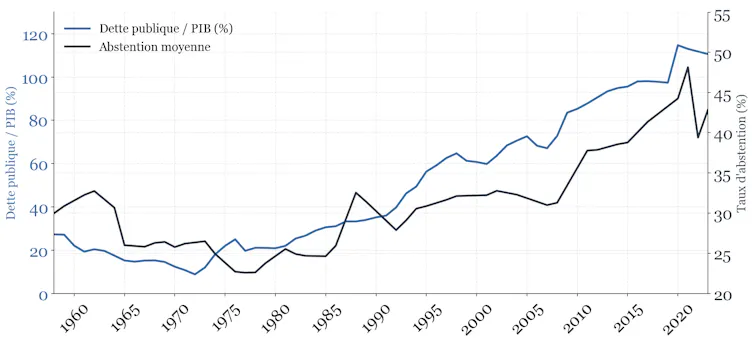
For France today, the indicators of structural-demographic theory all point to a crisis: the relative impoverishment of the working and middle classes, the gradual closure of pathways to homeownership and public services, intensified competition within the elite, legislative paralysis, and historic distrust of institutions.
What is unique about structural-demographic crises is that they paralyze the very conditions necessary for their resolution.
Any ambitious reform capable of addressing the root causes—redistribution of wealth, fiscal consolidation—requires precisely the political cohesion whose breakdown lies at the heart of the crisis. This is a fundamental tension in such moments: the urgency to act and the growing inability to do so reinforce each other.
What are the possible outcomes?
History, however, offers a range of possible outcomes. The American New Deal of the 1930s shows that such moments of crisis can lead to profound and lasting institutional changes when sufficiently broad coalitions manage to assert themselves. Conversely, the absence of such coalitions has led other societies toward violent upheavals, as in France in 1789.
The paths a society takes during a crisis are not dictated solely by the severity of the crisis. These are also moments when the ability of key players to seize opportunities to forge a new social contract is particularly important. The structural roots of this crisis urge us to look beyond the short term—the cycle of elections and media attention—and take the long term seriously. Not to succumb to fatalism, but to understand that windows of opportunity for structural reforms are rare, and that societies that have seized them have fared better than those that have merely endured them.
This article was written as part of the symposium“Thinking About the World to Come,” organized on June 11, 2026, by the “Foresight, Imagination, and Public Policy” Chair at CY Cergy Paris Université, the Learning Planet Institute, and the association Le 106, in partnership with The Conversation France.