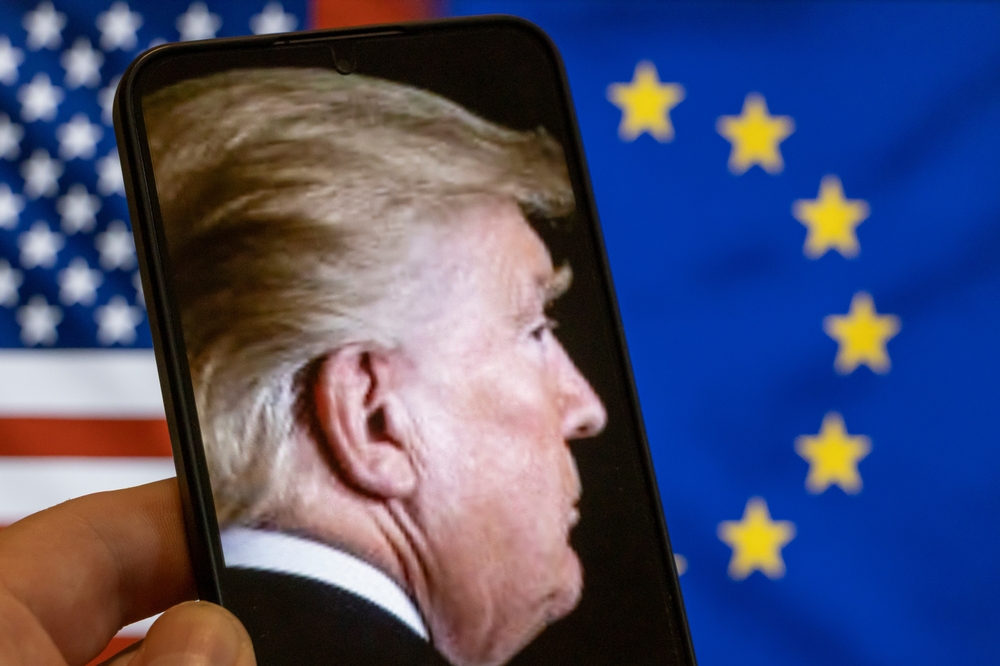
Beyond his erratic stances, the U.S. president continues to throw the European Union (EU) off balance. Donald Trump’s repeated attacks are all the more destabilizing because they target the United States’ historic allies.
His renewed threats, the 1st
er April 2026: The decision to leave NATO in response to the Europeans’ refusal to provide military assistance to its armed forces in order to reopen the Strait of Hormuz is yet another manifestation of a toxic disregard for the balance of power.
This Darwinian policy, rooted in contempt and humiliation, has set out to map the international scene in terms of “state species.” On one side are predatory powers, each destined to reproduce. On the other, subjugated prey, all doomed to disappear. This is how, astonishingly, the president was able to threaten, on April 6, to “wipe out Iranian civilization.”
The EU's Strengths and Weaknesses
On this scale of values, the EU clearly has no role to play as a dominant force. As the war in Ukraine drags on and conflicts continue to erupt around the globe, statements from the U.S. administration continue to undermine Europe’s standing. If the Union intends to avert this grim fate, it must urgently address the obstacles that are hindering its full maturation.
It is true that the growing number of member states makes it difficult to speak with one voice on matters of sovereign authority, especially in times of crisis. But the mechanism of qualified majority voting could be applied more widely, as could the use of enhanced cooperation. For several years now, Berlin and Paris have been proposing the formation of various “pioneer” groups capable of drawing other partners along in their wake.
The coalition of volunteers to secure Ukraine and the “E6” group—which brings together the six largest economies in the EU—Germany, France, Italy, the Netherlands, Poland, and Spain —to strengthen the EU’s economic levers, demonstrate this commitment to endowing the EU with strategic sovereignty. Three recent developments suggest that a number of countries are becoming increasingly aware of the need to work toward establishing an EU projection force on the international stage.
Defense of Greenland, expansion of France's nuclear umbrella, and involvement in the Middle East
First, the Greenland incident —which pitted Denmark directly against Donald Trump—mobilized the EU to a large extent. On the political front, Brussels authorities were able to present a united front to assert, loud and clear, Danish sovereignty over the autonomous Arctic territory. And on the military front, the deployment of European contingents—organized by Copenhagen with the firm support of Paris—has revived the idea of a European pillar within NATO.
While Operation “Arctic Endurance” remains modest in logistical terms, it underscores, above all, the desire to resist American aggression. Despite this, the ongoing discussions between the United States and Denmark regarding the expansion of the U.S. military presence in Greenland to four bases (up from the current single base, the Pituffik Space Station)—which would allow President Trump to claim an honorable exit from the Greenland crisis—could, on the contrary, reinforce Europe’s dependence.
Especially since the Trump administration regularly displays signs of authoritarianism. Washington’s policies are, in fact, susceptible to the theories of German jurist Carl Schmitt, who, in the 1930s, developed the concept of authoritarian liberalism. Thus, in both the rhetoric and actions of U.S. officials, we find the principles of a “strong state for a healthy economy,” an overt dichotomy between “friend and foe,” and references to territorial gains as messianic acts. Furthermore, billionaire Peter Thiel, a steadfast supporter of Trump, has no qualms about invoking his interpretations of the Bible to speak of “holy wars” during his lectures in Europe. As for Pete Hegseth, whose official title of “Secretary of State for Defense” was recently changed to “Secretary of War,” he fully embraces the term “crusade.” Sporting a tattoo of the Jerusalem Cross and claiming God’s support for his cause, he explains in no uncertain terms that the United States possesses the “arsenal of faith”—in other words, a mandate to use force.
Second, Emmanuel Macron’s widely noted speech on extending France’s nuclear umbrella to EU member states is a step toward greater European autonomy. While breaking away from his predecessors’ doctrine of the “strict sufficiency” of France’s arsenal, President Macron is promoting the idea of expanding capabilities to lend credibility to this “advanced deterrence.” France is thus taking the initiative to envision a pan-European defense strategy at the continental level, building on its own national strengths.
And third, in the context of the Iranian conflict, Paris is once again assuming the role of a strategic vanguard with the deployment in the Mediterranean of a naval force that no other EU country is able to field. In response to the growing political decoupling between the United States and the EU, France’s reaction to U.S. intervention is grounded in international law. While seeking to help maintain regional balance, France aims to reaffirm Europe’s core identity: respect for normative values. And the EU is now offering a relatively coherent response to the Iranian conflict, based on diplomatic de-escalation.
The rejection of offensive military engagement and the defense of European economic and security interests
But this French activism must contend with a number of obstacles stemming primarily from Germany. In addition to the dramatic rift between Paris and Berlin over the agreement with Mercosur, disagreements are mounting on strategic issues such as energy (Paris, unlike its partner, believes that electricity production requires a nuclear power fleet to ensure geopolitical independence) and the EU’s defense industry (Berlin is distancing itself from many programs launched jointly with Paris, such as the next-generation fighter jet and tank).
Finally, diplomacy brings its share of complications to the Middle East. While Germany has declined to recognize Palestine and has softened its stance toward Israel—yesterday in Gaza and today in Lebanon—France, for its part, has adopted a highly critical stance toward the Israeli government.
The EU’s overhaul is therefore by no means a done deal. Nevertheless, it remains vital. For a break with the world of yesterday—based on a system of international rules that the United States flouts after having once been their guarantor—is imperative for everyone. Put simply, the European model is no longer suited to today’s challenges. In this great game of shifting alliances, the EU can draw inspiration from the positions of another North American partner that is urging it to rethink itself. Also under pressure from Washington, Canada is proposing a middle path inspired by de Gaulle. At the last Davos Forum, Prime Minister Mark Carney positioned himself as a champion of the middle powers—all those that Donald Trump’s Darwinism would gladly see disappear.
This alternative path—which requires a political vision—could have been championed by a European leader. But we must start at the beginning: building leadership. And the prospect of the 2027 French presidential election makes the project even more uncertain. Without a helmsman at the helm, charting a course seems illusory—especially in the midst of turmoil.
This article is republished from The Conversation under a Creative Commons license. Readthe original article.