

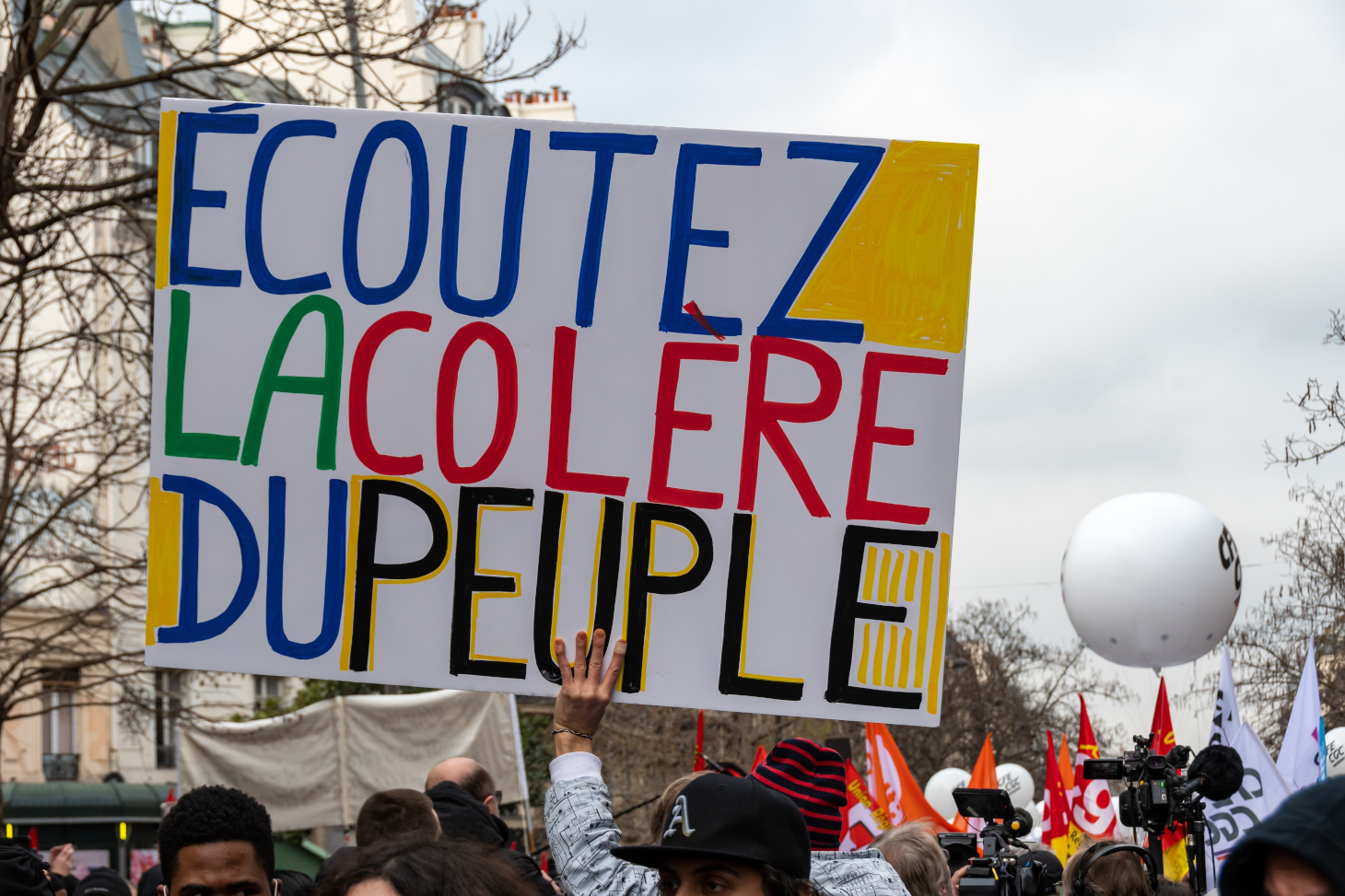
Do the spontaneity and intensity with which opponents of pension reform express their dissatisfaction influence the structure of their arguments?
The terms used to describe the phenomenon speak for themselves: revolt, denial of democracy, shame, scandal, humiliation, betrayal…
In all the testimonials, perceptions of the issues at stake seem to be tied to personal feelings, as if the context of the reform were giving people the freedom to speak openly about long-buried emotions.
The comments often highlight personal suffering. Situations of distress—which until now seemed contained or unspeakable—are brought to the fore to comment on the effects of the reform. It’s almost like a revelation: anger over the reform puts new words to vulnerabilities and feelings of powerlessness.
Do these emotions influence the formation and expression of political opinions? This question has not always been taken seriously in the social sciences, but it has sparked a multidisciplinary revival over the past two decades. In France, for example, philosophers and historians suggest that an “emotional turn” is taking place, one linked to globalization, the rise of individualism, the growth of social media, and the ecological crisis.
They draw on concepts such as hatred, fear, doubt, faith, and desire to offer a new interpretation of social life centered on these sensitive dimensions. But in the field of political science and among sociologists, the issue is still primarily addressed from the perspective of expressed and apparent emotions that reflect or accentuate power relations.
Some studies, for example, focus on the passions that characterize street protests. Others analyze how compassion and empathy are invoked in court cases or to resolve conflicts. Still others show how the authenticity of tears shown on live television can support a political leader’s strategy.
Whether they are individual or part of a collective framework, whether they express acts of resistance or conquest, these emotional mechanisms characterize what Machiavelli called the “comedy of power ” and what Guy Debord later termed the “society of the spectacle.” To echo Norbert Elias’s central thesis, these visible emotions legitimize court society without ever truly challenging the established order or the prevailing codes of power.
[Nearly 80,000 readers rely on The Conversation’s newsletter to better understand the world’s major issues. Subscribe today]
With the pension reform, outbursts of anger have a particular emotional impact in that their visceral nature goes beyond the traditional drivers of symbolic violence theorized by Pierre Bourdieu.
While these existential questions had previously been expressed mainly in the private sphere of confidences or confessions, the latter gives way under the weight of the emotional burden.
From a psychoanalytic perspective, one could say that public statements about the reform resemble an act of acting out. By publicly addressing traumas that had previously been repressed, individuals demonstrate resilience.
And this process of self-reflection reveals deep-seated—and at times narcissistic—flaws in their relationship with institutions and authority. These resentments run deep.
The current movement is thus reminiscent of the findings of anthropologist Pierre Clastres, who studied how members of so-called “pre-state” Amazonian tribes conceived of living together by explicitly rejecting any form of organized coercion and authoritarian leadership. A parallel can be drawn with the opponents of the reform, who reject it primarily on the grounds that their dignity and freedom are under threat.
The deep-seated wounds that emerge most prominently in the testimonies relate to the acute sense—especially among the most vulnerable populations—of being disavowed: with the reform, their dignity is trampled upon and their pride is wounded.
Retirement directly addresses issues of social utility, individual destiny, and our relationship with death. Calculations regarding the legal retirement age and pension benefits act as a magnifying mirror that challenges each of us to recognize the place we occupy in society. The reform highlights wage inequalities; it underscores health challenges, the ability to adapt to the labor market, the role of family during difficult times, chaotic career paths, and the loss of self-esteem during periods of crisis…
The government has certainly based its reasoning on budgetary formulas designed to save the pay-as-you-go pension system. But the method has a fundamental flaw that is often seen as intolerable: the contribution period stems from an accounting equation in which individuals are treated as mere pawns on a vast chessboard. Their contribution is assessed solely based on criteria that are quantified, planned, and indexed in a one-size-fits-all manner, without paying any attention to the uncertainties and setbacks inherent in each person’s life journey.
It is at this point that injuries take on a political dimension. The lack of recognition—coming from the political sphere— is perceived as a sign of arrogance, contempt, and sometimes even haughtiness.
Emmanuel Macron has become the champion of top-down governance and streamlined parliamentarianism; through Article 49.3, he embodies an authoritarian and overbearing conception of power. He unwittingly fuels the outbursts of hatred toward politics because, for the time being, he has failed in his attempt to simultaneously embody the two bodies of the King.
It is in the face of this misunderstanding and this dilemma that emotions may be clouding the traditional paths to the politicization of public opinion. Outrages are not limited to cries and tears.
As they face one challenge after another, these experiences may shape their understanding of citizenship. From one protest to the next, the deep wounds within each person’s life story become the compass guiding their reasoning. Their voices give voice to suffering and vulnerability. And every feeling gains legitimacy… Much like with the “Yellow Vests” movement at the roundabouts, the cries from the heart become rallying cries, and resistance to change becomes a political argument.
Alongside these personal reactions of dignity and pride, the reform also provokes a less wholesome emotional mix rooted in violence and intolerance. The violence stems from the feeling that fundamental freedoms are seriously threatened by the reform. Intolerance spreads based on the idea that, within this reform, there is an overwhelming majority of helpless victims and a few manipulative culprits. Coming right after the traumatic experience of the health-related lockdown, this is a particularly anxiety-inducing time. The debate over the retirement age acts as a catalyst: the dark emotions of disgust and withdrawal suddenly find fertile ground for all forms of expression and propagation, as evidenced by certain hate speech that sometimes reaches alarming proportions. Violence and withdrawal also reflect a form of exhaustion or an inability to engage in dialogue with others.
This breakdown in a sense of otherness could benefit—as a study by the Jean-Jaurès Foundation points out—the National Rally party, which is so adept at channeling frustrations and fears.
And calls for a referendum—whether from the right or the left—foster the dangerous illusion of a sovereign and salvific vox populi.
By combining dignity and fury, pride and withdrawal, the days of national mobilization bring together a range of emotions. They lend credibility, visibility, and thus legitimacy to a form of citizenship centered on the self that is, to say the least, ambiguous from a democratic standpoint.
How can we engage in politics and shape public policy in the face of this emotional confusion, which social media constantly amplifies? The question remains unanswered, especially when traditional mediators, too, seem to be succumbing to the blindness caused by their own emotional wounds.