

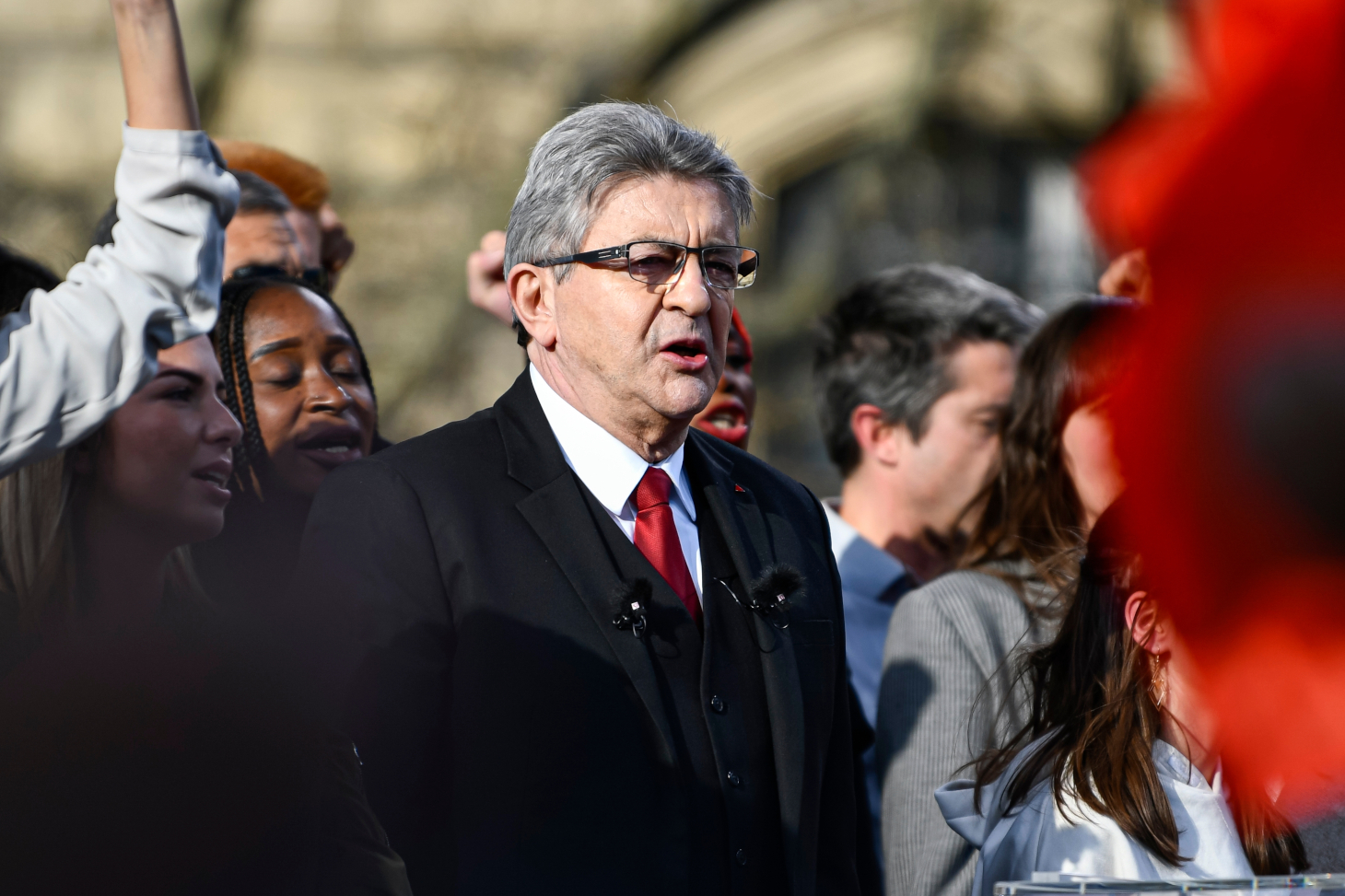
The term “fâchés pas fachos,” meanwhile, appears to have emerged in the context of the 2012 French legislative elections. It was used by Jean-Luc Mélenchon, then a candidate for a seat in the Pas-de-Calais and later founder of the party La France Insoumise, to describe disaffected voters who were sometimes tempted to vote for the far right—particularly those disappointed by the “Hollande-aligned” left and those who abstained from voting—but who did not, for that reason, identify with the ideas of the National Front.
I want to address those who are angry but not far-right. After all, what good would it do to put Marine Le Pen in power? Her proposals are nothing but class contempt. She doesn't want to raise the minimum wage or cap prices. #MelenchonHolograms pic.twitter.com/Z64wbVPOoi
— Jean-Luc Mélenchon (@JLMelenchon) April 5, 2022
Reused in 2017, this expression would be used again during the “Yellow Vests” movement, even as the movement’s composition was still uncertain.
While the term “fâchés” requires little explanation, the term “facho” does, given how frequently it is used and the connotations it carries in public debate. As an ideology and political system inextricably linked to Benito Mussolini, fascism emerged in the late 1910s. Fascism is characterized by political powers that impose, in particular, nationalism, totalitarianism, and authoritarianism. However, the use of this term is not always closely aligned with its scholarly definition, as historian Olivier Forlinpoints out: “The label ‘fascist,’ when applied to an idea, a discourse, or a political action, has often served to cast their authors as adversaries and to demonize them. Conversely, it has also served to rally a previously scattered camp in preparation for political struggle. Antifascism has served as an ideological glue to unite political forces, particularly in France and Italy […].”
According to historian Nicolas Lebourg, fascism is one strand within the sub-fields of the far right, but the two terms are often used interchangeably in public discourse.
[More than 85,000 readers rely on The Conversation’s newsletters to better understand the world’s major issues. Subscribe today]
Highlighting this metonymy provides a better understanding of the expression in question. Indeed, in France, the far right is notoriously represented by the National Rally (RN) and Reconquête. Although the former publicly denies it, it is even recognized as such by the Council of State. There is no doubt that, for Jean-Luc Mélenchon, the “fascists” referred to in the expression are found among the potential voters for this party. His aim, therefore, is to attract angry people to his side, but not those on the far right, who are incompatible with his own ideology.
This expression does not, of course, mean that there are the “angry ones” on one side and the “fascists” on the other. In reality, on one side are the angry people who have ties (political, ideological, activist, etc.) to the far right, and on the other are people who are simply dissatisfied but have no connection to that political movement.
We can extend this parallel by referring to two emotions that, in broad terms, can help characterize these two groups: anger for the “angry-but-not-fascists” and fear accompanied by anger for the “angry-fascists.”
Anger may be a negative emotion, but it also serves as a powerful driving force—for example, when we experience what we consider to be injustices. In 2023, the pension reform sparked massive protests, to the point of breaking records for the number of participants. These demonstrations were fueled by anger toward a policy that was deemed, among other things, unfair.
The differences between the two groups are evident in their varying levels of support for the pension protests (strategy in Parliament, street demonstrations, opinion polls, etc.). While the left called for street protests, the National Rally (RN) limited itself to low-key participation in the National Assembly, as researcher Sylvain Crépon points out. It is clear that by the end of this movement, support was stronger among voters of Jean-Luc Mélenchon than among those of Marine Le Pen. Conversely, hostility toward the movement was far greater among Le Pen’s supporters. While the anger of the “angry non-fascists” largely defines them, that of the “angry fascists” is a driving force that coexists with another highly intense emotion on the far right: fear.
While the anger of the “angry far-right” is undeniable, it is often accompanied by a certain fear—or even more than that. Thus, far-right individuals are both afraid—for example, of individual or collective extinction , as illustrated by the “Great Replacement” conspiracy theory —and angry at what they perceive as government inaction, particularly regarding immigration, which is sometimes even seen as an incitement.
The far right—whether that of Marine Le Pen or Éric Zemmour—is the part of the political spectrum that is most anxious about the future and most preoccupied with the idea of decline.
People with a right-wing authoritarian personality—which is very common among the far right—also have a strong need to conform to social norms. This leads them to feel fear or hatred toward anything that does not fit within these norms, and thus to exhibit high levels of racism, sexism, homophobia, and so on.
All of these factors show that, beyond anger, fear is very much present among far-right individuals. It is no coincidence that this political movement is associated with numerous terms ending in “-phobia” (xenophobia, homophobia, Islamophobia, etc.).
Ultimately, is appealing to the “angry but not far-right” still relevant today? It’s quite possible that it is. This appeal makes sense because the “angry but not far-right” and the “angry and far-right” do not seem to fall on the same spectrum, as evidenced by the low overlap between the electorates of Jean-Luc Mélenchon and Marine Le Pen between 2017 and 2022.
Even though the far right attracts disaffected citizens, these citizens also have another political refuge: abstention.
The change in vote shares between 2017 and 2022—+2.4% for Jean-Luc Mélenchon and +1.9% for Marine Le Pen, respectively—suggests that Mélenchon’s appeal to the “disgruntled” has at least partially resonated. What does the future hold? The latest Harris Interactive poll A simulation of the 2027 presidential election places Marine Le Pen in the lead in all scenarios, with Jean-Luc Mélenchon advancing to the second round in seven of the eight scenarios. If this showdown were to take place, there is no doubt that the former representative from Bouches-du-Rhône would rally the “angry but not far-right” electorate to offer a new political outlet to the growing number of abstainers. This strategy may not have run its course yet.