

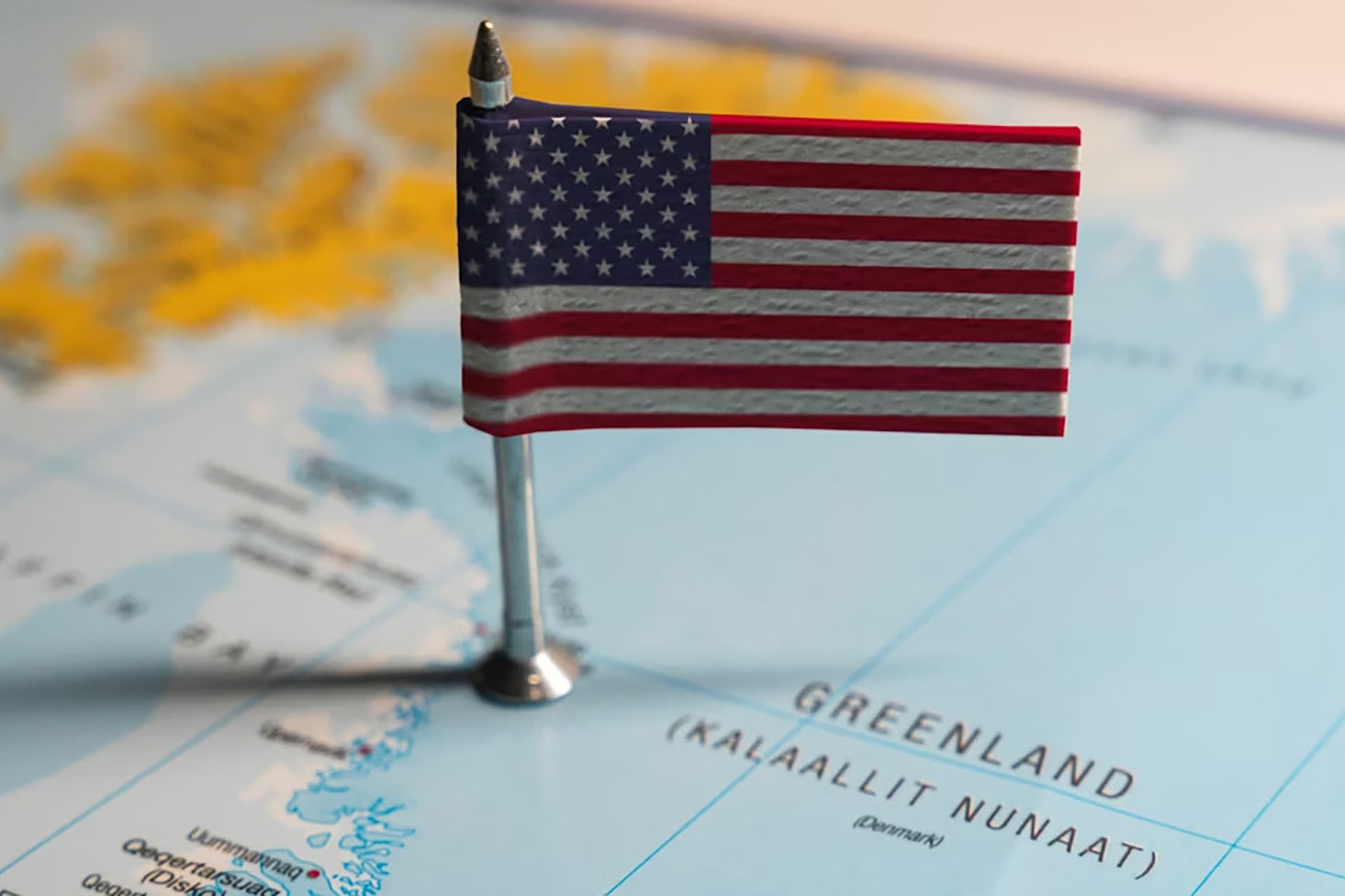
While the attack on Venezuela has just confirmed the United States’ determination to use force to control the entire American continent, in defiance of international law, the future of Greenland—which is also in Washington’s crosshairs—requires increased attention from Europe.
“The attack on Venezuela is a frightening example of a scenario where power politics takes precedence. We do not yet know what is happening or where we are headed. But we will all have to reflect on our worldview and take a stand.” This message posted on LinkedIn (in Danish) by Greenland’s Minister of Economy, Trade, Minerals, and Justice, Najaa Nathanielsen, clearly reflects the concern prevailing in Nuuk, which has intensified further since the events of January 3, 2026, in Caracas. For her part, Danish Prime Minister Mette Frederiksen expressed alarm: “If the United States chooses to launch a military attack on another NATO country, then that’s the end of everything.”
U.S. threats against Greenland—which began as soon as Donald Trump returned to power a year ago—have significantly intensified in recent weeks, particularly with the appointment on December 22, 2025, of Louisiana Governor Jeff Landry as “special envoy for Greenland.” Landry openly describes his mission as annexing Greenland to the United States (“make Greenland a part of the U.S.”).
The appointment is, unsurprisingly, a testament to the U.S. president’s tenacity regarding his plan to annex the Danish territory. The emphasis placed by Donald Trump and Jeff Landry on the history of Louisiana— sold by France to the United States in 1803, when it accounted for more than 22 percent of the country’s total land area—reflects—again, unsurprisingly—the transactional logic of the policy promoted by the Trump administration, a market-driven logic that unabashedly encroaches on the realm of international security.
But is Greenland really, for the United States, a matter of “national and international security” that would justify its annexation? And if not, what are Washington’s real ambitions?
Create a division between Greenland and Denmark
No stranger to false allegations, Donald Trump is once again challenging Danish sovereignty over Greenland: “[Three hundred years ago], we were there too, with ships—I’m sure of it.” Yet there is no doubt whatsoever about Danish sovereignty over Greenland. It was ruled upon by the Permanent Court of International Justice in 1931 and officially recognized by the United States in 1951. No change to the island’s status can take place without Denmark’s consent, in accordance with the 2009 agreement between Denmark and Greenland on Greenlandic self-government.
When, on January 7, 2025, Mette Frederiksen responded to the U.S. proposal to purchase Greenland by stating that the island’s future belongs to the Greenlanders, her response was considerate toward Greenland but incomplete. Greenland is still part of Denmark, and a vote by the Danish Parliament, the Folketing, is required for any move toward independence. Donald Trump is deliberately playing on the colonial history between Denmark and Greenland to sideline a key player in the situation—one that is, moreover, a member state of the European Union.
Similarly, it is false to claim that the Danish government has not spent any money on Greenland’s defense, as Trump asserts. Admittedly, until recently, Denmark’s involvement was modest (the presence of the Joint Arctic Command in Nuuk, patrol boats and frigates, and the dog-sled patrol Sirius covering Greenland’s northern coast). “We can do more within the existing framework,” Danish Foreign Minister Lars Løkke Rasmussen stated in 2025. Denmark approved two defense programs in 2025 totaling nearly 6 billion euros, and Copenhagen also approved an order for 16 U.S. F-35 fighter jets: Denmark’s goodwill is clearly not enough to quell Washington’s expansionist ambitions.
The narrative war waged by the United States in support of the plan to annex Greenland is no trivial matter. It seeks to plant doubt in people’s minds about the legitimacy of Denmark’s sovereignty and, by playing on its colonial past, to drive a wedge between Greenland and Denmark. Another aspect of Washington’s rhetoric is the exaggeration of the Russian and Chinese military threat to Greenland.
Exaggerated Risks Used to Justify the Annexation of Greenland
On the issue of security, Donald Trump has repeatedly mentioned the presence of Russian and Chinese military ships around Greenland. This is false: the ships in question were spotted off the coast of Alaska.
The Russian Navy’s projection of power in the GIUK chokepoint (the maritime area between Greenland, Iceland, and the United Kingdom) is problematic and is a key driver behind NATO’s Northern Viking operations. It is also a source of concern in Greenland with regard to critical infrastructure (particularly undersea telecommunications cables). Security risks are therefore not negligible, especially as China is strengthening its military power worldwide and, in particular, its aircraft carrier capabilities.
However, while it is important to exercise control over Greenland’s territory, there is no immediate significant military threat to Greenland that would justify its annexation by the United States. Donald Trump is deliberately exaggerating the threat in order to legitimize the annexation of Greenland, a move opposed by both Greenland and Denmark.
Beyond the rhetoric and false allegations, repeated ad nauseam, Washington’s threats must be taken seriously, as they are accompanied by concrete and more discreet measures.
In their 2025 annual report, Danish intelligence agencies raised concerns about the United States for the first time. Denmark, historically one of the most pro-Atlanticist countries in Europe, is distancing itself from Washington.
Expansionism in the Service of Well-Considered Interests
In reality, the Trump administration is less concerned with security issues (even though that is its official justification) than with an expansionist agenda that revives the Monroe Doctrine, which asserts exclusive U.S. control over the “Western Hemisphere.” The new U.S. National Security Strategy clearly revives this doctrine (“We will apply a ‘Trump corollary’ to the Monroe Doctrine,” it states).
This opportunistic expansionism in the run-up to the midterm elections promises to make a big splash. Annexing Greenland is undoubtedly more flattering to the White House occupant’s ambitions than strengthening defense partnerships for unproven needs, especially since he has clearly stated that Europeans should, in the future, ensure their own security.
However, while the 2025 National Security Strategy may very well be “the longest suicide note in U.S. history, ” to quote historian Anne Applebaum, it nonetheless poses an immediate danger to Europe, where, in a surreal reversal, democracy and supranationalism are not only described by the Trump administration as threats, but even more so as dangers more serious than the authoritarian regimes of Russia or China.
Contrary to Trump’s claims —that the United States is not interested in the island’s mineral wealth (“We have so many sites for minerals, oil, and everything else”)—U.S. investment in Greenland is on the rise. Ronald Lauder, the billionaire heir to Estée Lauder who is said to have been the first to suggest to Donald Trump the idea of “buying” Greenland, has acquired stakes in Greenlandic companies and expressed interest in building a hydroelectric power plant on Greenland’s largest lake, Tasersiaq, to supply power to an aluminum smelter.
Officials in the Trump administration are reportedly in talks to have the U.S. government acquire a stake in the private American company Critical Metals Corp, which owns Tanbreez, one of the largest rare earth mining projects in Greenland. This move would give the United States direct access to rare earth mining in Greenland, at a time when China holds a near-monopoly on the extraction and refining of these minerals worldwide.
Finally, economic retaliatory measures targeting Danish industries have already been implemented: contracts for five offshore wind projects on the U.S. East Coast have been suspended, two of which are being developed by the Danish company Ørsted.
A response from Greenland, Denmark, and the European Union
It is therefore urgent to adopt measures at the Greenlandic, Danish, and European levels. On October 8, 2025, in Strasbourg, Greenland’s Prime Minister Jens-Frederik Nielsen clearly expressed his openness to deeper cooperation with the EU before the European Parliament: “We need cooperation and partnerships with countries and institutions that share our values.”
On January 6, 2026, in a post on his Facebook account, he thanked several European countries for their support in the face of threats from Washington: the leaders of France, Germany, Italy, Poland, Spain, as well as the United Kingdom, stated that “it is up to Denmark and Greenland, and them alone, to decide on matters concerning Denmark and Greenland,” and that “security in the Arctic must therefore be ensured collectively, in cooperation with NATO allies, including the United States.”
Three points therefore stand out. First, from a narrative perspective, Denmark’s assertion of sovereignty over Greenland does not come at the expense of the Greenlandic people’s self-determination, but for the time being protects Greenland from a U.S. takeover of a territory that, under Danish law and in accordance with international law, has the capacity to decide its own future under the terms of the 2009 self-government agreement.
Second, from an economic standpoint, excessive interdependence with the United States could lead to political vulnerability and jeopardize democracy in Greenland. The Greenlanders have already adopted clear protective measures: notably, in February 2025, the Parliament (Inatsisartut) passed an emergency law on political party financing that prohibits foreign or anonymous donations to parties and candidates and caps private contributions at the local level. Parliament is currently reviewing a bill on the screening of foreign direct investment aimed at enabling authorities to review, approve, impose conditions on, or block foreign investments that could pose a threat to national security or public order. The EU adopted a similar instrument in 2019.
Third, with regard to security, it is essential to develop a framework for European cooperation that benefits Greenland and is in agreement with Denmark—cooperation that could initially take the form of a regular strategic dialogue on security and resilience in the Arctic among the EU, Greenland, and Denmark—without waiting for the results of the U.S. midterm elections.
This strategic dialogue could have begun as early as the start of 2025. But Washington’s threats were not taken seriously, and a considerable delay ensued. It is unclear whether the proposal by European countries for a response within the framework of NATO ...is sufficient to convince the United States to refrain from using force to annex Greenland. It is therefore urgent to recognize that the EU must have the courage to rethink its relationship with the United States, and to see itself and assert itself unequivocally as a power.