

Over the past two years, the EU has launched a number of initiatives to jointly produce ammunition (the ASAP instrument, adopted in July 2023) and to strengthen the European defense industry (the EDIRPA plan announced in September 2023), without having resolved the issue of its relationship with NATO and the United States. Yet the war in Ukraine underscores Europe’s dependence on Washington—strategically, logistically, and in terms of capabilities.
In this context, how is the war in Ukraine affecting Franco-German military cooperation at the political-strategic level?
It is a truism to say that French and German strategic cultures are different. The military and defense policy—shaped by the history of each country and the functioning of their respective domestic political systems—do not occupy the same place and do not perform exactly the same functions—aside from the fundamental function of defending the territory and the population, which is common to all militaries.
[More than 85,000 readers rely on The Conversation’s newsletters to better understand the world’s major issues. Subscribe today]
The French Expeditionary Force, heir to a long historical tradition, bears little resemblance to the Bundeswehr, which was established in 1955 as part of the North Atlantic Treaty Organization to counter the Soviet conventional threat during the Cold War.
Nevertheless, while the final years of the Merkel era did not erase the strategic differences between Paris and Berlin, they appeared to converge toward the idea of a more substantial European defense alongside NATO, invoking—albeit with differing implications—the notion of European strategic autonomy on the French side and European sovereignty on the German side.
But despite the Munich Consensus, which as early as 2014 affirmed Berlin’s view that Europe’s leading economic power needed to assume greater responsibility in the areas of international security and defense, France continued to view Germany as a cautious partner on these issues. Academic literature and many experts have long regarded Germany as a “reluctant power.”
Russia’s military invasion of Ukraine on February 24, 2022, seemed to mark a turning point: three days later, the German chancellor announced a new era (Zeitenwende). Germany was coming to realize that conventional war in Europe was possible, and that it had neglected its defense budgets and capabilities for too long, despite recurring criticism from successive parliamentary commissioners for the armed forces, whose annual reports highlighted the critical state of the Bundeswehr.
At the time, France saw this as an opportunity to finally work more effectively with Germany on defense matters, and even to promote the European defense policy, notably by adopting—in March 2022—a European Strategic Compass, the development of which had been launched under the German presidency of the Council of the EU in 2020.
But very quickly, strategic differences between France and Germany resurfaced: while Paris saw the war in Ukraine as confirmation of the need to finally give the EU a substantial defense capability based on its own forces, Germany—like a majority of other European countries—came to believe, on the contrary, that NATO needed to be strengthened.
This divergence in analysis is reflected, in particular, in the German chancellor’s launch ofthe European Sky Shield Initiative—without any real consultation with Paris and to the detriment of European sovereignty in this area—by rejecting the defense system proposed by France and Italy (SAMP/T) in favor of an Israeli system supported by Washington (Arrow 3).
Added to this is the off-the-shelf purchase of U.S. military equipment (notably F-35 fighter jets), clearly demonstrating Germany’s unwavering commitment to the transatlantic pillar of European security, and Berlin’s mistrust—shared loudly and clearly by many European countries, foremost among them Poland and the Baltic states—toward France’s aspirations for an autonomous European defense.
However, France has also recognized the importance of strengthening a European pillar within NATO in order to improve dialogue with its European partners. But hopes for major change in German defense policy were quickly dampened by the chancellor’s procrastination regarding the delivery of battle tanks to Ukraine in January 2023, demonstrating Germany’s ambiguity on military issues despite the 100-billion-special fund allocated to re-equip the Bundeswehr, and a German public whose views on military matters are in a state of transition.
While Europe’s “Franco-German engine” seemed to be struggling on a regular basis before 2022 (despite the signing in 2019 of the Aachen Treaty, whose implementation was disrupted by the COVID-19 pandemic), it now appears to have ground to a halt.
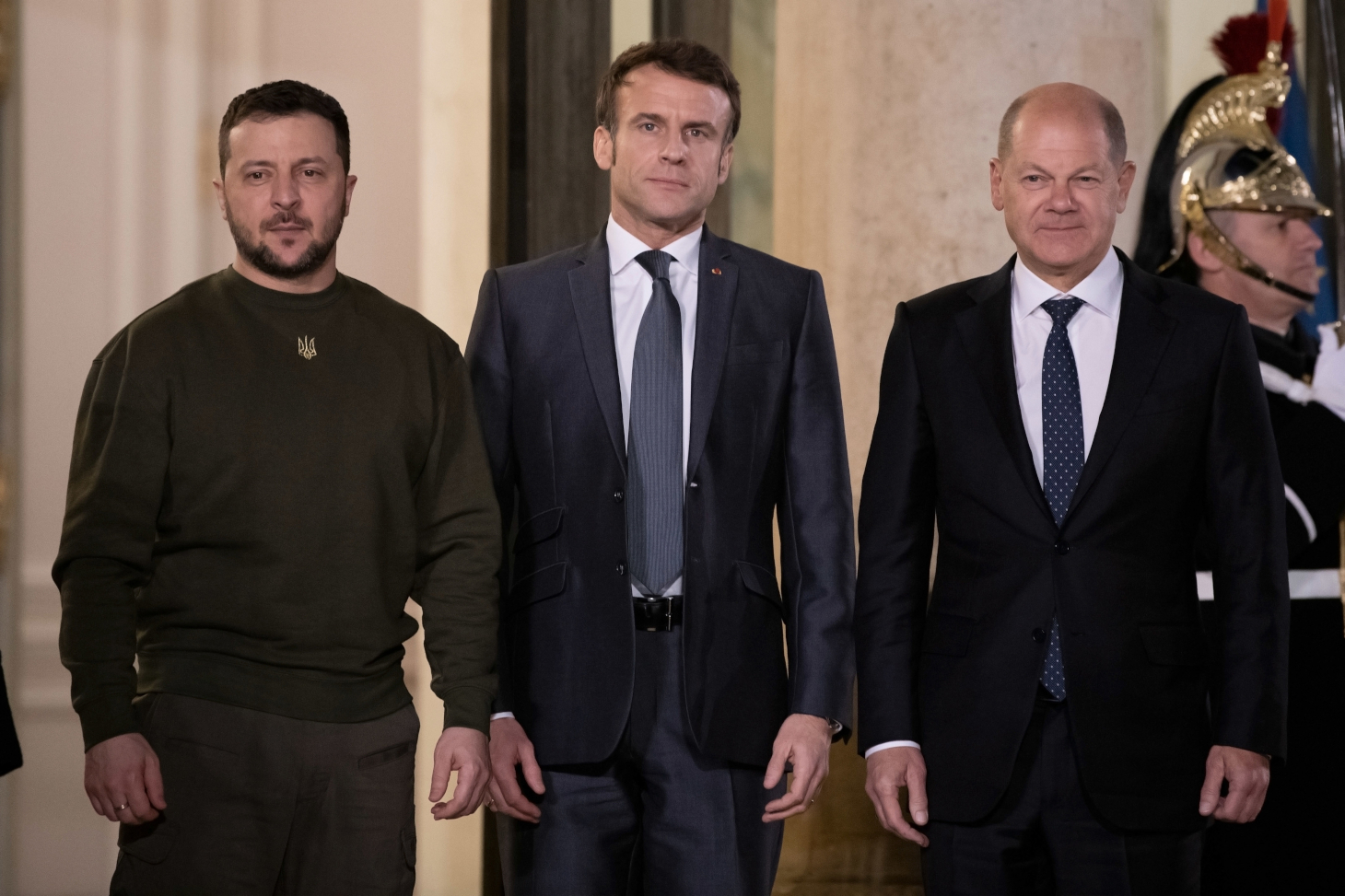
Several factors can be cited to explain this. First of all, the interpersonal aspect—which plays an important role in Franco-German relations—is not in the best shape: while relations between the two defense ministers or between the former French foreign minister and her German counterpart appeared to be strong, many observers cannot help but note the lack of chemistry between President Macron and Chancellor Scholz, whose highly personal governing style , incidentally, is causing confusion across the Rhine.
Thus, the absence of any reference to France in the chancellor’s speech in Prague in August 2022 on the future of Europe, and the limited consultation with Germany’s traditional French ally during the drafting of Germany’s very first security strategy, published in June 2023, served to confirm Franco-German tensions that led to postponements and a reduction in the frequency of the Franco-German Ministerial Council meetings in 2022 and 2023. In place of these meetings—aside from the symbolic meeting in January 2023 celebrating the 60th anniversary of the Treaty of Reconciliation—a bilateral seminar was held in Hamburg in October 2023 so that the two government teams could get to know each other better.
Similarly, when it comes to military and financial aid to Ukraine, the two countries are not acting in a coordinated manner, but rather through direct bilateral relations with Kyiv. Germany has contributed 20 billion euros to this aid (including 17 billion in military aid) since 2022, whereas France has so far provided only around 1.7 billion (including 544 million in military aid), according to figures from the Kiel Institute for the World Economy. Paris pledged an additional 3 billion euros in military aid during President Zelensky’s visit to Paris on February 15, 2024, and Berlin, for its part, announced an additional 1 billion euros.
Finally, in practical terms, the injection of the 100-billion-euro special fund and the significant increase in the German military budget (estimated at around 2% of GDP in February 2024) have intensified the existing industrial competition between Paris and Berlin, calling into question the tacit division of labor that had prevailed until then between Germany’s economic power and France’s military power. It should also be noted that in recent months, exchanges between the two defense ministries have been marked by the ups and downs of military industrial cooperation projects (notably the SCAF and MGCS programs).
While partners in Paris and Berlin have often criticized the influence of the Franco-German duo in the European integration process in the past, it now seems certain that while this influence alone is not enough, it remains a necessary condition for building consensus in Brussels, including on military issues.
One of the lessons from the war in Ukraine in this regard is the importance of giving greater consideration to the security interests of the Baltic states and the countries of Central and Eastern Europe, which were highly critical of Paris and Berlin’s attitude toward Moscow at the start of the war, deeming it too accommodating. One development that appears to be emerging in this regard is a renewed focus on the Weimar Triangle, as Franco-German-Polish cooperation has been made easier by the arrival in power in Warsaw of the pro-European government that emerged from the fall 2023 elections.
A second area of convergence for France and Germany relates to the U.S. factor: the 2024 presidential election could lead to a strengthening of European defense if Donald Trump were to return to the White House, particularly in light of the unequivocal remarks he made in February 2024 regarding the inadequacy of certain European contributions to NATO’s military budget. This is what happened between 2016 and 2020, a period of significant progress for European defense policy, marked in particular by the launch of Permanent Structured Cooperation.
Even in the event of a Democratic victory, Paris and Berlin can find a way to bridge their differences by working on the concept of a European pillar within NATO. France has, in fact, demonstrated its goodwill by playing a very active role in NATO’s presence in Eastern Europe to counter the Russian threat.
Thus, while disagreements—particularly those of an industrial nature—are bound to persist, it is through political channels that Franco-German military cooperation could regain some flexibility. However, considerable uncertainty remains on this point in light of upcoming European and national elections, given the rise of populist rhetoric in both countries and the economic and social crises that fuel it.