

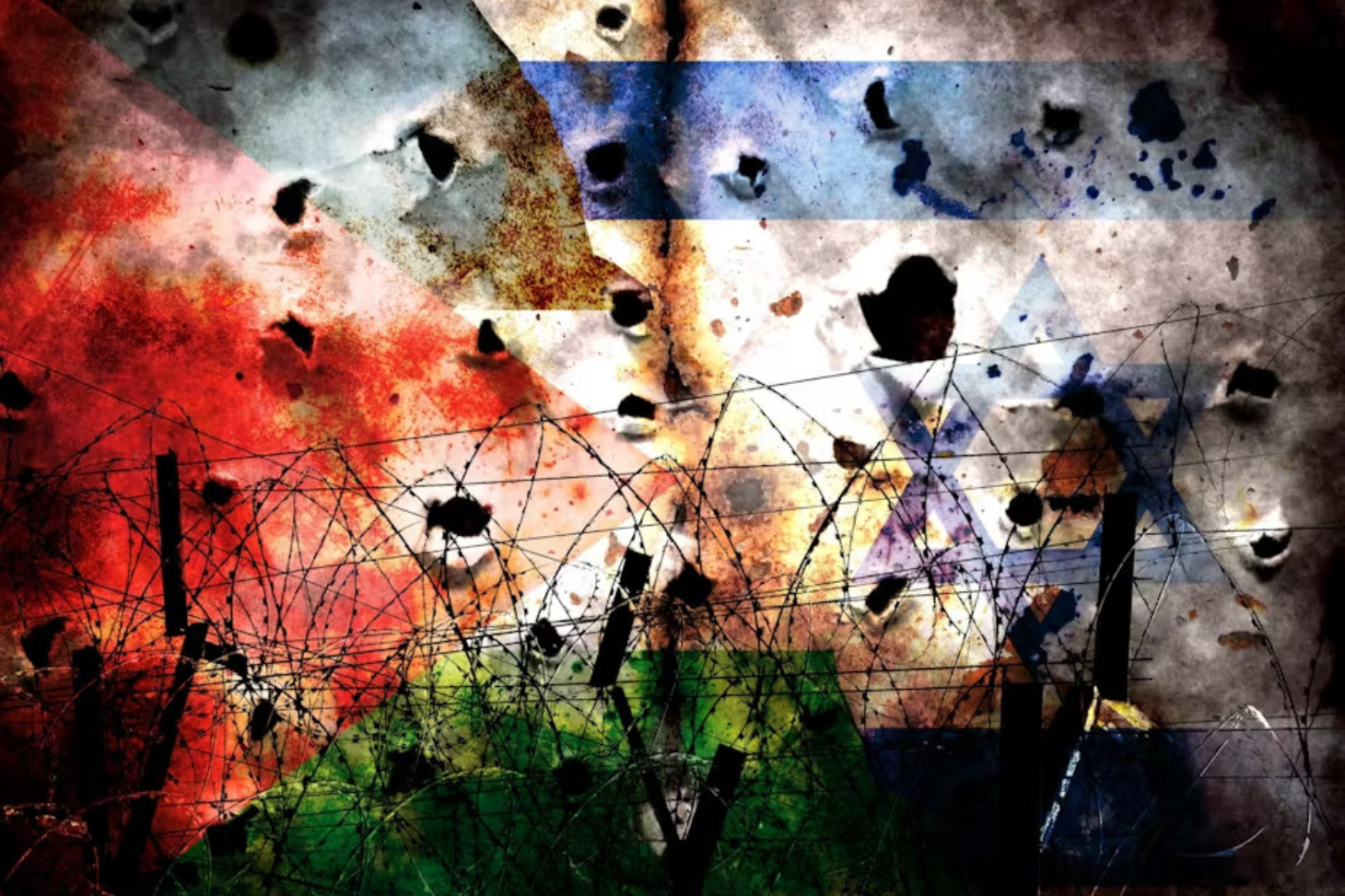
This opposition, which is often exaggerated, is constantly on display in the streets, on college campuses, and on television sets in major Western countries as well as in Arab and Muslim countries, leaving observers—and, above all, decision-makers—dizzy.
The conflict has multiple dimensions—military, certainly, but also political and highly symbolic. It pits two deeply traumatized collective memories against one another: that of the Israelis, haunted by the Holocaust and the pogroms of the early20th century, to which the massacres of October 7 have often been likened; and that of the Palestinians, scarred by the Nakba—that pivotal date in 1948 that triggered their first mass exodus and to which the current situation of the people of Gaza is comparable. It is imperative to always take these perspectives into account when seeking to understand the motivations and psychological stakes for both sides.
On the Palestinian side—and among Arabs and pro-Palestinian groups in general—the perception of the year 1948 remains central. That year marked the Nakba —literally, “the catastrophe”—the first major exodus, which forced 700,000 Palestinians onto the roads.
For Jews, 1948 was merely the point in time from which the Jewish people were able to begin to come to terms with what had happened to them. Indeed, the establishment of Israel on May 14 of that year was a small victory, a moment of joy before decades of traumatic exploration of the collective tragedy that was the Nazis’ campaign to exterminate the Jews of Europe.
In terms of the construction and reconstruction of Jewish memory, time only served to reveal and amplify the contours and details of the trauma of World War II.
Consequently, for Israeli society, the second half ofthe 20th century was not a time of post-traumatic recovery, but rather the beginning of a never-ending exploration of trauma. The memory of the Holocaust embodies a shared, collective element within Israeli society and the public sphere. The two minutes of sirens that sound throughout Israel every year on Holocaust Remembrance Day are an example of this.
However, this human tragedy has often been exploited by Arab-Muslim political demagoguery—and also by Israeli political demagoguery. On the Arab-Muslim side, one recalls, for example, the call to “drive the Israelis into the sea”—a deliberately genocidal statement by former Syrian dictator Hafez Al-Assad in the 1960s—and the Holocaust-denying remarks made by Iranian President Ahmadinejad in 2009. In Israel, the exploitation of the memory of the Holocaust can go so far as to accuse Palestinians of “Nazism” when they resist efforts to expel them from East Jerusalem and replace them with Jewish settlers.
Since 1948, Palestine’s cultural and literary resistance has resonated around the world through its trauma. In terms of culture, art, and literature, Palestinian identity can be considered the most globalized, the freest, and the most remarkable compared to other Arab identities that have their own states. One need only compare the impact of the work of Palestinian literary critic Edward Said and the official emergence of postcolonial studies with his book *Orientalism*, published in 1978, with the social and political damage caused by the hollow and ideological anti-imperialism of Arab regimes over more than 50 years.
We should also highlight, among other things, the influence ofthe iconic Palestinian artist Naji al-Ali, who was assassinated in London in 1987 and had been the target of threats not only from the Israeli occupation and various Arab regimes but also from the PLO (Palestine Liberation Organization).
Meanwhile, the actual situation of Palestinians in Palestine and in the diaspora has only worsened. Wars, defeats, and massacres—from Jordan (1970) to Lebanon (1982)—culminating in the Syrian regime’s destruction of the Yarmouk camp, the world’s largest Palestinian refugee camp, between 2012 and 2015. Even before the current bombardment of Gaza killed thousands of Palestinians and an Israeli minister suggested a nuclear bomb as a solution, more than 200 Palestinians had already been killed in 2023 by the Israeli army or by settlers in the West Bank.
Another symbolic event on the path toward the erasure of Palestine’s memory and existence was the recognition by Donald Trump’s United States of Jerusalem as the official capital of the State of Israel (2017). The United States, as the world’s leading power, did not, through this decision, legalize Israel’s settlement policy; rather, it endowed it with absolute, extralegal, and arbitrary power.
In recent years, the Palestinians have thus experienced a revision—or even a repeal—of the legal terms of their cause, the betrayal of the Arab monarchies, which are accelerating the process of normalization with Israel, and, above all, the unprecedented aggression of settlers in the West Bank under the protection of the Israeli army and the radical Israeli government. Would it be conceivable for this iconic people to see both their memory and their very existence perish in a dull, quiet political defeat?
Today’s conflict is being waged on several levels by the warring parties: violence, symbols, and memories. Meanwhile, the elites of the major Western powers find themselves overwhelmed by the issue ofthe conflict spilling over into their own territories and by the petty politics that result from it. Thus, the cycles of revenge between these two traumatic events seem to unfold without a referee, at the risk of eluding any normative interpretation, whether legalistic or humanistic.
From a formal standpoint, it can be acknowledged that Hamas was democratically elected in 2006 following the Palestinian legislative elections and was immediately boycotted by Western diplomatic circles because it was labeled a terrorist organization by them. However, from the perspective of political philosophy, democratic elections constitute less a procedural exercise than a renewal of the consensus on the social contract. It is a regular and anticipatory reaffirmation of political freedom and the depersonalized sovereignty of law and institutions. None of this was evident in the 2006 Palestinian election, as it represented a negative and revisionist moment in the peace process with Israel on the part of Palestinian voters deprived of statehood. The Oslo Accords, signed in 1993 between Yasser Arafat, leader of the PLO, and Yitzhak Rabin, Israeli prime minister, merely allowed Israel to secure recognition from the Palestinians, without ever halting settlement activity or leading to the establishment of a Palestinian state.
Even before the war that broke out on October 7, very few experts believed in the realism or feasibility of a sovereign Palestinian state, given the fragmentation of its purported territories as defined by the Oslo Accords. On the Israeli side, withdrawing 700,000 settlers from the occupied territories would be political suicide for any government. On the contrary, nationalist and extremist rhetoric now dominates Israeli political life, extending even to the idea of a “Greater Israel”—that is, the continuation of settlement expansion until the last Palestinian has left.
In a recent article published in NewLinesMagazine, journalist Lydia Wilson offers a psychological analysis of the history of this conflict and the nature of the emotions of its two warring parties.
She points out that Gerard Fromm, a psychotherapist who has published on the trauma of September 11 and on the psychology of the Israeli-Palestinian conflict, contrasts the “Never again” mindset of the Jewish psyche with the “Never surrender” mindset of the Palestinian psyche.
Israel’s “Never Again” was built on the memory of some two thousand years of persecution and exile, culminating in an attempt at annihilation. Meanwhile, the Palestinians’ “Never Surrender” reflects an ongoing trauma of dispossession, humiliation, and occupation. Both of these belligerent stances are driven primarily by extreme, traumatic emotions, and they reinforce each other in a negative cycle. From this perspective, the most dangerous and unpredictable event imaginable would be a violent, existential, and unmediated confrontation between these two sides.
According to psycho-historian Charles Strozier, co-author of *The Fundamentalist Mindset*, the “apocalyptic mindset” is characteristic not only of Hamas but also of the Israeli-Palestinian conflict more broadly, due to the presence of the apocalypse in both narratives, linked to their mutual negation of one another.
Commenting on recent events, particularly the Hamas attacks, Strozier states: “[Hamas] wants an overreaction; it wants to provoke Israel into unleashing the full force of one of the world’s best armies against fighters armed with rifles and cheap drones.”
Why would Hamas carry out an operation so self-destructive to its political future? What were its leaders hoping for when they planned this operation, if not to embarrass their allies and provoke their enemies?
Observers in the Arab world and beyond have put forward two possible explanations. The first: Hamas may have decided on its own to launch the “final battle” and drag its allies—Hezbollah and Iran—into a regional conflict that would even involve the United States. In other words, only an open-ended and unlimited war could bring the Palestinian issue back to the forefront of international politics and lead to a final resolution of the Palestinian cause.
Second hypothesis: This war was secretly backed by regional powers such as Iran and/or Turkey. The goal is, first, to undermine the prospect of normalization between Israel and Saudi Arabia and, second, to force the Americans—through a major crisis—to carry out an equitable and lasting redistribution of roles in the region that goes beyond Israel’s exceptional status or the enhanced role of the Arab monarchies. As an American historian recently pointed out in the New York Times, the United States has, in any case, lost control over Israel and the entire Middle East as a result of this conflict.

While the global and media spheres pit pro-Palestinians against pro-Israelis in terminological controversies related to the legal realm (occupation, colonization, terrorism, etc.), the armed conflict between these two belligerents lies elsewhere: in revenge. According to psychological analysis, extreme emotions provoke extreme behavior that can escalate to extreme violence.
While some Jews and some Palestinians cry out for revenge in front of a camera—and these scenes go viral around the world via social media—there is nothing to accompany them that explains how these “hateful” people are haunted by traumatic memories that have been exacerbated by a recent traumatic event. Has humanity already lost control over the flow of social media and its impact on the realm of human reason and the realm of politics?
Don’t the risks of conflating Jews with colonization and Palestinians with terrorism become toxic for democratic societies? What damage will this conflict inflict on the peaceful pluralism and flourishing freedoms of our societies?
It is not the UN, but the political West that presents itself as the protector unconditional of the State of Israel. Shouldn’t the unconditional nature of this protection require, in return, unconditional powers? Isn’t it up to these protectors to impose an absolute and final peace in the Middle East? Aircraft carriers and nuclear submarines Can't they, just for once, translate a Decision and positive political will?