

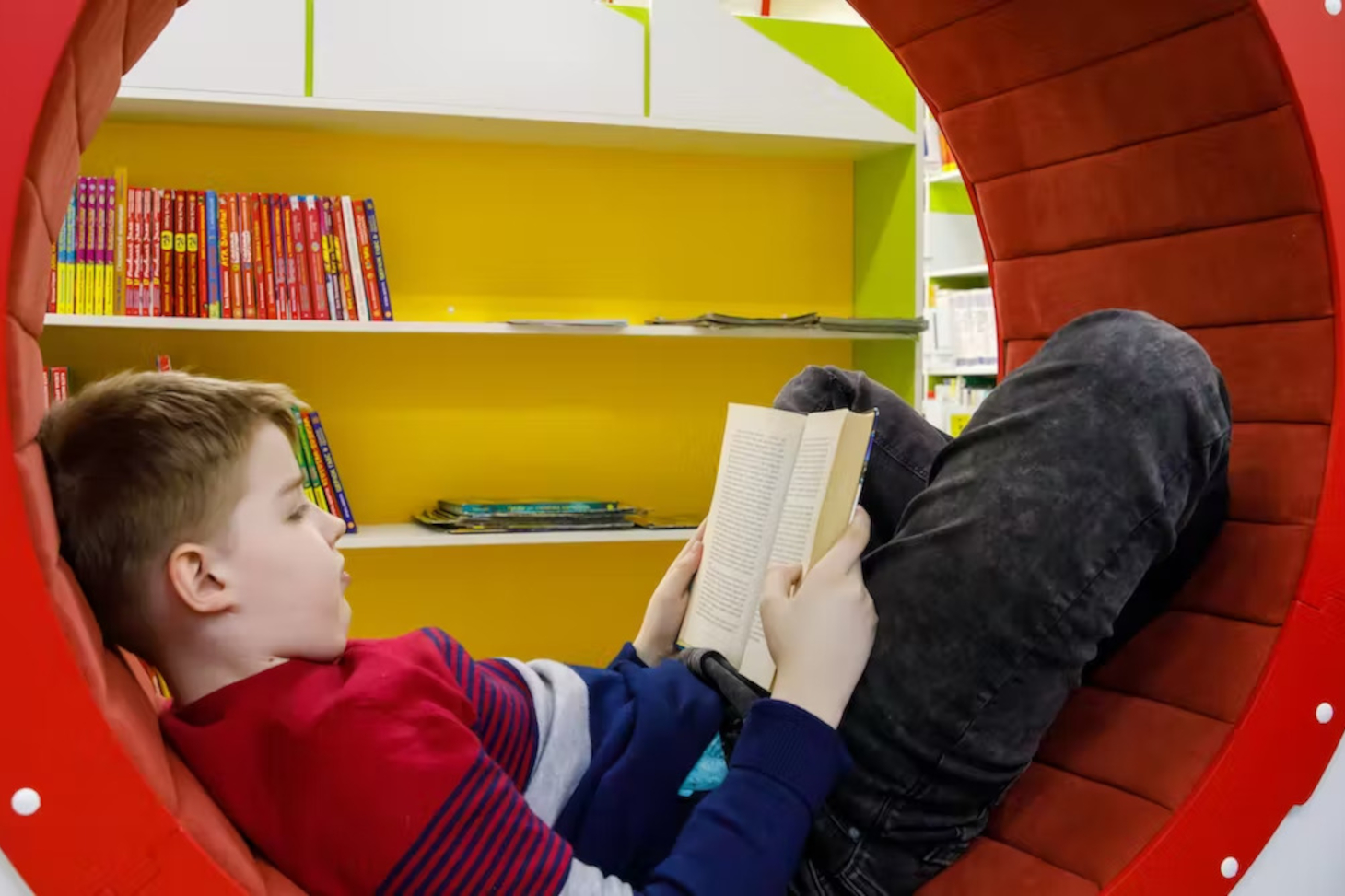
In Russia, the cultural landscape is changing as a result of laws passed by lawmakers since February 24, 2022. This is particularly true in the field of children’s literature, where pro-regime activists and cultural experts have called for restricting young readers’ access to certain books—or even banning them altogether—targeting primarily works that allegedly promote “Western values,” such as those by J. K. Rowling.
On December 13, 2022, Vladimir Putin called on the government to adopt measures that would promote among young people “the heroes of Russian history and folklore who embody traditional values.” This goal was immediately supported by some cultural policy experts.
In Europe, there is a tradition of adults regulating children’s reading in order to pass on shared knowledge and values to the younger generation. Generally, governments opt for the approach of making recommendations: they commission and distribute lists of works recommended for children to read. But when children’s literature becomes a weapon of propaganda, the government uses censorship to restrict readers’ access to texts that, from its perspective, threaten the dominant ideology. This is what is happening today in Russia.
Russian policy on children's literature is now based primarily on the idea that it should convey "traditional spiritual and moral values" that are unique to Russia. Several federal laws regulate children's publishing:
The Fundamentals of the State Youth Policy in the Russian Federation Through 2025 (Decree No. 2403-r of November 29, 2014)
The Strategy for the Development of Education in the Russian Federation through 2025 (Decree No. 996-r of May 29, 2015)
The State Cultural Policy Strategy for 2030 (Ordinance No. 326-r of February 29, 2016)
This document defines “traditional spiritual and moral values” as follows: “Life, human dignity, human rights and freedoms, patriotism, civic-mindedness, service to the Motherland and responsibility for its destiny, high moral ideals, a strong family, creative work, the primacy of the spiritual over the material, humanism, charity, justice, a sense of community, mutual aid, and mutual respect, historical memory and the continuity of generations, and the unity of the peoples of Russia.”
Nikolai Patrushev, Secretary of the Security Council of the Russian Federation, stated on May 30, 2022, that the state should commission more cultural products capable of “preserving historical memory, fostering national pride, and promoting the development of a mature civil society that is aware of the role it must play in the country’s development and prosperity.”
[Nearly 80,000 readers rely on The Conversation's newsletter to better understand the world's major issues. Subscribe today]
According to the government’s conservative view, Russia has, throughout its history, been surrounded by enemies determined to destroy it. This desire to dismantle Russia is said to have culminated in World War II, which—in the narrative put forward by Russian authorities—is largely reduced to the USSR’s triumph over German Nazism, a triumph of which present-day Russia is said to be the sole heir.
Art and education must therefore instill in young people the idea that today’s Russia is, above all, the country that saved the world from Nazism through a heroic effort, no aspect of which can be called into question. Any references to historical facts that might cast a shadow on this idealized view—such as the Molotov–Ribbentrop Pact, the mistakes of leaders, or the colossal number of human casualties, at least some of which could likely have been avoided, etc.) are considered distortions of history and are prosecuted under Federal Law No. 278-FZ of July 1, 2021 , “On Amendments to the Federal Law ‘On the Commemoration of the Victory of the Soviet People in the Great Patriotic War of 1941–1945.’”
The Misadventures Olga Kolpakova's Novel Is Currently Enduring The Mugwort Christmas Tree perfectly illustrate the consequences of the regime’s hardening stance on these issues.
The book, published in 2014 by Kompas Guide, won the 2019 Piotr Erchov Prize—awarded to works for young people—in the category of “best patriotic work for young people.”
However, in the summer of 2022, the Department of Internal Affairs of the Sverdlovsk Region (Ural) issued a verbal directive to libraries to remove the book from open access. Libraries are no longer allowed to lend this book to minors or use it in events aimed at young audiences. How could a book that had previously been praised by teachers and government officials become the subject of such a ban?
The protagonist of the novel, which takes place during World War II, is a five-year-old girl named Marihe, short for the German nickname “Mariechen” (“little Marie”). She lives near Rostov-on-Don with her family, who speak German and know only a few basics of Russian, as they belong to the group known as the Germans of Russia.
Like the Volga Germans, whose tragic fate is better known, these Soviets are descended from Germanic peoples who settled in the Russian Empire in the second half ofthe 18th century. Catherine II had invited them to settle and cultivate the lands newly annexed to the Russian Empire in what are now the Volga region, southern Russia, and eastern Ukraine. Over the next 150 years or so, there was no policy of Russification or mass assimilation directed at them. German communities formed entire villages. The spread of the Russian language occurred unevenly, depending on individual social trajectories. Religious differences played a role, limiting interfaith marriages in which Russian might have become the common language. Nor was the school system able to impose the Russian language, since education was not mandatory.
In 1941, as Nazi troops advanced and threatened these regions, able-bodied men were sent to the front, and their families—including Marihe’s—were deported to the Urals and Siberia.
The story is told from the little girl’s perspective. Thus, the author describes the historical events of 1941–1942 as they might have been perceived by a young child. This text, written “on one’s knees,” to useErich Kästner’s expression, and this childlike perspective create a sincere and emotionally charged narrative voice that expresses a clear anti-fascist stance.
Kolpakova also draws on the literary tradition ofthe 19th and20th centuries to describe Marihe’s unhappy childhood. The plot follows the major events of this portrayal: separation from a parent, wandering, living with strangers, the death of a loved one (brother, sister, mother, or father), estrangement, then a chance encounter with friends or relatives, hunger, destitution, illness, providential help from strangers, and grueling physical labor…
The little girl describes hunger this way: “In the spring, my grandmother started making soup with stinging nettles, dandelions, and dill. Sometimes Lilia would go up into the mountains to pick sorrel. Water and stinging nettles just don’t taste good—especially without salt or potatoes. I cried; I didn’t want to eat that concoction.”
These material hardships are presented as trials that help us grow.
Marihe’s naive view of the political context is counterbalanced by the author’s unequivocal stance against fascism. The child sets the ethical tone of the story: “In every nation, there are good people and bad people, kind people and cruel people, greedy people and generous people. The ones we now called ‘Nazis’ were the bad Germans. That’s what Dad had said.”
But in June 2022, as part of his administrative duties, Ivan Popp, an associate professor at the Ural Pedagogical University, reviewed the book at the request of the Sverdlovsk Region government. According to his findings, the novel “distorts historical facts, speculates, and invents legends” and “following the European liberal trend, compares the Soviet Union with fascist Germany […], falsifies historical facts, and discredits Russian leaders and history.” Svetlana Uchaikina, Minister of Culture for the Sverdlovsk Region, relied on this analysis to demand, via a confidential memo, that the book be removed from children’s libraries.
In mid-July 2022, Olga Kolpakova posted Popp’s text online and reported instances of the book being removed from open access in certain libraries. This announcement stirred a reaction among children’s authors and specialists in children’s literature, who posted messages on social media supporting the novel and criticizing Popp’s analysis of it, and who continued to share updates about her situation. Authors also launched a campaign to provide financial support to the author and her publisher. The Moskauer Deutsche Zeitung, a biweekly magazine published in German and Russian, has taken a stand in favor of the book, and children’s writers have written to the Sverdlovsk regional government to defend the book and its author. Evgeny Roizman, the former mayor of Yekaterinburg (the largest city in the Urals) and now a political prisoner, has also voiced his support for the book. The publisher asked the Institute of Literature at the Russian Academy of Sciences, the Pushkin House, to conduct a literary analysis of the novel.
Russia is banning children's literature deemed insufficiently patriotic ... Putin is gradually stifling Russian cultural life. "The Wormwood Tree" by Olga Kolpakova, which deals with forced migration during World War II, is being removed from libraries. I wonder why? https://t.co/tzoNzyLwqs
— HackneyBelle (@HackneyBelle65) July 24, 2022
This expert report, prepared by the Center for Research on Children's Literature, highlights the literary and educational value of Kolpakova's novel. After reading it, the governor of the Sverdlovsk Region, Yevgeny Kuivashev, stated in August 2022 that banning the book was unacceptable.
No official decision has been made, so libraries continue to remove the novel from their shelves.
Despite the heavy cloud hanging over Russia today, this multifaceted support—including that from a high-ranking official like Kuivachev—shows that there is still a small space for debate in Russia today. However, as evidenced by the fate of the book A Summer in a Pioneer Tie, by Elena Silvanova and Katerina Malisova, who are facing charges for LGBT+ propaganda, the censorship of The Mugwort Christmas Tree raises serious concerns about the intellectual climate in which Russian children are growing up. This episode reveals mechanisms for controlling people's minds whose impact on Russian society is likely to be felt for a long time to come.