

Donald Trump wants to annex Greenland, seemingly with Vladimir Putin’s indifference—or even approval. Denmark refuses to cede its autonomous territory, whose residents recently elected a coalition in which three out of four parties advocate for independence. Beyond the issues surrounding the natural resources of the vast Arctic island, what is also at stake here is the defense of Greenland, currently provided by the United States through NATO.
In January 2025, President Trump declared the United States’ intention to take control of Greenland and threatened Denmark—under whose jurisdiction the island operates as an autonomous territory—with economic or military retaliation if his demand was not met.
These remarks have shocked European, Danish, and Greenlandic political leaders. Washington’s openly expansionist stance calls into question the transatlantic relationship—and, with it, Greenland’s security architecture. In response, French Minister of Foreign and European Affairs Jean-Noël Barrot, as well as Robert Brieger, Chairman of the European Union Military Committee, suggested as early as late January that European troops be deployed to Greenland.
From Monday through Friday and on Sundays, receive free analysis and insights from our experts for a different perspective on current events. Subscribe today!
This unanimous condemnation is not enough to deter the new administration in the White House. In March, plans for a visit to Nuuk, the capital, and Sisimiut, Greenland’s second-largest city, by a U.S. delegation led by Vice President J. D. Vance—without an official invitation—were strongly condemned by Danish and Greenlandic authorities. On March 26, Donald Trump cynically declared in the Oval Office that the world needs the United States to own Greenland, and that Denmark must cede Greenland to the United States.
In the face of protests from Denmark and Greenland, the U.S. delegation’s itinerary was scaled back, but the symbolic significance remains strong: J. D. Vance visited the U.S. space base at Pituffik on March 28.
Washington and the Defense of Greenland
To date, it has been primarily the United States that has provided security for Greenland. But it should not be forgotten that it is at NATO’s request that the U.S. has managed the Pituffik base (known as Thule until 2023) since the 1951 defense agreement signed with Denmark—amended in 2004 to include Greenland as a partner. This agreement in no way calls into question the sovereignty of the Kingdom of Denmark over Greenland, a sovereignty that the United States had already recognized in 1916.
It is also NATO members who, through the Northern Viking exercises, are strengthening their position in the GIUK zone (Greenland, Iceland, and the United Kingdom), which has become a major strategic concern due to Russia’s projection of naval power.
However, in a stunning statement made on March 27 at the International Arctic Forum in Murmansk, Vladimir Putin appeared to support the U.S. plan to annex the territory: “These,” he said, “are serious plans on the part of the United States regarding Greenland. These plans have deep historical roots.” ” He added: “Greenland is an issue that concerns two specific countries. It has nothing to do with us.”
Could the economic rapprochement sought by Moscow and Washington in the context of negotiations over the war in Ukraine have ramifications in the Arctic? Kirill Dmitriev, President Putin’s advisor on foreign investment and economic cooperation, states: “We are open to cooperation on investment in the Arctic. This could involve logistics or other areas that would benefit both Russia and the United States.” “But before any agreements are reached,” he adds, “the war in Ukraine must come to an end.”
Greenland's Growing Involvement in Its Own Security
Danish Prime Minister Mette Frederiksen wants to believe that the transatlantic bond remains strong. However, while the weakening of this bond raises questions about Greenland’s security, the autonomous territory’s march toward independence introduces another factor.
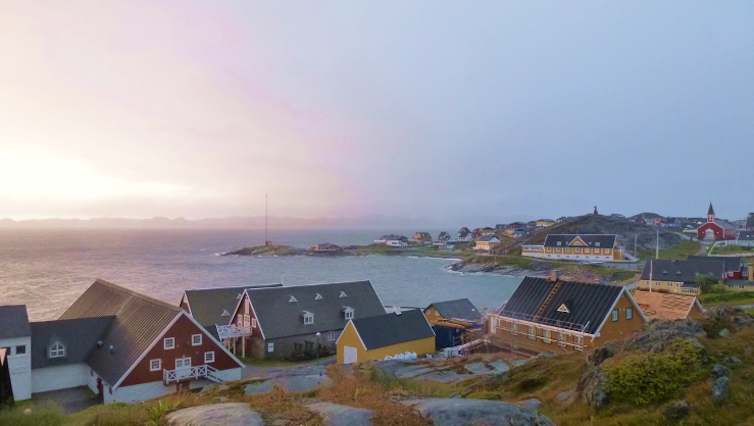
Greenland’s security is inevitably shaped by its relationship with its former colonial power. Today, Greenland is self-governing in several areas of administration, but security and defense, in particular, remain under Denmark’s jurisdiction. However, the Greenlandic government, the Naalakkersuisut, is increasingly seeking to be involved in decision-making regarding these areas. Hoping for economic benefits and the promotion of local expertise, it aspires to gradually take charge of certain aspects of security policy.
The autonomous territory was consulted in a meaningful way for the first time on defense issues during the implementation of the defense agreement signed on January 27, 2025, between the Government of Denmark and the parties represented in the Danish Parliament, valued at 2 billion euros. The agreement aims to improve surveillance, assert sovereignty, and enhance societal resilience in the region, as well as to support allies and the NATO mission. The parties also seek to strengthen cooperation in intelligence and research and to modernize the facilities of the Joint Arctic Command in Nuuk. To this end, three new Arctic patrol vessels are planned.
In this context, the results of the parliamentary elections held in Greenland on March 11 indicate a strong desire for greater economic development that would pave the way for independence.
A New Government at a Critical Moment in Greenland’s History
The two parties that have dominated Greenland’s political landscape for the past 50 years—the left-wing environmentalist party Inuit Ataqatigiit (IA) and the social-democratic party Siumut—have seen their combined support drop by half, with the loss of support going to the center-right party Demokraatit (29.9% of the vote)—which advocates for liberal economic policies in Greenland, particularly in the fishing sector—and the populist nationalist party Naleraq (24.5%). Like all Greenlandic parties except Atassut (a liberal-conservative party that received 7.5% in the last legislative election), Naleraq supports Greenland’s independence but calls for immediate independence. The broad governing coalition formed on March 27 brings together the Demokraatit, Inuit Ataqatigiit, Siumut, and Atassut parties, but excludes Naleraq—a decision that reflects a desire not to jeopardize Greenland’s future at a time when Washington is hammering home its determination to get its hands on the island.
During its campaign, the Demokraatit party emphasized that Greenland was not for sale, while calling for Greenland’s independence supported by a free association agreement with Denmark or the United States. Free association refers to international agreements between small states and a major power that guarantee them security, defense, and significant financial aid, such as the 1986 Compact of Free Association, which governs relations between the United States and Pacific microstates such as Micronesia, the Marshall Islands, and Palau. This option appears to have fizzled out as anti-American protests take place in front of the U.S. Consulate in Nuuk. IA and Siumut recommend participation in NATO as a complement to Danish national defense, with IA noting that Greenland could hold a seat in the NATO Parliamentary Assembly.
The majority of Greenlandic politicians—both women and men—are seeking a security partnership that complements the one between the autonomous territory and Denmark. This desire for a postcolonial arrangement is also clearly reflected in the pursuit of diversified economic partnerships with, for example, Iceland, the United Kingdom, the United States, and Asian countries. The European Union does not feature prominently in the political parties’ proposals, perhaps because of the agreements already signed under the 1985 Greenland Treaty, which links Greenland and the EU. The EU provides Greenland with 13.5 million euros annually in exchange for access to its waters for EU fishing vessels, and 3 million euros to support sustainable fishing. In addition, 225 million euros have been allocated for the 2021–2027 period to support education and green growth.
With regard to raw materials, the EU and Greenland signed a strategic partnership agreement in November 2023, in the form of a memorandum of understanding aimed at establishing sustainable value chains for raw materials. Naaja H. Nathanielsen, then Greenland’s Minister of Foreign Affairs, Trade, Mineral Resources, Justice, and Gender Equality, stated that this agreement would be supported by a roadmap to ensure concrete results that benefit both parties, but that the EU needed to encourage its member states to invest.
In terms of defense and security, Greenland’s options are not that varied. Aside from relying on the United States and Denmark, they consist of two non-mutually exclusive possibilities: NATO and European defense.
Limited scenarios requiring Greenland's approval
For Greenlanders who want to be masters of their own destiny, any exclusive dependence on the United States is problematic. According to a recent poll, 85 percent of them oppose U.S. policy on this issue.
Relying exclusively on NATO could also be a risky decision. If the United States withdraws from NATO—as Trump has repeatedly threatened to do—the legitimacy of its management of the Pituffik base would disappear. And if the United States no longer provides a reliable safeguard against Russia’s projection of naval power and its hybrid threats—but instead threatens Greenland itself, as it has been doing so persistently—then European partners and the European Union’s capabilities come into play. The countries that participated in the Northern Viking exercises—Norway, the United Kingdom, and France—would certainly become more important players, as would, possibly, Iceland, which, while it does not have its own armed forces, represents an “unsinkable aircraft carrier.”
Whatever options are chosen, they will be relevant to Greenland’s security only if they are freely chosen by the Greenlandic people. Caught between the threat of American expansionism and the postcolonial context, it may be the EU, with its legal framework and values, that could offer Greenlanders the best chance to determine their security on their own terms.