

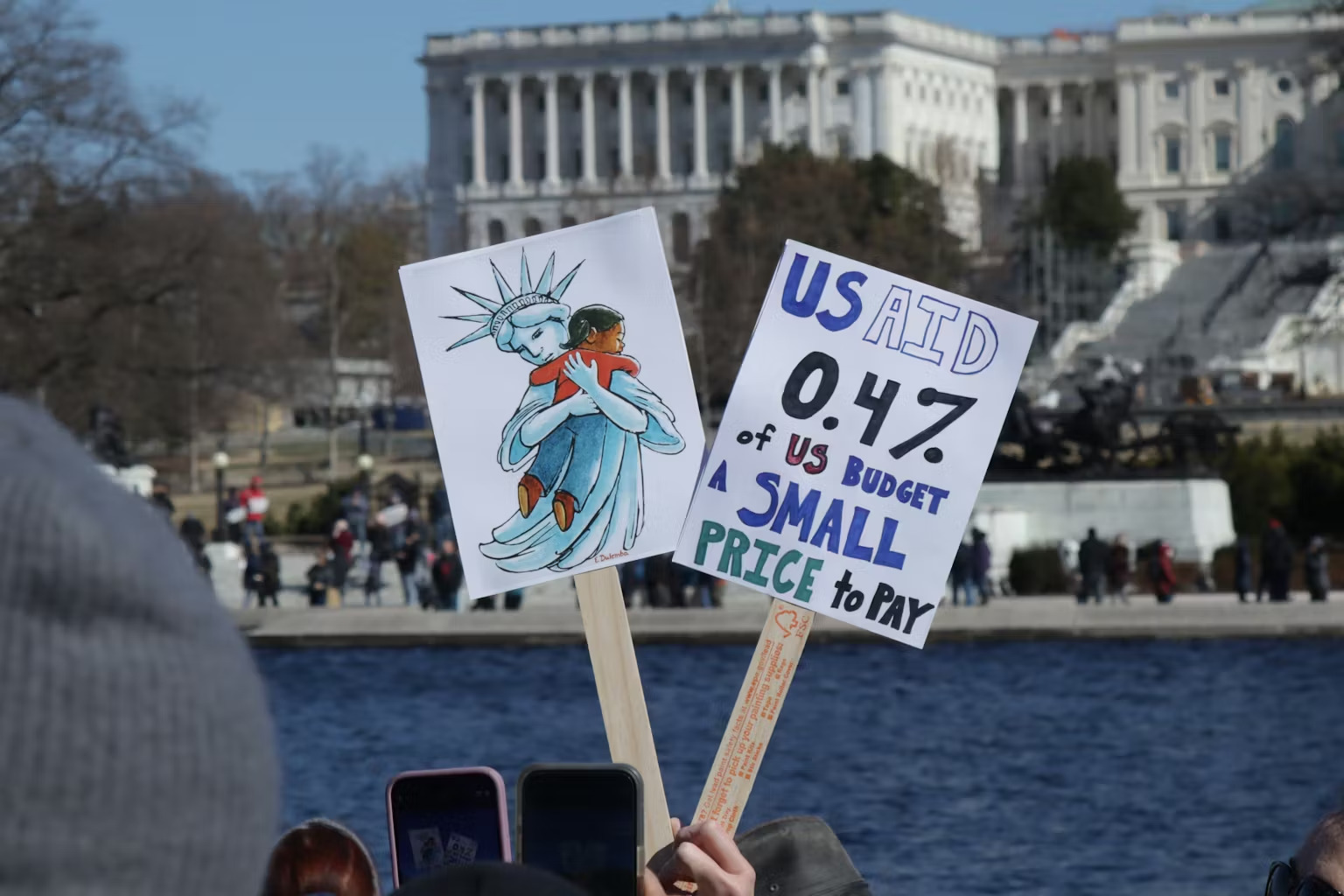
Since Donald Trump’s reelection, more than 200 million people worldwide have found themselves in vulnerable situations. Until then, the United States had been the leading financial contributor to international organizations. But as soon as he returned to the White House, the president carried out a massive financial withdrawal, leaving many NGOs, United Nations humanitarian agencies, and even the Red Cross in dire straits.
In his book Humanitarian Action: The Twilight of the Gods?, recently published by Un monde nouveau, Pierre Micheletti—a member of the Board of Directors of SOS Méditerranée and Honorary President of Action Against Hunger—analyzes the mechanisms that led to this situation and proposes a new framework for organizing humanitarian aid.
The sudden cutoff of funding from the United States government to humanitarian actors has stunned all organizations involved in this form of international solidarity. The International Red Cross Movement, UN agencies, and international nongovernmental organizations (INGOs) are already assessing how the announced restrictions will impact their operations on the ground—with the social consequences that all leaders have in mind.
A scramble immediately ensued among these three major groups of humanitarian actors to protect their programs and the people they support, as well as the future of their employees—both at the headquarters of the various organizations and in the countries where they operate.
This crisis is the extreme consequence of a funding system that concentrated virtually all of the funds committed each year on a few Western countries. Prior to its withdrawal, the United States was the world’s leading provider of emergency aid, ahead of the European Union. The withdrawal of the leading contributor, however, occurred against the backdrop of a humanitarian aid model whose flaws and weaknesses had been evident for several years. The “Paris Summit for a New Global Financial Pact” had thus provided an opportunity for leaders from various sectors of the humanitarian community to speak with one voice, highlighting the essential changes that were needed. A further milestone was reached in 2025, marking a turning point.
Exposing the human consequences of the financial collapse of the model that prevailed until early 2025, analyzing the mechanisms that have long been at work and made the impending disastrous consequences possible, and envisioning how to resist and rebuild a system of international emergency aid immediately point to a “collective unconscious” that must be called into question: The West can neither claim nor assume a monopoly on compassion for the world’s misfortunes.
The financial capacity to foster international solidarity—as well as the strategies and actors capable of providing vital support to populations facing major crises—cannot be the sole responsibility of a small portion of humanity in today’s globalized world.
The concept of the West—which is a subject of debate—is sometimes manipulated by those who wish to reaffirm the primacy of cultural factors over all other considerations, in order to describe the composite spaces that shape global international society. The term “the West” is used in this book not as an identity construct, but as an evolving geographic area resulting from political, economic, legal, and military cooperation among various countries in the aftermath of World War II.
In the case of the United States, this distinction is all the more crucial given that the abandonment of humanitarian aid is accompanied, on the part of the country’s new leaders, by a narrative that reaffirms (among other things) the importance of a shared “culture” as the necessary fuel for solidarity. This is evidenced by the emergence of the concept of “Christian diplomacy” within President Trump’s administration. To avoid any debate or controversy, the necessary “decentering” referred to by historian and political scientist Sophie Bessis serves, in the pages that follow, as a reference to the shift in perspective—now imperative—required to respond to humanitarian emergencies. A shift away from the small group of 20 key donor governments that until now have made up the exclusive club of funders.
The central argument put forward—which largely underpins the resulting analyses and proposals—is that the economic model quantifies the tangible reality of the political logic underlying the funding mechanism. The source countries, the methods of allocation and implementation, and the allocation decisions made by donors all reflect the geopolitical interests and motivations of the funders.
The collapse of budgets in early 2025, resulting from the United States’ withdrawal as the leading provider of global humanitarian aid, is one component—albeit a minor one in terms of volume—of a broader official development assistance (ODA) framework that is also affected by the United States’ withdrawal through the dissolution of its development agency, USAID (United States Agency for International Development).
The dynamics that led to the emergence of the concept of ODA are rooted in historical patterns, an understanding of which is essential to grasping the dominant model of international solidarity. “Dominant” here does not refer to an imposed dictatorship, but rather to the pervasive influence of the patterns that have shaped the development of the Western world since 1945.
The multilateral framework specific to humanitarian action has just fractured. Since the end of World War II, we have witnessed the evolution of a constantly changing international order, without this leading to significant changes in the economic model of international solidarity. The 2020s have seen a series of breaking points, the most recent of which was the financial earthquake of early 2025, which has begun to outline the contours of a multifaceted depression.
It is by analyzing the causes of the financial crisis—and the disastrous consequences of the current situation for people left to fend for themselves—that we can identify ways to bounce back and revive a system that we can hope to improve.
A system that is better protected from the political rivalries that shape and undermine the model of international solidarity that prevailed until its historic mentor withdrew its support.
The challenge is not only to resolve the financial equation, but also to devise and implement a governance framework for a sustainable model that has yet to be created. In other words, it is about reshuffling the deck of political rivalries and power dynamics that are reemerging among countries, in order to reaffirm a shared commitment to act in concert in the face of the major humanitarian crises of today and tomorrow.
Thus, a new form of multilateralism—one that includes civil society—is emerging. This multilateralism will have to take into account the widespread rejection of a model of international solidarity modeled on the objectives and mechanisms of mutual aid established by some of the victors following the defeat of Nazism.
As we move forward, we must acknowledge the evolving concept of “borders,” which global phenomena—such as environmental degradation and the emergence of new infectious diseases—are transcending. It is also about reaffirming—as the foundation of our shared existence—the imperative and common commitment to protect what are now commonly referred to as “global public goods,” including peace. In this new conception of international relations, solidarity does not stem from compassion based on an asymmetry of resources, but rather from an awareness of the human community’s shared destiny.