

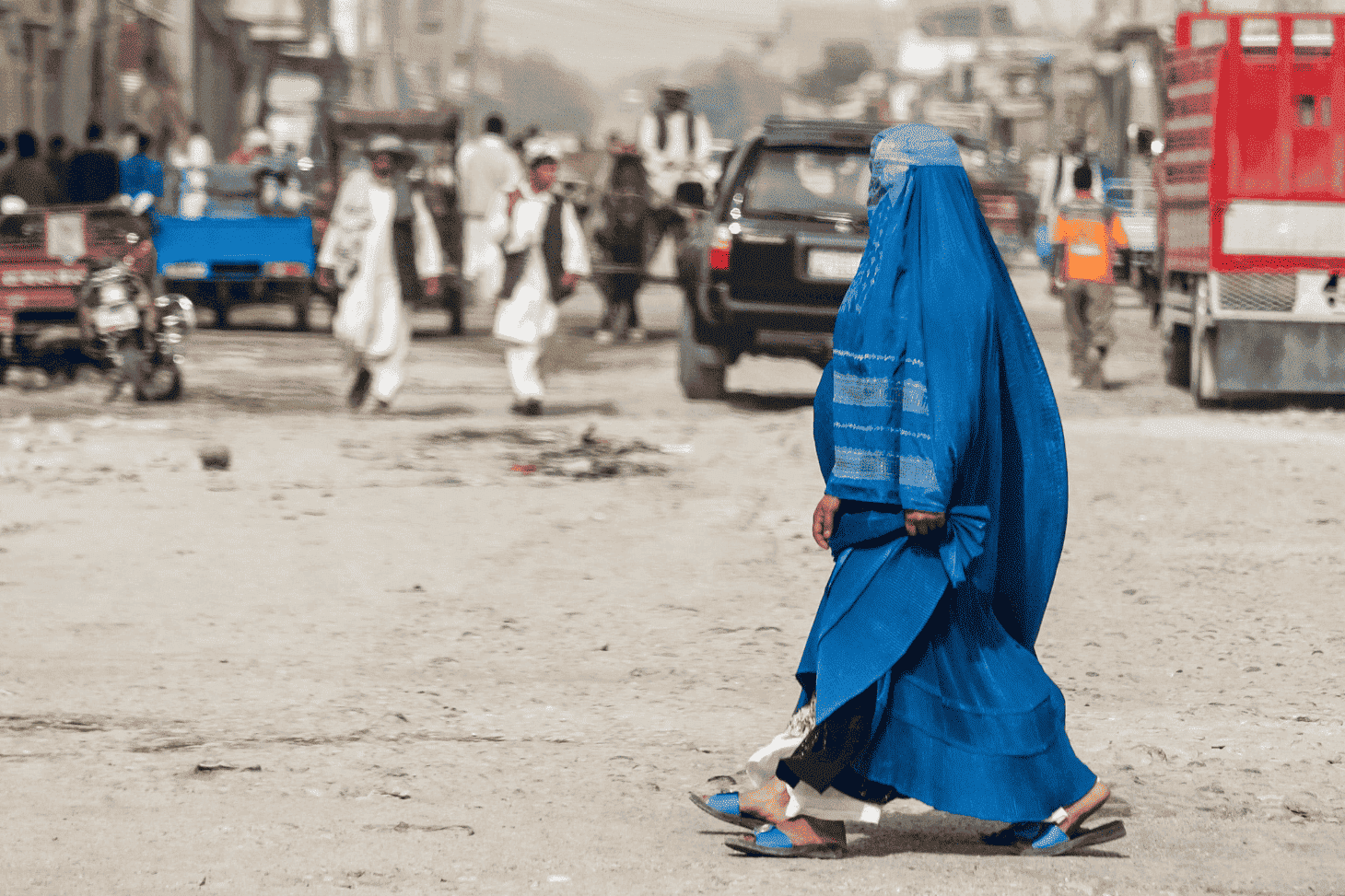
Since the Taliban returned to power on August 15, 2021, the situation for women in Afghanistan has continued to deteriorate. On January 4, 2026, the regime enacted a new penal code based on a rigid, literalist interpretation of the Sunni Hanafi school of thought, which, according to the Afghan NGO Rawadari, enshrines provisions that legalize certain forms of violence and severely restrict women’s freedoms, while reinforcing impunity for perpetrators.
In this context, the situation of Afghan women is particularly concerning. The future of their rights in the country remains more uncertain than ever.
Legalizing Domestic Violence
The full text of the new penal code was published on February 26, 2026, bythe Afghanistan Analysts Network (AAN), an independent research center specializing in political and social analysis of Afghanistan. This publication immediately sparked deep concern, both internationally and within Afghan civil society, even though the latter is now severely weakened and largely suppressed. The few actors still active operate discreetly or from abroad, particularly in support of women’s rights, by denouncing this type of legislation on the international stage.
The central provision of this new law is found in Article 32, which legalizes violence against women. From now on, a husband can be prosecuted for domestic violence only if it results in visible fractures, open wounds, or serious injuries requiring medical treatment. In other words, most forms of domestic violence (physical, psychological, or sexual) are exempt from criminal punishment as long as they do not leave obvious marks on the victim’s body.
Even in cases recognized by law, the penalty remains limited and does not exceed fifteen days’ imprisonment. This provision also reveals a grotesque imbalance in the hierarchy of crimes. By way of comparison, Article 70 punishes the organization of animal fights (dogs, camels, sheep, or birds)—intended to spare them unnecessary suffering—with five months in prison, a penalty significantly harsher than that prescribed for serious acts of violence against women.
Legally, this provision now allows certain acts of violence to be justified in the name of “family discipline,” thereby granting the husband an implicit right to administer a form of “correction.” Furthermore, no provision establishes a clear means for women to seek justice in cases of domestic violence, even when such violence leaves visible marks and therefore falls under the scope of Article 32. Victims must prove their injuries, but they are prohibited from undressing in front of a judge, making it virtually impossible to seek redress.
The lack of appropriate procedures, combined with severe restrictions on women’s freedom of movement and their ability to exercise their legal rights, contributes to domestic violence going largely unpunished in practice.
Restriction of Fundamental Freedoms
The new criminal code does more than simply legalize domestic violence.
Article 34 provides that a woman who visits her family without obtaining ad hoc authorization from her husband each time may be sentenced to three months in prison. According to the second paragraph, this penalty may also apply to family members who take her in or protect her. Thus, even the victim’s own family—which could serve as a refuge in cases of domestic violence—finds itself exposed to legal penalties.
Even before the adoption of this new penal code, restrictions on Afghan women had already begun in December 2021, with a series of decrees issued by the Ministry for the Promotion of Virtue and Prevention of Vice. Among the key provisions, women must be accompanied by a mahram (a male relative, typically a father, brother, husband, or son) for certain trips or public activities, including travel and access to certain government services.
These measures were subsequently codified in the law on the “Promotion of Virtue and Prevention of Vice, ” ratified by Hibatullah Akhundzada, the supreme leader of the Taliban, and published by the Taliban regime’s Ministry of Justice on July 31, 2024.
The law imposes a strict dress code. Women must cover themselves completely in the presence of all non-mahram men (men who are not close family members) and wear clothing that is neither sheer, tight-fitting, nor short, in order to prevent “corruption.”
It also prohibits women’s voices (whether speaking, singing, reciting, or reading aloud at gatherings) from being heard in public, as this is considered likely to lead to “vice.”
The law also prohibits women from using public transportation alone, without being accompanied by a male relative. The new penal code thus reinforces these measures, virtually erasing women from social life and, above all, from legal life.
International Pressure: What's Next?
On January 22, 2026, the Afghan NGO Rawadari estimated that nearly nine out of ten Afghan women would face gender-based violence during their lifetime. This estimate is particularly alarming given that the new criminal code seeks to legalize such violence and further isolate the victims.
Volker Türk, the UN High Commissioner for Human Rights, who has described Afghanistan as a “graveyard for human rights,” has strongly condemned this new code, viewing it as a step toward a form of “gender apartheid.” Non-governmental organizations, such asAmnesty International and Human Rights Watch, have also raised concerns about this new Afghan penal code.
On March 6, 2026, Amnesty International called on the Afghan authorities to conduct a comprehensive review of the text, arguing that it violates fundamental principles of international law, including equality before the law and protection against violence. The European Union, for its part, through its special envoy Gilles Bertrand, also condemned the code, emphasizing that it institutionalizes inequalities, normalizes domestic violence, and restricts women’s autonomy.
However, beyond these condemnations, it remains difficult, under current international law, to take concrete action. Moreover, in the current international context—marked by the war in the Middle East and other major crises—the situation of Afghan women has been pushed to the back burner. The international community has few means at its disposal to pressure the Taliban regime and protect human rights, particularly those of women.
This article is republished from The Conversation under a Creative Commons license. Readthe original article.