

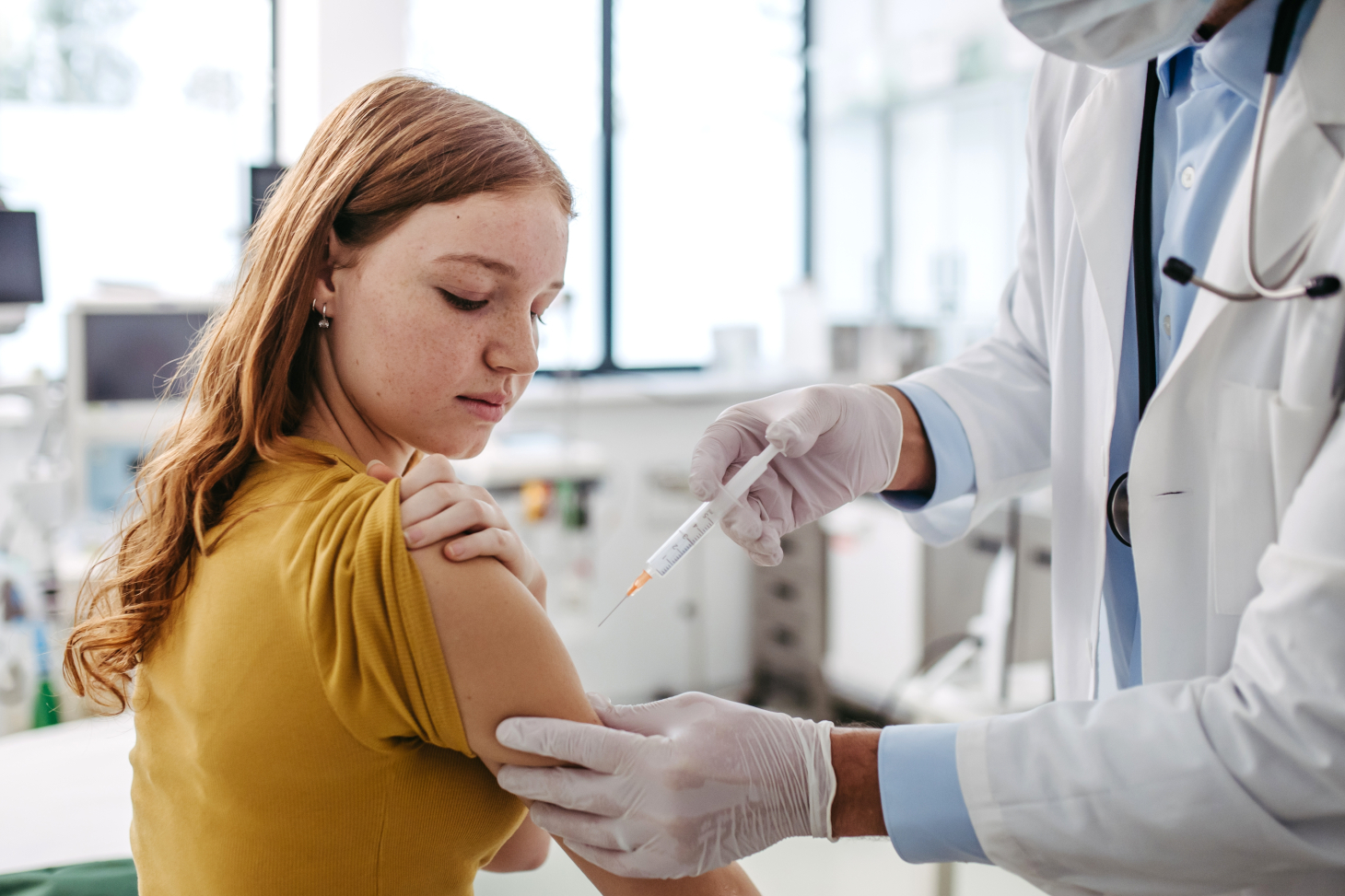
At the start of the 2024 school year, the widespread vaccination campaign againsthuman papillomavirus (HPV) infections was renewed in middle schools for 5ᵉ-grade students—both girls and boys—for the second time. As a reminder, it was in February 2023 that Emmanuel Macron, the President of the Republic, announced the implementation of this program.
Until then, vaccination coverage had been particularly low in France when compared to figures from other European countries, which were already organizing vaccination days in schools.
In France, since the first vaccination campaign in schools, vaccination coverage among 11- to 14-year-olds has jumped by 17 percentage points to 48% (55% for girls, 41% for boys).
It has been established for several years now that vaccination is effective against HPV infections, genital warts (condylomas), and precancerous lesions of the cervix. Furthermore, while HPV can cause cervical cancer, several other types of cancer are also linked to it, such as cancers of the vulva, vagina, anus, and oropharynx.
The Gardasil vaccine has been available in France since 2006. The latest version, Gardasil 9—which protects against 9 strains of HPV, including 7 high-risk strains that can cause cancer— is the one recommended. HPV vaccination is recommended for all boys and girls aged 11 to 14, with catch-up vaccination available between the ages of 15 and 19.
Despite this, the HPV vaccine (as was also the case with the hepatitis B vaccine) was the target of a widespread smear campaign in the 2000s. This led to particularly strong mistrust among the public, which persists to this day. This phenomenon has given rise to significant “vaccine hesitancy,” which could be defined as “the act of delaying or refusing a safe vaccination despite its availability.”
 Every Tuesday, our newsletter "And above all, good health!" gives you the tools you need to make the best decisions for your health (sleep, diet, mental health, physical activity, new treatments, etc.)
Subscribe today.
This hesitation may be due to various factors. Studies conducted before the COVID-19 vaccine became available have shown the role of socioeconomic and sociodemographic variables (age, gender, education level, etc.) as well as factors related to beliefs. Thus, the so-called “5 A’s” model —which stands for Access, Affordability, Awareness, Acceptance, and Activation —identifies environmental factors as well as other vaccine-specific determinants and inter- and intra-individual causes.
It should be noted that the Canadian Center for Vaccination Evidence and Exchange (CANVax) translates the 5 A’s into French as “access, affordability [affordability, Ed.],awareness, acceptance, and activation.”
It is these last types of barriers to vaccination that are the most relevant and easiest to address.
Behavior change is a classic topic in psychological research, and it remains a focus of study to this day, particularly in the field of health psychology. Among the concepts derived from social science research, the Theory of Planned Behavior is a widely used theoretical and practical tool.
The guiding principle is as follows: individuals’ behavior can be modified by influencing their intention regarding that behavior, which is itself determined by three factors.
It is therefore possible to influence these factors that determine one’s intention to engage in a particular behavior. In this way, individuals can be encouraged to reflect on the benefits that the behavior might bring them, both in terms of physical health and psychological well-being.
It is also possible to refer to close-knit groups or authority figures, such as a doctor or gynecologist, in order to encourage individuals to conform to norms from which they would not want to deviate.
One way to positively influence self-efficacy is through behavior-oriented planning: anticipating the steps involved, as well as the factors that facilitate or hinder the action being taken (vaccination), can help reduce dropout rates and discouragement when faced with initial obstacles.
These lessons and recommendations for action should be considered in light of certain factors specific to HPV. Thus, while—as mentioned earlier—the vaccine still elicits some skepticism, the fact that HPV is a sexually transmitted infection (STI) can make efforts to address the issue—or even simply bringing up the subject—particularly challenging.
It is therefore necessary to provide thorough training to healthcare professionals as well as external stakeholders who work in schools—particularly middle schools—in order to ensure that the information disseminated is as appropriate and up-to-date as possible.
Another characteristic specific to HPV infections is that, for many people today, they are still viewed as limited to, associated with, and perceived as problems that affect (exclusively) women. While it is true that women are the most affected by HPV, it is nonetheless true that men also suffer from it and are a source of HPV transmission.
There is, therefore, a need to move away from these outdated practices. This has begun to happen since the High Authority for Health issued a recommendation in late 2019 to vaccinate boys as well, followed by a decision in late 2020 to also cover the cost of the vaccine for boys.
It is also worth noting that these behavioral changes must be accompanied by a public health policy aimed at facilitating decision-making and action toward vaccination. Indeed, if individuals wish to get vaccinated but cannot access the vaccine for practical reasons (cost of vaccination, medical deserts, or logistical difficulties in accessing care or a Free Information, Screening, and Diagnosis Center (CeGIDD), etc.), the decision to adopt this behavior may remain unfulfilled.
The proposed approach of vaccinating students on middle school campuses therefore seems sound, although access to information about HPV—including for national education professionals and parents—is also crucial for optimal vaccination coverage.
It is through these efforts—by providing the human, logistical, and financial resources needed to support an ambitious public health policy—that we can hope to eradicate HPV, as well as Researchers have determined that this is possible for Australia in about twenty years.