


Long underestimated, this multifactorial aspect is now beginning to be better understood, and the diversity of its causes is becoming clearer. Unexpected and long-misunderstood factors are now coming to light—particularly in the field of genetics: “A large number of individual, cultural, biological, social, and environmental factors converge to increase or decrease the likelihood that a particular individual will consume a certain amount of a given psychoactive substance… Other conditions, known as those with complex etiology, appear to be caused by the interaction of multiple genes and environmental factors. Addiction is one of them.” (WHO Report “Neurosciences: Psychoactive Substance Use and Addiction , ” published in 2004)
"Environmental and genetic factors contribute to individual differences in vulnerability to initiating substance use, or to becoming an abuser or dependent on various substances," noted Philip Gorwood, a psychiatrist specializing in behavioral genetics, in 2008.
It was in 2009 that the concept of epigenetics truly came into focus for me, during a lecture by Patrick McGowan, who had been invited to the Maison de Solenn by Prof. Bruno Falissard (Center for Research in Epidemiology and Population Health, or CESP). This specialist in neuroscience and epigenetics presented his study, published in the scientific journal *Nature*, which showed that childhood trauma could alter the expression of certain genes and lead to suicide.
It was already known that disruptions in the hypothalamic-pituitary axis (the hypothalamus and pituitary gland are located in the center of the brain), such as elevated levels of cortisol (a glucocorticoid, or stress hormone), are associated with depressive episodes and suicide attempts.
To investigate a possible link to these tragic situations, McGowan studied the expression of a gene encoding cortisol receptors (NR3C1) in the brain structure with the highest concentration of these receptors: the hippocampus. He did so in three groups: suicide victims who had been abused as children (twelve individuals), suicide victims with no history of abuse (twelve individuals), and twelve controls (victims of sudden or accidental death, with no history of abuse).
He observed that the expression of this gene was reduced only in victims of childhood abuse. And the mechanism involved was not strictly genetic—such as a gene mutation—but “epigenetic”: one or more letters of the “word” making up the gene were not changed but altered (like an “e” turned into an “é”), in this case through “methylation.” These children were unable to cope with stressful situations due to the dysfunction of this brain axis.
It is now well established that the use of psychoactive substances can induce these epigenetic changes. Identifying the mechanisms behind them will lead to a better understanding of prevention messages such as “zero tolerance for alcohol and tobacco during pregnancy”… which should also apply to the expectant father.
We have a good understanding of what characterizes our genetic heritage—our genome. Enclosed within the cell nucleus, it stretches along the chromosomes, which consist of a DNA molecule wound around proteins called histones. This “chromatin” structure makes it possible to pack a large amount of genetic information into the tiny nucleus.
The genome itself consists of coding regions (primarily genes) and non-coding regions. The information contained in the coding regions is accessible to the cellular machinery only if the chromatin is not wound too tightly; the genes can then be transcribed intomessenger RNAs.
Each mRNA is then transported out of the nucleus to be translated into a protein. Proteins are essential and perform a wide variety of functions within the cell and the organism, both structural and functional.
As mentioned, the genetic code of a gene may contain an error (mutation) in the DNA itself, which leads to the synthesis of an abnormal protein. This may have no consequences… or it may cause genetic diseases that can potentially be passed on to offspring.
However, sometimes no mutation can be identified: we must look not at the genetic sequence itself but at what surrounds it.
The term “epigenetics” was first proposed by Conrad Hal Waddington, a British paleontologist and geneticist (1905–1975), in the 1940s as “the branch of biology that studies the cause-and-effect relationships between genes and their products.” He proposed the concept of the “epigenetic landscape,” that is, the set of reversible, heritable, and adaptive modifications to gene expression that do not alter the gene sequence itself. Gene expression can thus be reduced or silenced in a flexible, dynamic manner throughout an organism’s lifetime.
The epigenome—that is, the set of epigenetic modifications inherited by a cell—thus serves as a true record of the environmental impacts (exposure to nutritional, toxic, or psychosocial stressors) to which it has been subjected.
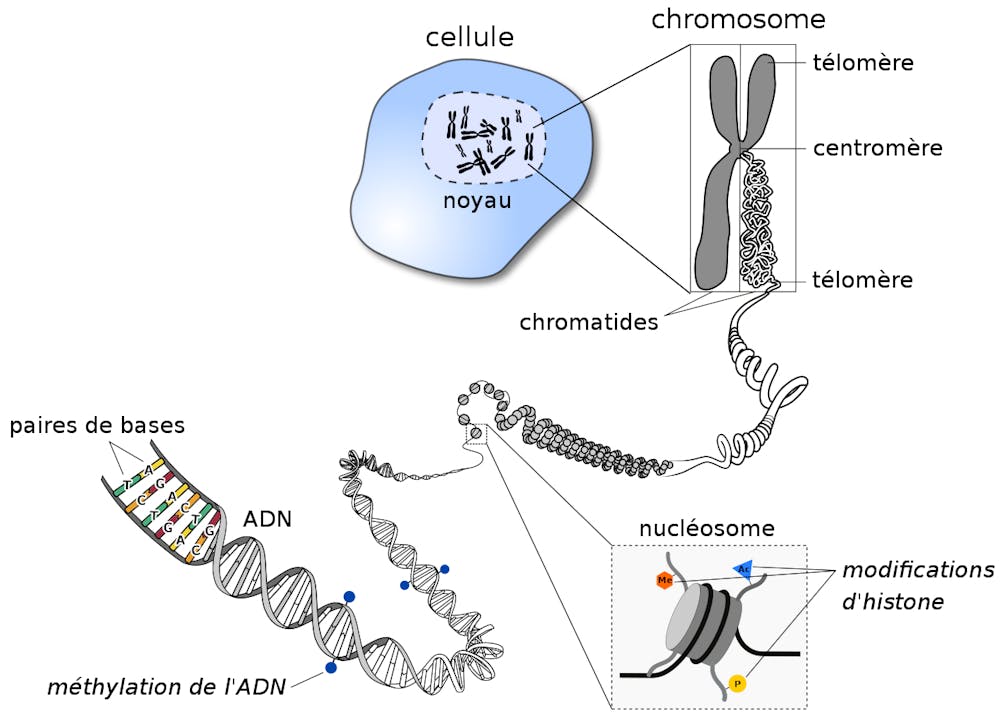
Epigenetic changes can occur at various levels and take many forms:
● Certain small RNAs that do not encode any genes are called “interfering” because their function is to interfere with the normal expression of DNA. They thus play a regulatory or structural role.
● Chromatin can be remodeled. This can lead to its inactivation and to dysregulation of gene expression.
● Histones, which enable DNA to be packaged, can also be chemically modified: by methylation (addition of a “methyl” groupX-CH3), acetylation (addition of an “acetyl” groupX–CO-CH3), phosphorylation (the addition of a phosphate group), or ubiquitination (the addition of a small protein called ubiquitin, which triggers the degradation of its target).
The effects are varied (chromatin condensation or decondensation to repress or activate gene transcription…), rapid, and short-lived.
● Finally, DNA can also be modified by the same type of chemical reaction. For example, local methylation silences genes in a stable but potentially reversible manner.
We had the opportunity to revisit these key topics at the annual conference of the Société francophone de tabacologie, held in Reims in November 2021. It was the topic of a session that I moderated with Dr. Jean Perriot.
On this occasion, Johanna Lepeule (IAB, Grenoble) addressed the issue of maternal smoking and placental DNA methylation. In a study published in 2020 in *BMC Medicine*, she and her team analyzed the placentas of 568 women, divided into three groups: nonsmokers (381 women); former smokers (70 women), who had quit within three months prior to pregnancy and did not smoke during pregnancy; and current smokers (117 women), who smoked within three months prior to pregnancy and during pregnancy.
The main findings were as follows:
● Alterations were observed in 152 regions of the genome where, after former smokers quit, DNA methylation appeared to return to the same level as that of nonsmokers. The changes in these regions were classified as reversible.
● Alterations were observed in 26 genomic regions where the level of methylation remained unchanged despite smoking cessation among former smokers and was comparable to that of current smokers. These regions may therefore carry the memory of preconception exposure to tobacco.
Among the genes affected by tobacco, a number have been identified as particularly important for fetal and childhood development.
So the message is clear: you must quit smoking as soon as the design plan is formulated.
Quitting smoking should apply to both the expectant mother and her partner. This is because the DNA of developing sperm can also be affected by methylation.

Alcohol also has a proven epigenetic effect, as noted by Prof. Mickael Naassila, president of the French Society of Alcohol Studies (SFA) and the European Society for Biomedical Research on Alcoholism (ESBRA).
Here again, several epigenetic mechanisms are involved:
● DNA hypermethylation observed in certain specific regions of blood cell DNA,
● Methylation and acetylation of a histone.
These changes are seen in alcohol use disorders and in fetal alcohol syndrome.
Research is currently underway in France on molecules that could help reduce alcohol consumption and prevent relapse, such as the administration of histone deacetylase (HDAC) inhibitors, including sodium butyrate.
In January 2022, the National Academy of Medicine published a report on the subject, edited by Jean-Pierre Goullé and Michel Hamon (Addictions Subcommittee), which contains several important points to note. Here are the main ones, identified in animal models.
● Cannabinoids: THC (Δ9-tetrahydrocannabinol) “is likely to cause epigenetic changes. These changes may be observed in individuals whose both parents, or just one parent, used the drug before conception; whose mother used it during pregnancy; or who were exposed to THC during adolescence or even later in life.” DNA methylation, histone modifications, and the presence of non-coding DNA have been observed.
● Cocaine: It causes histone acetylation, DNA methylation, and methylation of non-coding DNA.
The use of legal (alcohol and tobacco) and illegal drugs alters our epigenome. It is therefore important to take this into account in public health initiatives and prevention efforts targeting couples who wish to have a child and young people in particular. The use of validated methods based on psychosocial skills already allows us to take action in this regard.
To quote Claude Olievenstein, a psychiatrist specializing in substance use disorders, “Addiction is the interaction between a substance (a psychoactive substance), an individual, and an environment (family and sociocultural).” We have just seen how a psychoactive substance can affect our offspring and alter our genome in ways that are reversible, heritable, and adaptive. This interaction can thus make us more vulnerable and lead us to develop an addiction.