

This finding is certainly not new: physical activity is good for our health… As early as 1953, British epidemiologist Jeremy Morris provided the first evidence on this subject. He demonstrated that London red bus drivers, who spent 90% of their shifts sitting down, had a risk of heart attack roughly twice as high as that of their fellow conductors, who moved between the decks of the famous buses.
Since then, epidemiological studies have consistently confirmed this positive relationship between physical activity and health—an association that can be partly explained by the anti-inflammatory and immune-protective effects of exercise. An increase of just 10 minutes of moderate- to vigorous-intensity physical activity per day could save the lives of approximately 100,000 people in the United States each year.
Based on these strong arguments, many public health messages urge the public to be more physically active, as exemplified by the well-known slogan “eat, move.”
At first glance, these campaigns seem effective: most people today say they are aware of the benefits of regular physical activity and report that they intend to adopt a physically active lifestyle.
Yet in France, as in most countries around the world, levels of physical activity have never been lower, and sedentary time (activities performed while sitting or lying down, with energy expenditure equivalent to that at rest) is skyrocketing, particularly among the youngest age groups. Today, 80% of adolescents worldwide are not physically active enough, and the amount of time spent on sedentary activities each day has increased by 30 minutes over the past 15 years.
This disconnect between laudable intentions and actual actions leads us to ask the following question: Is promoting the health benefits of physical activity an effective way to change people's behaviors?
As in other areas of life, the choice to go for a run rather than watch television is based on complex decision-making processes that our multidisciplinary research team is working to better understand.
In behavioral economics, neuroscience, and psychology, most theoretical models agree that our decisions are based on the subjective value we assign to the behavioral alternatives available to us. Thus, the higher the value assigned to an alternative, the greater the likelihood that we will choose it. Using stairs—whose health benefits seem obvious—should be a more attractive option than the ever-crowded escalators… Isn’t health our most precious asset?
Three factors involved in decision-making lead us to a completely different conclusion. The amount of effort required (effort discounting) and the time one must wait (delay discounting) to reap these benefits, as well as cognitive biases that distort beliefs (belief distortion), drastically reduce the subjective value attributed to the benefits of physical activity.
First factor: Health benefits are only achieved after investing a significant amount of effort over the course of one’s life. However, by following the principle of least effort, such a level of investment risks greatly diminishing the value attributed to the expected benefits. A quick estimate illustrates this well: engaging in the 150 minutes of physical activity per week recommended by the World Health Organization (WHO) throughout one’s adult life (between the ages of 20 and 80) would amount to spending approximately 325 days (including nights) striving for better health. An effort that some might find “excessive” in the hope of gaining between 0.4 and 4.2 years of life expectancy.
Second factor: the subjective value attributed to the benefits of physical activity is diminished because these benefits are intangible and delayed over time. Since Walter Mischel’s 1972 “marshmallow test” with children, we have known that the prospect of an immediate, tangible reward is often more appealing than the prospect of a larger, delayed reward. This tendency applies to all stages of life, but it is particularly difficult to imagine a teenager committing to physical activity over the long term if their sole source of motivation is improved respiratory capacity or the preservation of their future cognitive functions.
Third factor: The health effects of physical activity are not immune to cognitive biases that may diminish their subjective value. In particular, mechanisms that distort our beliefs cause us to treat information that conflicts with our preferences or beliefs with “motivated skepticism.” Illustrating these biases, one study found that out of 16 smokers with lung cancer, only 2 attributed the cause of their illness to smoking. We can assume that a similar phenomenon exists with regard to physical activity: a tendency to underestimate its health benefits and to optimistically assume that a few extra hours spent watching television will have little impact. The likelihood of retrospectively attributing the onset of a health problem to a lack of physical activity also seems rather slim.
These three fundamental factors undermine the subjective value attributed to health benefits, which in turn explains the limited effectiveness of messages that focus solely on these benefits. Promoting this as the sole reason for engaging in physical activity risks fostering only a fragile commitment, one that relies solely on willpower—which, as we know, is fallible…
New Year’s resolutions made on December 31 are a concrete example: exercising for its health benefits or taking care of one’s physical appearance doesn’t stop gyms from emptying out as early as February…Especially since the ever-present temptations of a sedentary lifestyle, on the other hand, offer certain, immediate rewards that require no effort.
The model we have developed emphasizes the importance of incorporating positive outcomes other than health benefits into campaigns to promote physical activity.
The enjoyment derived from physical activity is widely recognized as a key factor in long-term commitment. Yet it is often overlooked when it comes to encouraging people to be more active. A perfect illustration of this point is that the WHO’s 2020 recommendations on physical activity mention the word “health” more than 200 times… but “enjoyment” not even once!
By focusing on the three key factors in decision-making—enjoying running, cycling, swimming, or jumping—we could foster physically active lifestyles that are sustained over time and across different contexts.
Experiencing positive emotional responses while engaging in physical activity first and foremost reduces the perceived cost of the effort. Activities in which individuals feel immersed or that align with their values are perceived as requiring less effort. Furthermore, the pleasure derived from physical activity provides an immediate reward, the effects of which tend to persist over a short emotional window (reduced anxiety, increased vitality, and improved sleep quality).
Finally, as a positive relationship with physical activity develops, beliefs about its benefits may become stronger. As the driving force behind a virtuous cycle, it seems more plausible to believe in potential benefits when the behavior that leads to them is perceived as enjoyable.
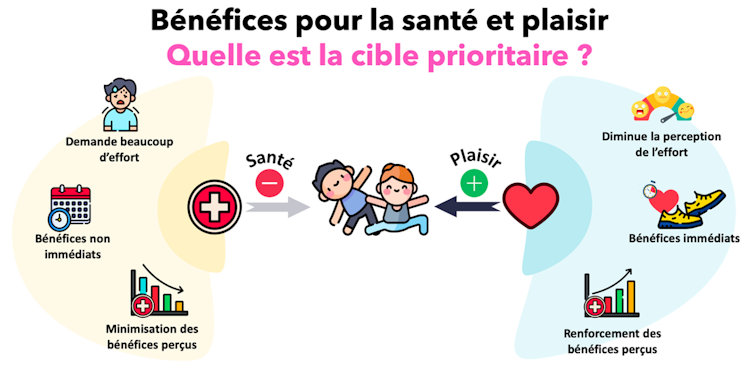
In short, experiencing (or expecting to experience) pleasure while being active reduces the perception of effort, provides immediate reward, and reinforces positive beliefs about physical activity. By factoring pleasure into the decision-making process, the subjective value associated with physical activity should increase, thereby promoting alignment between intention and action.
It may, however, seem naive to assume that all individuals, regardless of their life experiences, derive pleasure from physical activity.
But the fact that the emotional experiences derived from movement are, in part, within people’s control gives us good reason to be hopeful. For example, one study shows that simply reminding participants to “maximize” the pleasure they feel during a treadmill walking session allows them to have a more positive experience.
Similarly, a physical activity session offers a multitude of factors that can be adjusted to foster more positive emotions. Exercising in a setting we love, in good company, as the sun sets; listening to upbeat music; choosing a type of exercise and intensity that we find enjoyable—these are all factors to consider to ensure that physical activity becomes more than just a health benefit! Physical activity professionals (physical education and sports teachers, as well as adapted physical activity instructors) play a vital role here in supporting each person in their pursuit of pleasurable emotions.
While physical activity offers undeniable health benefits, simply highlighting these benefits is not enough to encourage people to maintain physically active lifestyles. Instead, let’s encourage everyone to discover the joy of physical activity and feel good in their own skin—in the hope that they’ll stick with it for the long haul!