

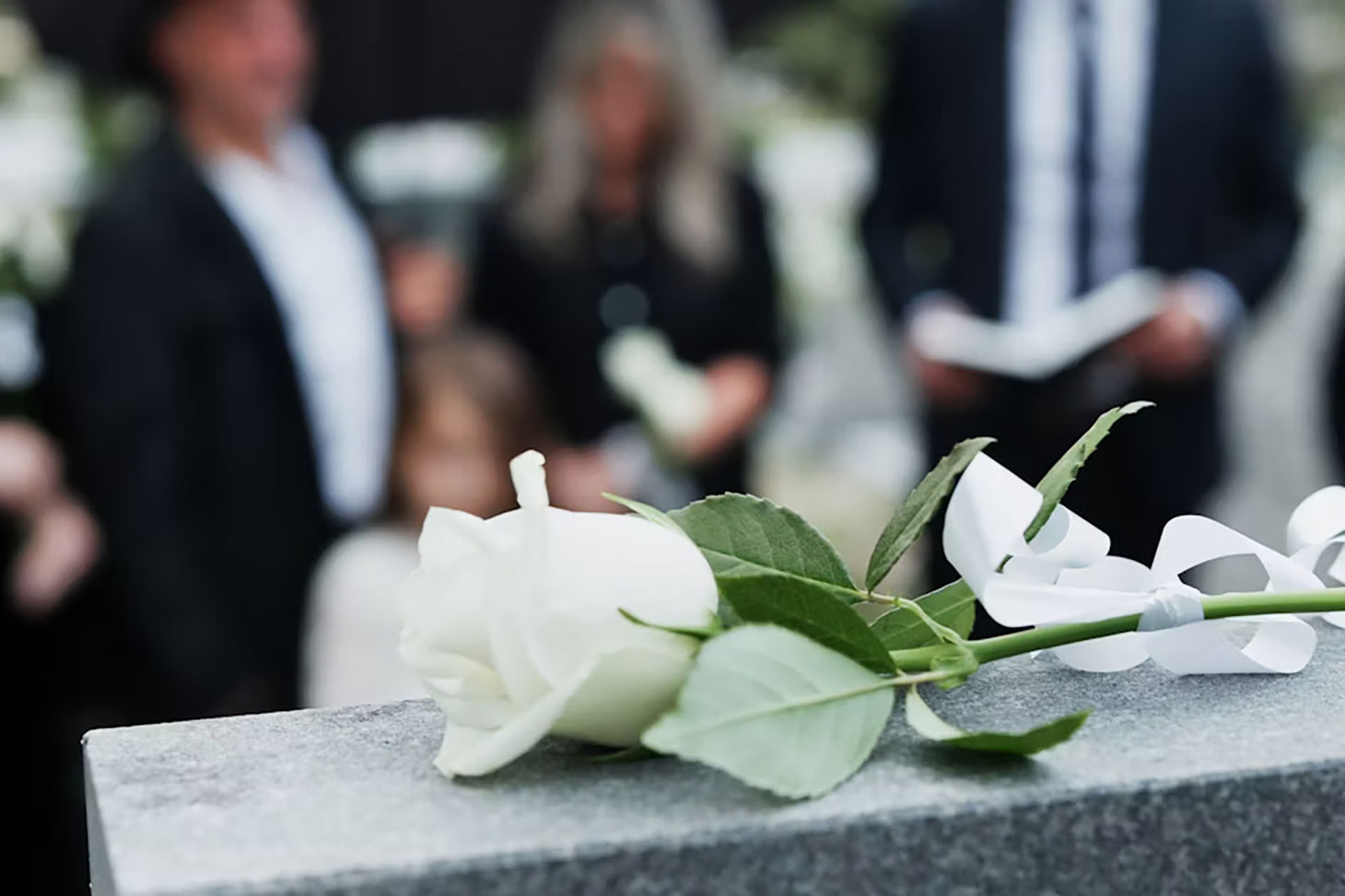
What happens to our bodies after we die? In societies where death is increasingly hidden from view, how have our rituals evolved? What will cemeteries look like in the future? Will burial or cremation be replaced by other methods? How will digital technology transform our funeral practices?
To answer these and many other questions, we’re presenting a series of six articles on the topic “The Body After Death, ” written by experts and illustrated by the artist Vito.
This third episode examines our contemporary funeral rites through the lenses of anthropology and sociology: How have they changed over the past few decades? How do we honor our deceased today? What does this reveal about our relationship with death?
The Essentials
- In contemporary societies, funeral rites have undergone a number of major changes.
- The funeral industry is now an indispensable part of society, and its professionals fulfill essential social and symbolic roles.
- Beyond official funeral rites, there are now various ways to honor the deceased.
However, research by anthropologists and sociologists debunks this common misconception. By combining these two disciplines, we can identify how funeral rites have changed and conclude that the deceased are still celebrated and honored—albeit in different ways. Here’s why.
Helping the living cope with the trauma of death
Human beings are defined by the fact that they are aware of their own mortality and suffer from this condition: the death of a loved one upsets the living, today as in the past, here as elsewhere. Anthropological studies teach us that this disruption is accompanied by a need to restore order—that is, to continue living, despite everything, by transforming our relationship with the person who is now absent.
These attempts to restore order are reflected in the funeral rite, in the desire to bring the living together around the deceased and to stand united in the face of an event that is beyond their control. In this sense, the funeral rite serves to support the group (and its members) and to reaffirm its survival and continuity. It also serves to acknowledge the fundamental separation between the living and the dead.
This is the role of rites of offering, which express two inseparable tensions among the living toward the deceased: the need to keep them with them a little longer, while accompanying them into the “afterlife.” This involves, for example, caring for the body, speaking words and singing, holding a wake, sharing food and drink, and placing objects beside the body and inside the coffin.
These rituals enable the living to adapt to, cope with, and overcome the trauma of death and its consequences, but they are not performed by everyone, nor do they take place at the same times, depending on the contexts studied.
Within the same space-time, rites of separation serve to put the deceased and death in their proper place. This involves not only showing respect for the deceased, but also protecting oneself from them: the deceased are frightening and may be contagious. It is necessary, both practically and symbolically, to ensure that they will not return. For example, the deceased is placed in a coffin—which may be sealed—and then buried in the ground or placed in a burial vault.
Sociology and Funeral Rites
Alongside anthropology, sociology invites us to consider the circumstances surrounding deaths (where, how, and with whom?), while linking them to the anthropological constants mentioned above.
The definition of funeral rites is the subject of endless debate within the humanities, and this article does not aim to revise that definition. It should be noted, however, that a funeral rite, as we understand it here, is a set of gestures, behaviors, discourses, and symbols that form a constellation around the deceased, representing the collective expression of honors and obligations toward the deceased—which are themselves negotiated in light of the individual and collective contradictions of the society under study.
In other words, funeral rites are a social construct that shapes our emotions through a staged ritual to which participants may or may not adhere.
Social scientists who have conducted research aimed at describing and understanding the current context of funeral rites agree on one point: several major changes have taken place in contemporary societies.
Major Changes
Thanks to advances in hygiene and medicine, Western societies—such as French society—have seen a significant drop in infant mortality and an increase in life expectancy. On average, we now live longer and in better health than our ancestors. A direct consequence of this is an aging population, which in turn leads to a growing number of annual deaths. In 2025, approximately 651,000 deaths were recorded in France. Projections for 2070 currently indicate 770,000 annual deaths.
Another key observation is that the places where people die have changed, with the vast majority of deaths now occurring in medical facilities rather than at home. The care of the deceased has gradually become more professionalized, and today it is no longer possible to do without professionals who specialize in end-of-life care and death (healthcare, mortuary, and funeral services).
In a socioeconomic context marked by secularization—a historical phenomenon whereby, since the second half of the 18th century, a gradual separation has taken place between the religious sphere and the public sphere, with churches relinquishing certain functions they once performed in civil and political society— and the professionalization of the funeral industry, it is also worth noting the emergence of a “death market” since 1993 and the law liberalizing funeral services.
Cemeteries (plots, green spaces), on the other hand, are managed by local governments. It is also their responsibility to fund the funerals of the “indigent” or those “without means.” If they own a crematorium, they may—through the terms set forth in their public service delegation agreement—regulate the prices of services or have a ceremony hall built. Finally, they may authorize the use of their community hall for funeral services (as they do for weddings or births).
Another major change that has taken place in France in recent decades: in a country where burial was the norm, the cremation rate has risen sharply. In 1980, it stood at 1 percent; today, it is 44 percent. Alongside urbanization, cremation has changed funeral practices, contributing to a certain detachment from the cemetery as the sole resting place for the dead. Indeed, the rise of cremation has allowed families to choose where to scatter the ashes with fewer restrictions, sometimes in defiance of the law.
We should also note the emergence of ecological aspirations regarding cemeteries and methods of body disposal (which is leading to the exploration of new practices, such as aquamation and terramation), as well as the recent digitization of our lives up to the time of death and beyond, which raisesethical, moral, and economic issues. Finally, among the new practices, we should mention the use of photography, video cameras, and live streaming during funerals.
In France, professionals dedicated to serving families
In France, the National Funeral Federation (the leading employers’ association in the funeral industry) counts 6,000 establishments and more than 23,000 professionals, with an estimated annual revenue of 3 billion euros.
The funeral industry is now an indispensable part of society. In fact, in our country, only funeral homes are authorized to transport the deceased and arrange for their burial or cremation. As a result, they have become true “ritual organizers,” orchestrating funerals and promoting new facilities (funeral homes, crematoriums).
Alongside them, we have seen the emergence, over the past decade or so, of funeral cooperatives that seek to change society’s view of death and funeral rites by promoting cooperative values and a commitment to service. They advocate against the commodification of death and in favor of reclaiming knowledge and expertise on these topics.
Funeral professionals perform essential—though often overlooked—social and symbolic functions: they organize and plan the ceremony with the family and loved ones, carry it out, and then dispose of the bodies—or, more precisely, ensure their cremation—and arrange for their final resting place, whether in a cemetery, a columbarium, or elsewhere.
These roles go hand in hand with interpersonal and emotional skills that, once again, are not widely recognized.
Unlike those in the healthcare and social services fields, funeral industry employees receive very little formal training and are primarily trained on the job. Building on a model in which families played a very active role (wakes, handling the body, funerals, etc.), French authorities have gradually shifted toward a model in which trained and paid professionals are responsible for caring for the dying and the deceased.
Understanding Contemporary Funeral Rites
Although France is a secular country, it has many believers, and the major monotheistic religions continue to play a significant role in funeral rites.
Apart from these religious funeral rites, there has been an increase in the number of so-called “civil” ceremonies. Unlike religious ceremonies, they focus less on the fate of the deceased in the “afterlife” (a matter relegated to the private sphere) and more on personalizing the farewell while offering comfort to the living.
The goal is to reflect the identity of the deceased and highlight their uniqueness by showcasing their various facets through music, slideshows, and personal tributes. In this contemporary context that celebrates the individual, funeral homes offer à la carte ceremonies, customized according to the choices of the deceased and their families.
We also observe that several rituals may be performed for the same deceased person. In fact, in addition to the official (institutionalized) funeral rite, it is not uncommon to see private or semi-public (instituting) rituals that correspond to the various social circles to which the deceased belonged: their workplace or school, their sports or recreational club, their groups of friends…For a single death, there may therefore be a variety of funeral rites involving different people, taking place at different times and in different locations.
Simply observing the official funeral rite is therefore no longer sufficient today to understand how a deceased person is honored: it is now necessary to broaden our perspective to take into account the aforementioned changes and their impact on the commemoration of the dead.
On the other hand, human reactions to death, as described by anthropology, do not seem to change: when faced with death, the focus is on bringing the living together, preserving memories of the deceased, honoring their memory, and maintaining a connection with them.
Acknowledgments
- The comic book panels were drawn by Victor Locuratolo (@Vito);
- The screenplay was co-written by Victor Locuratolo and Damien Charabidzé, the initiator of this series of articles;
- This publication was made possible thanks to funding from the Union du Pôle funéraire public (UPFP), an organization that brings together public funeral service providers to advocate for and promote their services, while ensuring dignified, ethical, and accessible support for all citizens. It also received funding from the Culture Department of the University of Lille, as part of its support for research and outreach projects that combine the arts and sciences.