

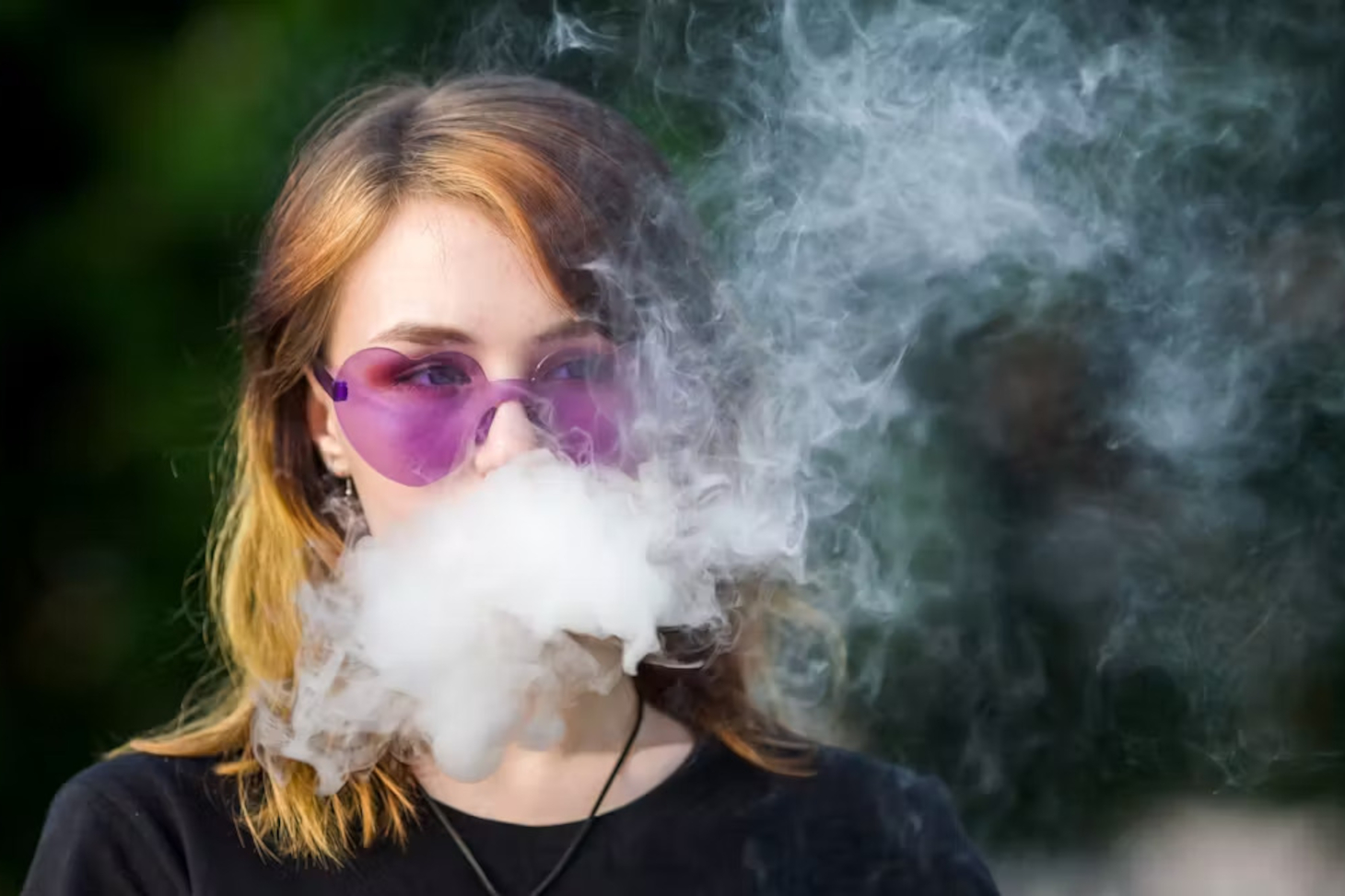
Beyond these environmental considerations, there are other arguments supporting the bill currently under review, which aims to ban this product. This relatively inexpensive mini e-cigarette is particularly popular among teenagers, despite a ban on sales to minors. What do you need to know about it?
Created in 2019 by Patrick Beltran and Nick Minas in California (United States)—both co-CEOs of Puff Bar—the puff (or “disposable pod”) is a mini e-cigarette with an attractive design that holds 1 to 2 ml of e-liquid.
It provides 300 to 600 puffs with sweet and fruity flavors, for a price ranging from 6 to 10 euros (other models provide up to 1,600 puffs). The puff comes in many flavors: puffs containing a wide variety of sweet and fruity flavors are available for purchase.
Regardless of their flavor, the liquids in vapes are made of synthetic nicotine—in other words, nicotine that does not come from tobacco leaves. More specifically, they are nicotine salts. What exactly are these substances?
Nicotine salts are produced by adding an acid (such as benzoic acid, lauric acid, sorbic acid, etc.) to nicotine base. They have the advantage of being less acidic than the nicotine found in cigarettes and in conventional e-cigarette liquids. Research suggests that this results in better nicotine absorption and alters the sensory experience: since they are less irritating, they cause less coughing.
Nicotine salts with a 5% concentration—or 50 mg/ml of nicotine—are available on the market, which is more than double the amount permitted in Europe (20 mg/ml). It is worth noting that concentrations of 57 mg/ml were found in the e-liquids used in the Juul, another stylish and colorful (but refillable) e-cigarette that enjoyed some success in the United States—before the Food and Drug Administration (FDA), the U.S. agency responsible for regulating food and drugs, ruled to ban it.
The use of nicotine salts is not insignificant, as it helps avoid the negative effects of traditional cigarettes—such as irritation and coughing—which limit cigarette use among people who have never smoked. As a result, they are easier to use and have no adverse effects.
The presence of nicotine can therefore lead to nicotine dependence, as can be observed in a nonsmoker who uses nicotine lozenges or tablets (NRT) or, of course, smokes a cigarette (which also contains other toxic substances).
This ease of vaping comes at a time when the use of e-cigarettes by some middle and high school students is on the rise, despite a ban on sales to minors in our country.
According to the EnCLASS study published in 2024, lifetime use (which reflects experimentation), monthly use, and daily use of cigarettes declined between 2018 and 2022 among French middle school students. Consumption of 10 or more cigarettes per day remains low (0.5%) and remained stable between 2018 and 2022. Lifetime and monthly e-cigarette use also remained stable over the same period.
There has also been no change in middle school students’ experimentation with e-cigarettes or their use within the past month. In 2022, one in five middle school students had already vaped, and one in ten had done so within the past month. Daily use was reported by 1.4% of middle school students in 2022 (the first year the question was asked). This means that the prevalence of daily use is equivalent to that of traditional cigarettes.
Among high school students, lifetime (experimental) use, monthly use, and daily use of cigarettes decreased between 2018 and 2022, as did the use of 10 or more cigarettes per day, which fell from 4.2% to 1.4% between 2018 and 2022. When it comes to vaping among high school students, the picture is more nuanced.
While there was a decline in e-cigarette experimentation between 2018 and 2022, both monthly and daily use increased (24.2% vs. 16.6% and 3.8% vs. 2.8%, respectively) over the same period.
It should be noted, however, that vaping does not serve as a gateway to smoking: rather, it has a displacement effect—a distracting effect—as we demonstrated in a recent publication presented by pulmonologist Bertrand Dautzenberg at the 2023 conference of the Francophone Society of Tobacco Research.
On March 21, 2024, members of the National Assembly and the Senate, meeting as a joint committee, reached an agreement on a final draft. This draft must still be definitively approved by the National Assembly and the Senate before it can be enacted. Its sole article amends the Public Health Code to prohibit the manufacture, offering for sale, sale, distribution, or free distribution of disposable or single-use e-cigarettes, known as “puffs.” Possession for the purpose of sale, distribution, or free distribution is also prohibited.
Violations of these prohibitions will be punishable by a fine of up to 100,000 euros (200,000 euros for repeat offenses). Officials from the competition, consumer protection, and fraud enforcement agencies will be authorized to investigate this new violation.
Following the CMP, the Minister of Health announced her decision to immediately notify the European Commission of the text, in accordance with the European Directive of April 3, 2014, known as the “Tobacco Directive.” The Commission will have six months to approve or reject it.
Other European countries, such as Germany, Ireland, and Belgium, are also considering banning “vapes” through legislation. On March 18, 2024, the European Commission gave its approval to the Belgian government.
However, it is not certain that this will be enough to completely prevent the use of these products.
A post titled “#Discreetshipping on TikTok: Online Sales of E-Cigarettes” shows that TikTok users around the world are violating local, state, and federal laws by selling e-cigarettes hidden inside other products or bundled in packages designed to avoid detection.
A ban on TikTok by the authorities would likely be somewhat effective… However, a less drastic solution lies with parents, who can monitor, restrict, or block access to TikTok using parental controls. The same approach can be applied to other social media platforms such as Facebook or Instagram.
Their own behavior also plays a key role: a survey published in 2023 by the “Alliance Against Tobacco” revealed that prevention starts with parents. In particular, the study notes that adolescents’ “use of e-cigarettes is higher when at least one parent smokes” (28%). The figure is even higher when both parents smoke (41%).
But we know full well that teenagers, in their search for novelty or thrills, sometimes do not hesitate to break the rules, as evidenced by occasional heavy drinking, experimentation with synthetic cannabinoids, or nitrous oxide.
Drawing on psychosocial skills—as we do atthe Regional Observatory on Adolescent Risk Behaviors (OTCRA at the University of Grenoble-Alpes, in collaboration with the Isère Regional Education Authority and the Isère Prefecture)—is another approach worth considering. These skills are defined as “a person’s ability to cope with the demands and challenges of daily life.”
Acquiring these social, cognitive, and emotional skills helps reduce the use of alcohol, tobacco, and cannabis in particular, which confirms the effectiveness of this comprehensive approach that is not solely focused on substances.
For more information:
The website ofthe French Observatory on Drugs and Addiction Trends;
The website ofthe Regional Observatory on Adolescent Risk Behaviors;
The association's website Tabagir.