

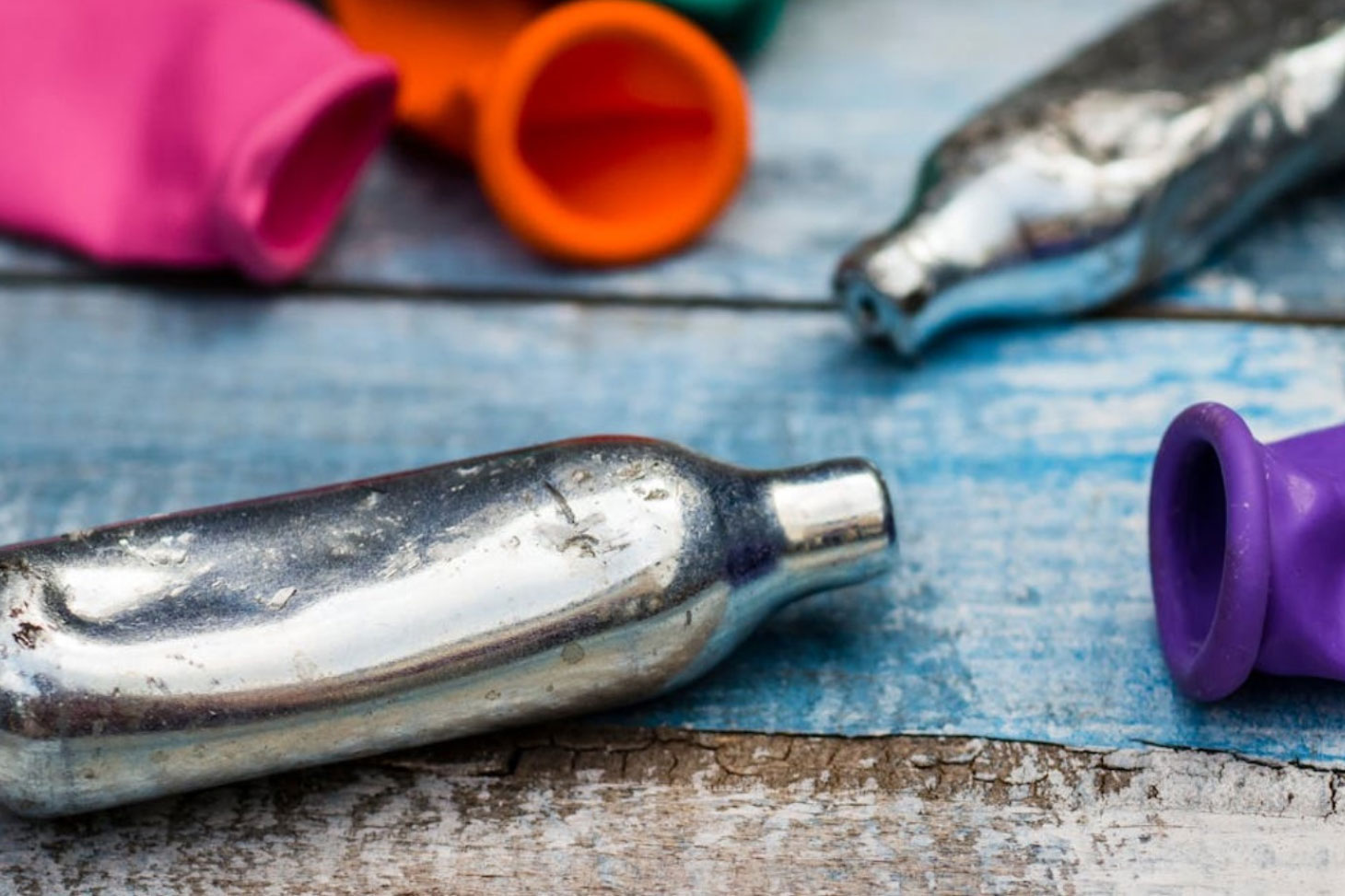
The ban on selling nitrous oxide—the so-called “laughing gas”—to minors is not enough. This substance continues to be misused for recreational purposes, at the cost of neurological damage that can lead to serious long-term consequences.
A few years ago, while I was speaking at a training session organized by the health services department, Bruno Revol, a pharmacist and professor-researcher, told us about the death of a student at the University of Grenoble following the inhalation of nitrous oxide.
While this gas, when mixed with oxygen, has long been used in the medical field as an anesthetic, it is other properties that have, in recent years, led a growing number of young people to misuse it: inhaling nitrous oxide causes fits of laughter and a loss of inhibition, which has earned it the nickname “laughing gas.” Sometimes, however, this comes at the cost of serious complications.
From “air bag parties” to the invention of general anesthesia
Nitrous oxide, with the chemical formulaN₂O, was discovered in 1772 by the English pastor Joseph Priestley, known for his work as a chemist and physicist. It was another British chemist, the young Humphry Davy, who discovered its euphoric and disinhibiting properties at the turn ofthe 18th and19th centuries.
His experiments soon caught on: chemists, doctors, playwrights, surgeons, poets…English high society organized memorable “air bag parties” to inhale this “laughing gas,” which also made its way to fairs.

It was not until themid-19th century that its analgesic properties (which become apparent at concentrations above 10%) were discovered. Although nitrous oxide has a low anesthetic potency and cannot be used to perform surgery on its own, this gas can nevertheless be used as an adjunct. Thus, in combination with ether inhalation, it made it possible to perform the first surgical procedures under general anesthesia.
Nitrous oxide was subsequently used for many years by dentists for tooth extractions. It was also used to treat the wounded during World War I, in place of chloroform and ether.
An anesthetic still in use today
Colorless and odorless, nitrous oxide has high diffusibility and low solubility in tissues, which explains its short duration of action. It is not converted (“metabolized”) by the body. Furthermore, it is rapidly eliminated through the lungs as soon as administration is stopped.
Currently, nitrous oxide is still used in anesthesia, in the form of a mixture consisting of 50% oxygen. Known as MEOPA (Equimolar Mixture of Oxygen and Nitrous Oxide), this mixture should not be confused with pure nitrous oxide, as noted by psychiatrist Daniel Annequin, a pain specialist.
Inexpensive, effective, fast-acting, and reversible, this analgesic is used when short-term, painful procedures must be performed outside the operating room (such as changing painful or burn dressings, performing lumbar punctures, applying sutures, etc.). It is also used in delivery rooms during labor.
In France, MEOPA is the drug of choice for painful pediatric procedures and treatments. Its use is authorized in private practice, particularly by dentists (with a nasal cannula). Although it can sometimes cause side effects (dizziness, nausea, vomiting, agitation, or drowsiness…), the risk-benefit ratio in favor of its use is still considered positive.
However, practical guidelines for its use in a medical setting have been established, particularly to account for its effects on vitamin B12.
It is this toxicity that is primarily responsible for the serious effects observed with repeated or chronic use of pure nitrous oxide, particularly when used “recreationally.”
Outside the Hospital: Risky Misuses
Nitrous oxide is not used exclusively in medical settings. For example, it is also used in the automotive tuning industry as an oxidizer to increase engine power, as well as in the culinary field as a propellant, particularly in kitchen siphons such as those used for whipped cream.

Every Tuesday, get the latest health news: nutrition, wellness, new treatments… Subscribe for free today.
The problem is that these cartridges are being misused and inhaled, most often through balloons. The effects sought by users—often teenagers and young adults—include euphoria, hilarity, uncontrollable laughter, distorted perceptions (auditory and visual), a sense of dissociation, a “floating” sensation, and disinhibition. Since these effects last only two to three minutes, users often take the substance repeatedly.
However, nitrous oxide is neurotoxic. It irreversibly inactivates vitamin B12. This vitamin, which is essential for nerve function (as well as for the formation and maturation of red blood cells and DNA synthesis), is primarily obtained from animal-based foods. Stored in the liver, it enables the proper functioning of the brain (synthesis of neurotransmitters) and the nervous system (myelination of neurons).
The inactivation of vitamin B12 by nitrous oxide gradually depletes hepatic stores and leads to a deficiency in neurological function, affecting the brain and neurons.
Health Effects
The risks associated with the recreational use of nitrous oxide can be immediate: frostbite from the gas released directly from the canister, asphyxiation due to lack of oxygen and resulting cardiac problems, loss of consciousness, disorientation in time and space, risk of falling, impaired alertness, dizziness, and overdose with motor and cardiorespiratory problems.
Complications resulting from repeated use at short intervals or in high doses can be severe and sometimes irreversible: addiction; neurological and neuromuscular damage (manifesting as pain, loss of sensation, loss of strength in the limbs, gait disturbances, and incontinence); psychiatric disorders; heart damage; and fertility problems.
These risks are heightened when the gas is combined with other psychoactive substances, particularly alcohol, poppers, cannabis, or psychostimulants.
In cases of chronic use, the toxicity of nitrous oxide with respect to vitamin B12, as well as the lack of oxygen in the brain (cerebral hypoxia), have significant consequences.
Neurologically, these manifest as simultaneous damage to the spinal cord and peripheral nerves (myeloneuropathy). In fact, due to the inactivation of vitamin B12, demyelination of the spinal cord occurs—in other words, damage to the myelin, the “sheath” surrounding nerve fibers, which is essential for the transmission of nerve impulses.
As a result, patients experience progressive numbness in the limbs and impaired coordination of muscle movements (ataxia) in both legs “”). Neurocognitive symptoms are also observed, including language disorders (aphasia) and amnesia.
The circulatory system is also affected, which manifests primarily as hematological disorders (bone marrow damage, anemia, leukopenia, thrombocytopenia, etc.). Cardiovascular problems such as arrhythmia, coronary syndrome, stroke, and pulmonary embolism can also result from chronic nitrous oxide intoxication.
In addition, various psychiatric and behavioral disorders have also been reported (including paranoia, delusions, and hallucinations, among others).
The issue of nitrous oxide addiction also arises, due to the presence of a withdrawal syndrome characterized by nausea, vomiting, sweating, tachycardia, tremors, sleep disturbances, and hallucinations.
What treatment is available in case of poisoning?
If you suspect nitrous oxide poisoning, here is what to do (for the person who is poisoned or those around them if the person is unable to do so).
If poisoning occurs during the day and the victim is conscious but experiencing persistent symptoms (tingling, unsteadiness, nausea, etc.), the victim’s primary care physician may be contacted. Poison control centers can also be contacted 24 hours a day (a list of phone numbers is available on their website).
If the person loses consciousness, behaves abnormally, has difficulty breathing or walking, or experiences seizures or sudden neurological symptoms, call emergency services (by dialing 15 or 112 from a cell phone).
Emergency department management is based on laboratory testing (plasma homocysteine and methylmalonic acid levels) and will be tailored to the patient’s symptoms.
Nitrous oxide poisoning should be suspected whenever individuals exhibit gait disturbances. These symptoms are caused by damage to the posterior columns of the cervical spinal cord or the presence of neuropathy.
A teleconsultation service dedicated to this issue was launched by Christophe Riou, an addiction specialist, in collaboration with the addiction monitoring center at the Hospices Civils de Lyon and the Pierre Wertheimer Hospital. Easy to access and discreet, it is tailored to young people and their families and friends.
Consumption is on the rise, particularly among young people
According to data from the Santé publique France Barometer, in 2022, 14% of 18- to 24-year-olds had already tried nitrous oxide, and more than 3% reported having used it during the year.
In 2023, 472 reports related to nitrous oxide use were recorded by the centers for the assessment and information on drug dependence and addiction surveillance, representing a 30% increase compared to 2022. Poison control centers, for their part, received 305 reports, a 20% increase from 2022.
These figures confirm the increase in the number of reported cases of complications associated with nitrous oxide observed in recent years.The French Association of Addiction Surveillance Centers also notes that the proportion of reports involving women is rising. These reports also reveal an increase in cases linked to repeated and prolonged use (that is, lasting more than one year).
Of these reports of abuse, misuse, and dependence, 92% involve the consumption of high doses and the use of large-volume cylinders, while 50% of them indicate daily consumption.
User Profiles
In the Netherlands, according to the European Union Drugs Agency, the 2020 general population survey of adults aged 18 and older found that nitrous oxide use in the past 12 months was highest among young adults aged 18 to 19 (14.5%) and 20 to 24 (12.1%).
In Denmark, a 2019 survey found that lifetime use among young people aged 15 to 25 was 13.5 percent, compared with 6.5 percent in the past 12 months.
A 2016 survey conducted in the United Kingdom found that 9% of 11- to 15-year-olds had been offered nitrous oxide, and in 2021, 1.8% of young people in the same age group admitted to having used it.
According tothe ANSM, users are more often men (58%) with an average age of 22, and 10% are minors. 80% of the reports cite neurological disorders.
Measures Prohibiting Sales in France
As of June 1, 2021, the sale of nitrous oxide (laughing gas) to minors is prohibited in all stores, public places, and online. It is also prohibited in bars, nightclubs, temporary drinking establishments, and tobacco shops.
In July 2023, a decree set a limit of 10 cartridges on the amount that can be sold to individuals; however, no specific penalties are mentioned in the event that this limit is exceeded.
On January 29, 2025, the National Assembly passed a bill in its first reading that would ban all sales to individuals, regardless of age, in all stores and online. The law is scheduled to take effect on January 1, 2026.
This ban will apply to the importation, sale, and distribution of the product, while providing for exemptions for certain professionals (in the medical, restaurant, and food industries) through a decree that defines authorized distribution channels and traceability requirements.
In addition, following Lyon’s lead last year, the city of Grenoble decided on May 5, 2025, to ban the use, sale, and disposal of nitrous oxide on public streets. The ordinance applies to the eastern and downtown areas of the municipality through December 31, 2025.
Let’s conclude by noting that nitrous oxide is a powerful greenhouse gas. It ranks third among the greenhouse gases whose emissions contribute to global warming, behind carbon dioxide (CO2) and methane (CH4) ( excluding water vapor). It is 265 times more potent than CO2 and has a long half-life of 120 years (in this case, the half-life is the time it takes for half of the substance in question to break down). Nitrous oxide is also one of the main agents responsible for the destruction of the ozone layer.
However, each year, emissions of nitrous oxide used for anesthesia alone are estimated at several million metric tons ofCO2 equivalent in developed countries. Consumption has been slow to decline in Europe despite numerous medical recommendations to restrict its use. This is yet another reason to avoid recreational use of nitrous oxide, aside from the health risks it poses…
Learn more
-
The webinar on “nitrous oxide” hosted by the French Association of Biological Psychiatry and Neuropsychopharmacology (AFPBN);
-
The website of the Teleconsultation focused on issues related to nitrous oxide.