


Our minds have a special relationship with repetition. Take the experience of déjà vu, when we mistakenly believe we have experienced a situation in the past, leaving us with an unsettling sense of déjà vu. We have discovered that déjà vu actually offers insight into how our memory works.
Our research has shown that this phenomenon occurs when the part of the brain that detects familiarity becomes desynchronized from reality. Déjà vu serves as a signal warning us of something strange: it is a kind of “confrontation with reality” carried out by the memory system.
Repetition can, however, have even more unsettling and unusual effects. The opposite of déjà vu is “jamais vu,” when something we know to be familiar suddenly seems unreal or new. As part of our recent research—for which we have just won the Ig Nobel Prize in Literature—we studied the mechanism behind this phenomenon.
The “never-before-seen” effect occurs, for example, when you see a familiar face and suddenly find it strange or unfamiliar. Musicians may experience this feeling when they lose their way in a passage of music they know very well. You also experience this effect when you arrive at a familiar place and feel disoriented there, or when you see it in a new light.
This is an experience even rarer than déjà vu —and perhaps even more unusual and unsettling. When people are asked to describe it in questionnaires about everyday experiences, responses include statements such as, “During an exam, I spell a word like ‘appetite’ correctly, but I read and reread the word because I can’t be sure it’s spelled right.”
In everyday life, this can be triggered by repetition or by staring at something, but that’s not always the case. Akira, a member of our team, has experienced this sensation while driving on the highway, which forced him to pull over to the shoulder so that his sense of not knowing what to do with the pedals and the steering wheel could “reset.” Fortunately, this doesn’t happen often.
We don't know much about this phenomenon. But we assumed it would be fairly easy to reproduce it in a laboratory setting. When you ask someone to repeat something many times, it often loses its meaning and becomes confusing.
It was on this basis that we conducted our research on the “never-before-seen.” In an initial experiment, 94 undergraduate students were asked to write the same word multiple times. They did so with twelve different words, ranging from the most common, such as “door,” to less common ones, such as “sword” (an uncommon term for a lawn).
We told the participants that they had to copy the word as quickly as possible and that they were allowed to stop. We gave them a few reasons why they might want to take a break, such as feeling strange, getting bored, or having a sore hand. The most common reason given was that things were starting to feel strange, and about 70% of the participants stopped at least once because they experienced something akin to “déjà vu.” This usually happened after about a minute (33 repetitions)—and especially with familiar words.
In a second experiment, we used only the word “the,” considering it to be the most common word in the English language. This time, 55% of participants stopped writing for reasons that met our definition of “unprecedented” (after an average of 27 repetitions).
Here’s how participants described their experience: “They lose their meaning the more you look at them,” “I feel like I’m losing control of my hand,” and—our favorite—“It doesn’t seem normal; it’s almost as if it weren’t a word at all, but someone had tricked me into thinking it was.”
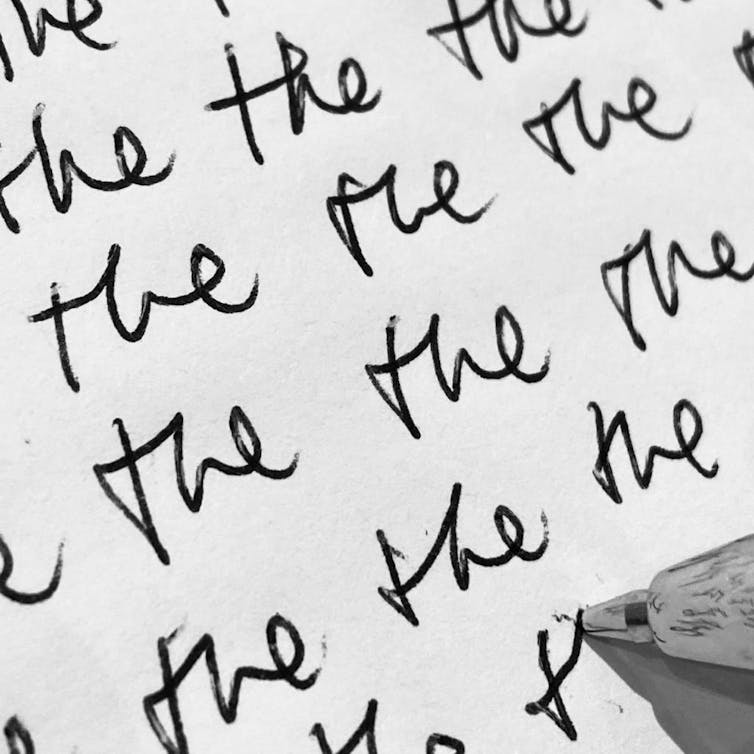
It took us about 15 years to write up and publish our findings. In 2003, we worked on the assumption that people felt strange when writing the same word over and over again. Chris, a member of our team, had noticed that the sentences he was asked to write over and over again as punishment in high school gave him a strange feeling, as if they weren’t real.
It took 15 years because we weren’t that smart and our idea wasn’t as innovative as we thought it was. In 1907, Margaret Floy Washburn, a little-known pioneer in psychology, published an experiment she conducted with one of her students that demonstrated the “loss of associative power” in words that were stared at for three minutes. The words became strange, lost their meaning, and fragmented over time.
We had reinvented the wheel. These methods and introspective investigations were simply no longer in vogue in psychology.
Our unique contribution is to suggest that the transformations and loss of meaning associated with repetition are accompanied by a particular feeling: the “never-before-seen.” It signals to us that something has become too automatic, too easy, too repetitive. It allows us to step back from our current way of functioning, and this sense of strangeness constitutes a confrontation with reality.
It makes sense that this happens. Our cognitive systems need to remain flexible, which allows us to focus our attention where it’s needed rather than getting bogged down for too long in repetitive tasks.
We are only at the beginning of our understanding of the “never-before-seen.” The main scientific explanation is “satiation,” which involves overloading a mental representation to the point where it loses all meaning. Among similar concepts is the “verbal transformation effect, ” in which the repetition of a word triggers “related” words, so that if people start by listening to the word “tress” on a loop, they eventually hear “dress,” “stress,” or “florist.”
This phenomenon appears to be linked to research on obsessive-compulsive disorder (OCD), which has examined what happens when someone compulsively stares at objects, such as lit stove burners. As with repetitive writing, this leads to a distortion of reality, which can help us understand and treat OCD. If repeatedly checking to see if the door is locked eventually renders the task meaningless, it becomes difficult to know whether the door is locked or not, and a vicious cycle sets in.
In conclusion, we are honored to have received the Ig Nobel Prize in Literature. The winners of these prizes contribute to scientific work that “makes you laugh and then makes you think.” We hope that our work on the “never-before-seen” will inspire further research and lead to a deeper exploration of the subject in the near future.