

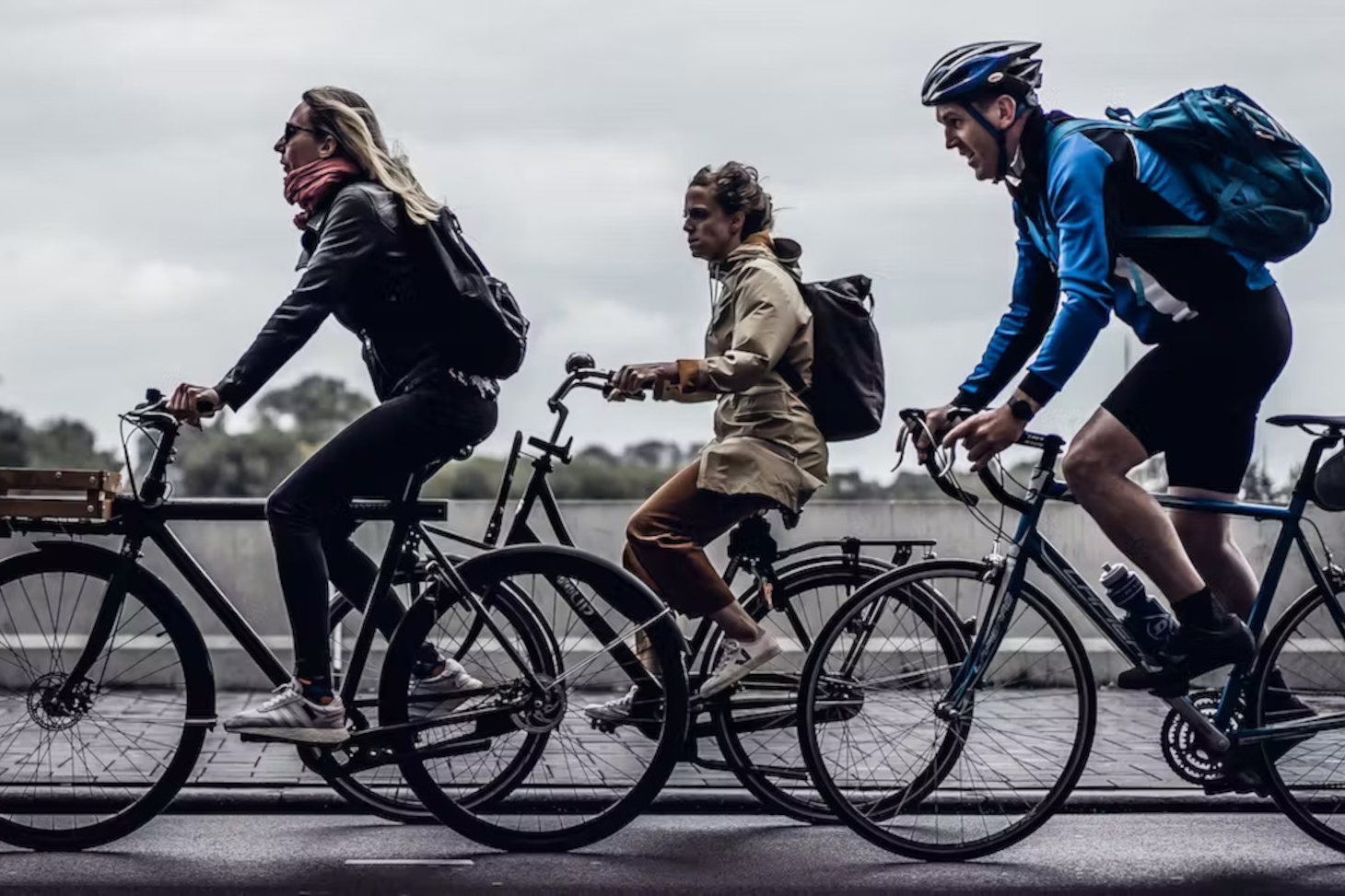
Cars remain the most common mode of transportation for commuting to work (73%), even for distances of less than 5 kilometers, which could easily be covered using alternative modes of transportation. Between 2015 and 2020, the modal share of bicycling (that is, the percentage of trips made by bicycle) increased by only 0.9 percentage points, rising from 2% to 2.9%.
This observation raises the question of the effectiveness of policies aimed at promoting the use of sustainable modes of transportation and so-called “active” mobility—in other words, forms of mobility that involve physical activity. This can include not only walking or biking, but also public transportation: on average, a trip by bus, tram, or train requires walking for at least ten minutes, depending on the distance to the stops.
These policies, which aim to encourage people to adopt different behaviors, have so far taken two main approaches: a punitive approach (carbon tax, low-emission zones designed to exclude certain vehicles) or an incentive-based approach, but from a strictly monetary perspective (sustainable mobility allowance).
However, our research indicates that there are other possible approaches, such as leveraging social influence or appealing to individual health concerns. By combining these approaches, it may be possible to enhance the effectiveness of public interventions. Here’s why.
Various research studies have suggested that social influence could be an important factor in encouraging the adoption of active transportation.
The problem is that, until recently, social interactions were assessed based on factors such as living in the same neighborhood, for example. However, these types of criteria alone do not fully capture social influence.
This can also be experienced, for example, through the enjoyment one feels when riding public transportation with colleagues one likes. This is what’s known as strategic complementarity: Carole likes to take the tram with Béatrice because it gives them a chance to discuss the latest episode of their favorite TV show…
Social influence can also manifest itself through the desire to conform to the behavior of those immediately around us: all of Anna’s friends ride their bikes to work, which encourages her to do the same so she won’t be the only one driving.
To understand the role of social influence, it is therefore important to be able to identify each individual’s specific social circle (friends, coworkers, family, etc.). This was the focus of the ResCampus research project, which was conducted among staff at the Grenoble university campus.
We began by collecting data to identify the coworkers with whom each person interacts in the workplace—whether during lunch or coffee breaks, for example. This information then allowed us to highlight the impact of social influence on transportation choices.
More specifically, we have shown that when a person adopts an active mode of transportation, the people with whom they interact at work are more likely to use an active mode of transportation as well (an average increase of 24% in our sample).
It is estimated that this effect is primarily due to conformity with the travel habits of one’s professional circle: changes in individual travel behavior lead to shifts in social norms within an individual’s circle, which in turn encourage them to change their mode of transportation.
Social influence therefore promotes the growth of active transportation. This type of transportation has a positive impact on the environment and our shared living spaces, as well as on personal quality of life and health. This represents another lever that can be utilized to encourage the choice of active transportation…
The argument regarding individual health is also an important motivational factor when it comes to encouraging the development of active transportation.
While driving every day contributes to a sedentary lifestyle, the growing popularity of cycling—thanks in particular to the development of urban infrastructure and the rise of electric bicycles—encourages regular physical activity.
It is now widely accepted that physical activity is not only linked to better health, but also to an improved quality of life and well-being.
However, these health benefits serve as a source of personal motivation and thus constitute an initial catalyst for behavioral change.
In other words, people don’t give up their cars because of the negative externalities associated with driving (pollution, noise, etc.), but rather because the alternatives—cycling or walking—are enjoyable and beneficial to their health and well-being.
This phenomenon can be explained, in particular, by self-determination theory, which posits that new behaviors are more likely to be adopted if they are associated with a sense of choice and free will rather than with a perception of obligation and coercion.
Based on these findings, public authorities should therefore direct their efforts toward ensuring that citizens view mobility more as a health-promoting behavior, and not merely as a “sustainable” one.
As such, the number of public initiatives highlighting the health benefits of active mobility could be increased. This could involve not only developing information campaigns but also organizing “mobility challenges.” During these events, held one day a year, a company’s employees are encouraged to use an alternative mode of transportation to the car for their commute to work.
Individualized coaching can also be provided to offer specific information and advice based on an understanding of each person’s individual needs and travel habits. For example, when the Low-Emission Zone was implemented in Grenoble, the metropolitan area rolled out a support program focused on changing mobility patterns, which users can access by scheduling an appointment with a mobility advisor.
Building on this foundation, social influence could subsequently amplify the impact of these policies through “snowball” effects, particularly in the workplace, where social interactions enhance the spread of best practices, as our research has shown.