


In practice, throughout the year, you can continue to download the Try Dry app from #DryJanuaryFrance, which is supported by, among others, the Fédération Addiction, a network of organizations and professionals in the field of addiction treatment.
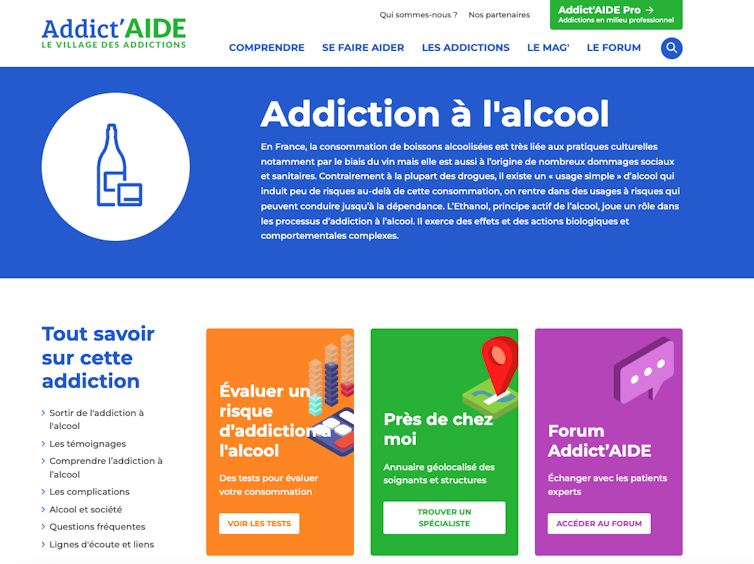
This app lets you easily assess youralcohol consumption by completing the AUDIT questionnaire ( Alcohol Use Disorders Identification Test ). The questionnaire is also available online through the Addict’AIDE Fund.
Depending on the results, you should consult your primary care physician or another healthcare professional.
Simple and short—with only ten questions—the AUDIT questionnaire is internationally validated. As its name suggests, this test assesses your alcohol consumption as well as your risk of developing a disorder related to that consumption, based on a score you receive after answering all the questions.
The first three questions concern the patient's drinking habits: how often they drink, the number of drinks consumed per drinking occasion, etc.
Questions 4 through 6 focus on alcohol dependence: loss of control, an inability to fulfill one’s obligations, and a need for alcohol first thing in the morning;
Finally, questions 7 through 10 focus on alcohol-related issues: feelings of guilt, regrets after drinking, blackouts (when you can’t remember the events of the previous night), injuring yourself or someone else (as a result of drinking), and receiving advice on how to cut back on drinking.
If the score is 7 or higher for men and 6 or higher for women, this means there is a risk that the person may have what is known as an “alcohol use disorder.” The higher the score, the greater the risk.
When discussing the issue of alcohol, the image of the drunkard or alcoholic described by the writer Émile Zola remains deeply ingrained in France. And because of changing drinking patterns—less regular alcohol consumption during meals, more heavy binge drinking one or two days a week—many patients are dependent on alcohol without realizing it and reject the idea.
This is particularly true for young adults who meet several criteria for alcohol dependence and are in denial. This pattern of alcohol consumption also appears to be on the rise among women over the age of 35.
This phenomenon also affects adolescents, starting as early as middle school. According to a survey published in 2024, episodes of heavy episodic drinking are reported among a significant proportion of adolescents—as early as the4thand3rdgrades of middle school—and a large number of high school students.
In any case, viewing heavy, occasional drinking (a term preferred over the Anglicism “binge drinking”), which occurs two to three times a week, as a form of alcohol dependence may encourage some of those affected to change their behavior and reduce their consumption.
Alcoholism encompasses alcohol dependence and its medium- and long-term physical and psychiatric consequences. It is essential to view an alcoholic—a term that is, and remains, pejorative—as a patient in every sense of the word.
In thefifthedition of the Diagnostic and Statistical Manual of Mental Disorders (DSM-V-TR), the concept of abuse and dependence was removed. Today, it is generally accepted that there is a continuum ranging from mild to moderate to severe alcohol use disorder (AUD), depending on the number of dependence criteria present (over the past 12 months).
In practice, certain warning signs should raise concern: heavy daily alcohol consumption, violent behavior, and negative impacts on family, social, and professional life. Physically, morning sweats or tremors, sleep disturbances, or high blood pressure may be indicative of a disorder related to alcohol use.
Unfortunately, alcohol consumption is rarely discussed during general practice visits, even though it should be routinely addressed, just as it is with tobacco. It is worth noting that tobacco and alcohol are two risk factors responsible for 75,000 and 41,000 preventable deaths, respectively, each year in France.
Early identification, followed by brief intervention (including a risk assessment), is essential. It is also crucial to provide ongoing support to help people reduce or stop their alcohol consumption!
Chronic alcohol consumption is the cause of many conditions associated with alcohol use disorder (AUD): cancers, diseases ofthe digestive tract, heart and blood vessels, nervous system, lungs, etc.
The health, social, and economic consequences of alcohol consumption are also significant. Alcohol is a cause of violence and accidents; in fact, one in four fatal traffic accidents is attributed to alcohol. As for the economic cost, it is estimated at 102 billion euros.
It is important to consult with a health and social services professional to ensure that each individual receives appropriate medical, psychological, and social care.
Support from a doctor (general practitioner or specialist), a treatment facility specializing in alcoholism, or a self-help group can help individuals become aware of this condition and set a goal of abstinence or reducing alcohol consumption.
Centers for Addiction Treatment, Support, and Prevention (CSAPA) have several distinctive features: multidisciplinary teams (doctors, nurses, psychologists, social workers, and patient advocates), long-term support, free services, and the option of anonymity. They are funded by the national health insurance system and managed either by nonprofit organizations or by public health institutions.
These centers are intended for people with TUA, as well as their loved ones, who can contact them directly. However, the person affected may also be referred by their doctor. Responsible for intake, information, and prevention, the multidisciplinary teams also provide medical, psychological, social, and educational care, as well as referral services.
You can find a list of treatment centers near you through Drogues-Info-Service by entering your address, city, or department. You can also find them throughthe directory on the Addict’AIDE portal.
Depending on the severity of TUA and the presence of physical, psychological, or psychiatric complications, hospitalization in specialized medical facilities may be necessary.
Depending on the region, addiction treatment services are available at various types of facilities, and patients can seek these services on their own initiative or as part of their care pathway through their primary care physician.
It is also possible to attend addiction counseling sessions. You can also reach out to what are known as addiction liaison and care teams (ELSA). These teams work with patients in the emergency room and during hospitalization, supporting the medical staff when an alcohol-related problem is identified.
Day hospitalization—where the patient comes to the hospital during the day and returns home in the evening—in an addiction treatment unit may be considered. This allows for a multidisciplinary assessment of the patients’ situations, the development of individualized treatment plans, and the provision of appropriate care.
Day hospitalization may be initiated as the first line of treatment or following a hospital stay, and may also be provided in crisis situations for patients already in our care. The support offered helps maintain connections with the patient’s social and family environment.
As for inpatient treatment for substance use disorders, it can be initiated—either on an emergency basis or as a scheduled admission—for detoxification, assessment, or to address complications and/or other associated physical or psychiatric conditions.
Finally, there are follow-up care and rehabilitation services for substance use disorders. These services admit individuals—either as a follow-up to hospitalization or through direct admission—to reduce or prevent functional, physical, cognitive, psychological, and social consequences and to facilitate patients’ rehabilitation.
The goal of treatment for alcohol use disorder is either abstinence (complete cessation of alcohol consumption), alcohol withdrawal (keeping in mind that complete withdrawal leads to abstinence), or a reduction in consumption (frequency and amount of alcohol consumed). This will depend on the severity of the disorder and the presence of complications that may require stopping all alcohol consumption.
Medications can also help maintain abstinence, prevent relapse, or reduce substance use, as a complement to psychotherapeutic treatment.
In 2023, the French Society of Alcohol Studies updated its recommendations regarding alcohol misuse. The guidelines detail psychotherapeutic support, ranging from brief interventions to motivational interviewing, as well as cognitive-behavioral therapy (CBT) and psychotherapies based on psychoanalytic, family, or psychosocial skills approaches.
We are not all equal when it comes to alcohol use disorder, which is complex and multifactorial: there are many risk factors, and treatment will be tailored to each individual.