

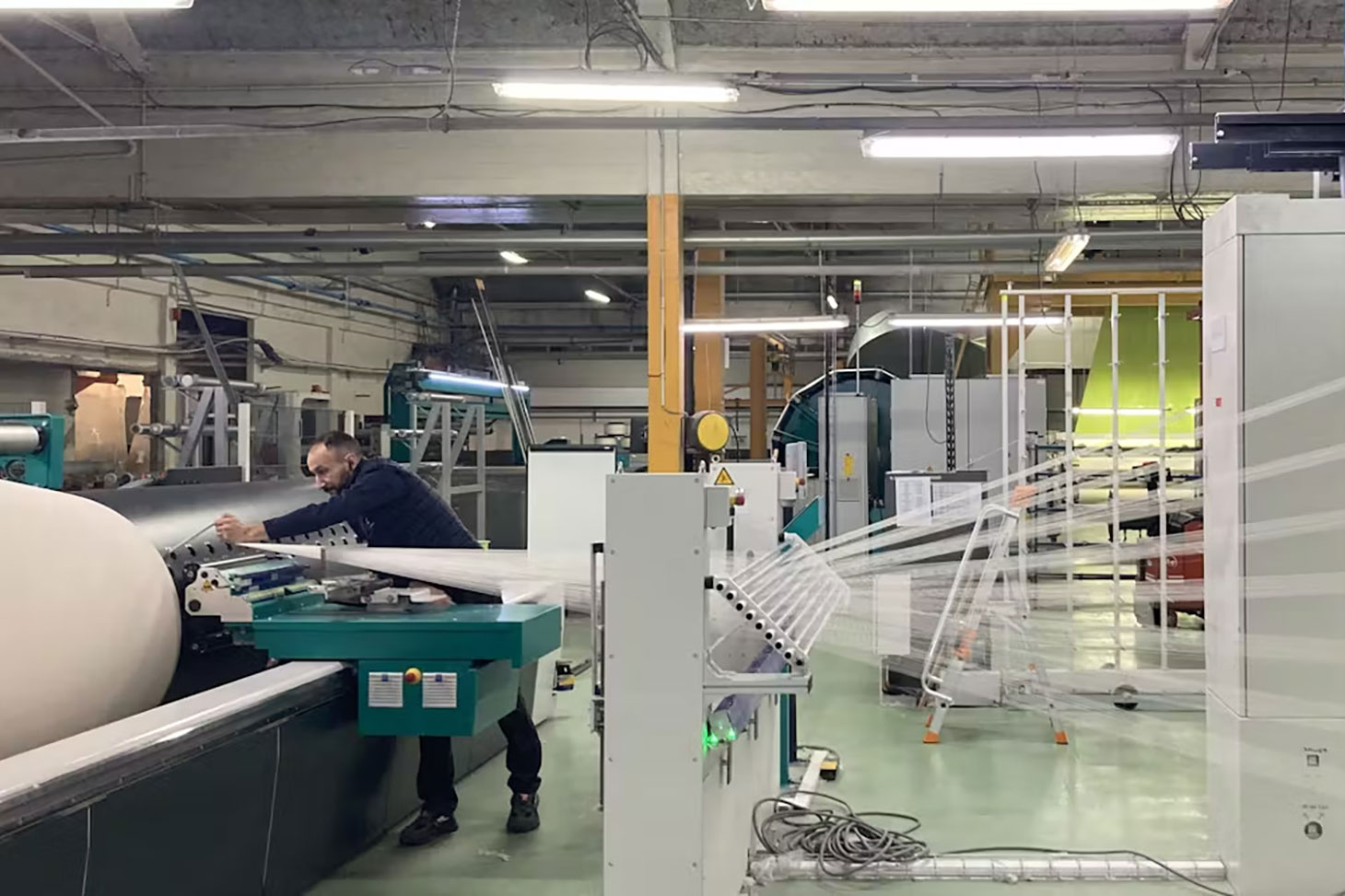
Rural areas are also home to industrial sites. Often isolated, these sites can be particularly vulnerable in the event of conflicts over local resources, whether water, land, or energy… Strategies are being devised to preserve them despite adversity.
Rural areas remain industrial strongholds. Although often overlooked by reindustrialization policies, they are nevertheless on the front lines of a crucial challenge: maintaining productive activity in a world where resources are becoming scarce. Water, land, energy, and labor are becoming critical factors. A field study sheds light on the vulnerabilities and adaptation strategies of rural manufacturers.
A Long-Standing Presence
The French countryside is far more industrial than one might imagine. In 2021, according to Eurostat, 33.4% of jobs in predominantly rural areas in France were in the industrial sector, compared with a European average of 23.3%. And 36% of all industrial jobs are located in a rural public intermunicipal cooperation entity (EPCI) in 2022, accounting for 25% of total jobs (Map 1).

There is a historical explanation for this pattern. From the textile valleys of the Vosges to the sawmills of the Morvan, and the ironworks of the Cantal, the location of these industries has long been determined by access to resources that were both abundant and inexpensive. But this balance is shifting.
With climate change, geopolitical tensions, and environmental standards, the “natural resources” on which rural industries once relied are becoming “constraints.”
Three regions studied, each with distinct characteristics
Our survey, conducted as part of the “Caravane des ruralités” initiative, focused on three rural and industrial intermunicipal communities: Porte de Drôm’Ardèche, in the Rhône Valley; Ballons des Hautes-Vosges; and Bocage Bressuirais, in the Deux-Sèvres department.
These three regions illustrate the diversity of trajectories in industrial areas. Porte de Drôm’Ardèche is a region experiencing strong growth (+6% in industrial jobs between 2016 and 2019). It combines residential and tourist appeal with productive activities (agriculture, logistics, industry). This has led to tensions over land use and water resources.
In contrast, the Ballons des Hautes-Vosges community of municipalities lost nearly 60% of its industrial and export-oriented jobs between 2006 and 2021. This region is experiencing a population decline. Geographical isolation, an aging population, and industrial specialization (textiles, metalworking, and the automotive industry) are holding the region back.
Finally, the Bocage Bressuirais region’s trajectory combines industrial tradition (furniture, metalworking, agri-food) with new growth drivers (robotics, industrial services). These factors give the region a certain degree of resilience in the face of economic shocks.
Fewer resources for the rural sector
The challenge of adapting to climate change is a concern for all the industry representatives interviewed. A textile manufacturer from the Vosges region, interviewed as part of the “Les Caravanes de la ruralité” research program, explained: “Three years ago, I never would have imagined that electricity prices would force us to shut down certain production lines for weeks on end, nor that there could be drought declarations here.”
A local elected official from Porte Drôm’Ardèche adds: “We now refuse to allow new businesses that are deemed to consume too many water resources under the Territorial Coherence Plan (SCOT), because the warning signs are flashing red. ” Although differences can be observed from one region to another, and depending on the size and sectors of activity of the businesses, concerns are being voiced everywhere, particularly regarding pressures on energy, water, and land.
Rural industries are more resource-dependent than others. In rural EPCIs, energy consumption accounts for, on average, 31% of local consumption (Map 2). On average, across all EPCIs, rural industry consumes more than 1,100m³per industrial job, compared to 721 m³ in urban EPCIs.
Overrepresented Industrial Sectors
This can be explained by the fact that resource-intensive sectors are overrepresented in rural areas: extractive industries, agribusiness, paper mills, cement plants, textiles, and so on. Furthermore, these activities often compete with other sectors, such as agriculture or tourism, which are themselves dependent on resources.

As a result, rural industries are not only more dependent but also more vulnerable, because rural industrial players operate in less densely populated labor markets, making them more interdependent. The entire production chain is thrown into turmoil when one of its links faces difficulties. “One of our suppliers went out of business because of skyrocketing energy prices, which put all the players in the industry in the valley in serious trouble,” explains a textile manufacturer from the Hautes-Vosges.
“When gas prices go up, it also affects our ability to hire because workers can no longer afford to travel forty kilometers to come work for us. And the labor shortages are very real—they sometimes force us to shut down production lines,” says a furniture manufacturer in Bressuire.
Adaptation Strategies
Three major adaptation strategies can then be implemented—often simultaneously—by industry and local public actors.
The first involves making sacrifices. Some companies choose to freeze operations, postpone investments, implement short-time work, or even shut down production lines. Some regions choose not to host new industrial facilities because they lack the capacity to negotiate over available resources. These “quiet withdrawals” raise questions about the socio-spatial impacts of such adaptation.
Innovating Toward Dry Industries
The second approach seeks to innovate in production processes through the development of so-called “dry” industries, the establishment of local energy loops, and the implementation of carbon capture systems. While promising, these strategies require significant investment, which risks exacerbating inequalities among companies or regions based on their capacity to innovate.
The last approach relies on leveraging available resources through the use of biomass, the revitalization of small hydroelectric plants, wastewater recovery, or the utilization of underutilized buildings. This requires strong local engineering expertise capable of coordinating networks, aggregating needs, and securing funding. These initiatives, though often ingenious, nevertheless face a regulatory framework that is sometimes ill-suited or overly rigid.
A Vulnerable and Strategic Industry
In an increasingly constrained world, the rural sector is both vulnerable and strategic. It is vulnerable because it is highly exposed to resource pressures and structural constraints (isolation, an aging population, and the fragility of small and medium-sized enterprises). But it is also strategic because it embodies the potential for a return to local production, localized self-sufficiency, and a just transition.
These findings show that the industrial resilience of regions depends closely on the ability to coordinate available resources, local governance, and public support. However, this coordination is far from uniform across the country, and national policies are sometimes ill-suited to the specific characteristics of rural areas. This requires supporting local cooperation (in logistics, energy, training, and the circular economy), bridging the engineering gap between regions, and capitalizing on the complementary strengths of urban and rural areas.
Discussions on reindustrialization cannot ignore considerations regarding the physical nature of economic activities, their regional roots, and the impacts of future climate change.