


Taxation of large corporations is a particularly sensitive issue. Indeed, a corporation that pays little tax relative to the profits it generates contributes little to national solidarity. At the same time, the share of profits going to shareholders is increasing. This situation can create a sense of injustice among citizens who contribute to the government’s budget through their direct and indirect taxes.
"We promise, we'll pay our taxes in France"... Amazon gets caught out on Instagram https://t.co/jq3qKDx3Fw
— 20 Minutes (@20Minutes) January 8, 2022
However, corporate taxation encompasses a wide range of situations, and it can sometimes be difficult to navigate. What is the actual amount of tax a company pays? Does this actual amount correspond to the amount of tax it would theoretically owe if the base rate were applied? And, most importantly, where can this information be found?
The answers to these questions can be found in a document published by every publicly traded company and freely available on its website: the tax return. The term may sound a bit odd, but it is a key document for understanding how large corporations are taxed on their earnings.
Tax documentation stems from the application of international accounting standards. It is worth noting that companies listed within the European Union have been required to follow these standards since 2005. These standards (IFRS, or International Financial Reporting Standards) provide a framework for the preparation and disclosure of their consolidated financial statements. Their primary purpose is to ensure greater accounting transparency on an international scale.
It is with this goal of transparency in mind that one of the IFRS standards requires every publicly traded company to publish tax evidence. This statement generally takes the form of a table and must be included in the company’s universal registration document (the equivalent of an annual report), which is freely available on its website. Its purpose is to reconcile the theoretical amount of corporate income tax (what the company would have been required to pay at the base rate) with the actual amount (the tax expense actually recognized).
The 2020 tax statement for the LVMH Group—the largest company on the CAC 40 in terms of market capitalization—illustrates the value of this comparison. While the group’s theoretical tax rate in France is 32%, its effective tax rate is 32.7%. The table-format analysis compares the two rates and identifies the various sources of the discrepancy.

In the case of LVMH, the main discrepancy stems from the impact of operations located in countries where the base corporate income tax rate is lower than in France: these offshoring activities reduce the tax rate by 6 percentage points. The impact of these relocations is offset by other types of variances. The effective tax rate thus rises to 32.7%. The actual amount of tax paid is also reported: 2,409 million euros for 2020.
You can see all the information a reader can glean at a glance (or almost) from this document. There’s no need for calculations or tedious searches for information. Tax rates are explicitly stated: the base rate is listed first, followed by the effective rate. The explanation of the difference between the base rate and the effective rate provides a better understanding of the group’s tax management. Does the group have operations abroad? Does it benefit from tax credits? etc.
It is easy to see why tax disclosures have become a major communications issue for large corporations. While the publication of such disclosures is mandatory, the format in which they are presented is left to the company’s discretion, allowing it to choose to reveal as much or as little as it wishes…
In this context, we examined the practices of large corporate groups regarding the disclosure of tax information. How transparent are they in their tax disclosures? What factors influence this transparency? We sought to answer these questions in a study focusing on the major companies listed on the Paris Stock Exchange.
An analysis of the published evidence reveals widely varying degrees of transparency; some disclosures are fairly concise, while others are much more detailed. In the vast majority of cases, companies report both their theoretical and actual tax amounts. However, it is less common for companies to provide the additional qualitative information that would allow for a better understanding of the discrepancies.
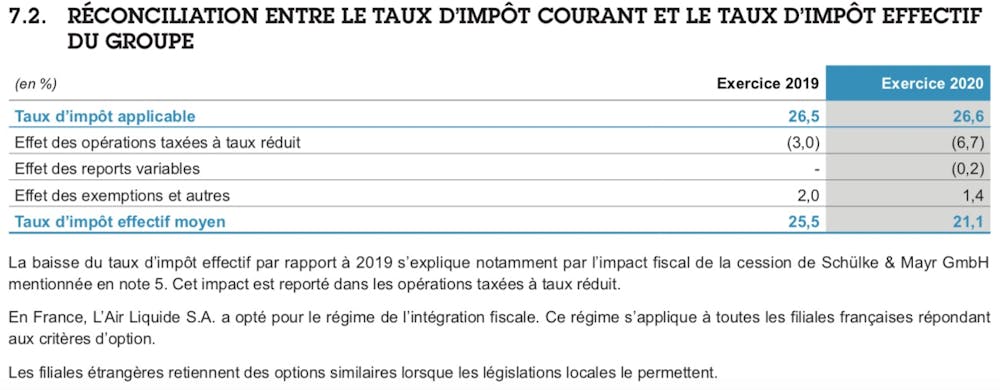
In our sample, a more in-depth analysis shows that the transparency of tax evidence actually depends on the effective tax rate. Thus, the further the effective rate deviates from the theoretical rate, the more vague or discreet companies are in their disclosures.
To establish their case, companies also take external factors into account. Companies operate in an environment on which they depend and which, consequently, guides their actions. In other words, to maintain their legitimacy, companies will respond to pressures arising from their environment.
We have thus identified two key factors that influence the transparency of the evidence.
One of these factors is competition. Publishing tax evidence is a risky endeavor: disclosing too little information may appear suspicious, while revealing too much could backfire on the company. However, in situations of uncertainty, a company tends to mimic the behavior of its peers. Indeed, we observe this phenomenon of sectoral mimicry in our sample. Companies align themselves with their competitors’ practices, so that the degree of transparency in tax disclosures varies from one sector to another but is relatively similar within a given sector.
The French government also plays a role. We have observed that the transparency of a company’s tax records increases when the government is a shareholder. This finding is consistent with the various initiatives taken by the government to promote tax transparency, both nationally and internationally.
In short, the quest for legitimacy is driving companies to be more transparent. This increased transparency can facilitate the work of stakeholders analyzing the tax responsibility of large corporations. It is also a lever that governments are trying to use to encourage tax compliance. In this regard, we can notably mention the recent decision A decision made at the European level: Multinational companies will now be required to disclose the amount of taxes they pay in each European Union country.
This article is republished from The Conversation under a Creative Commons license. Readthe original article.