

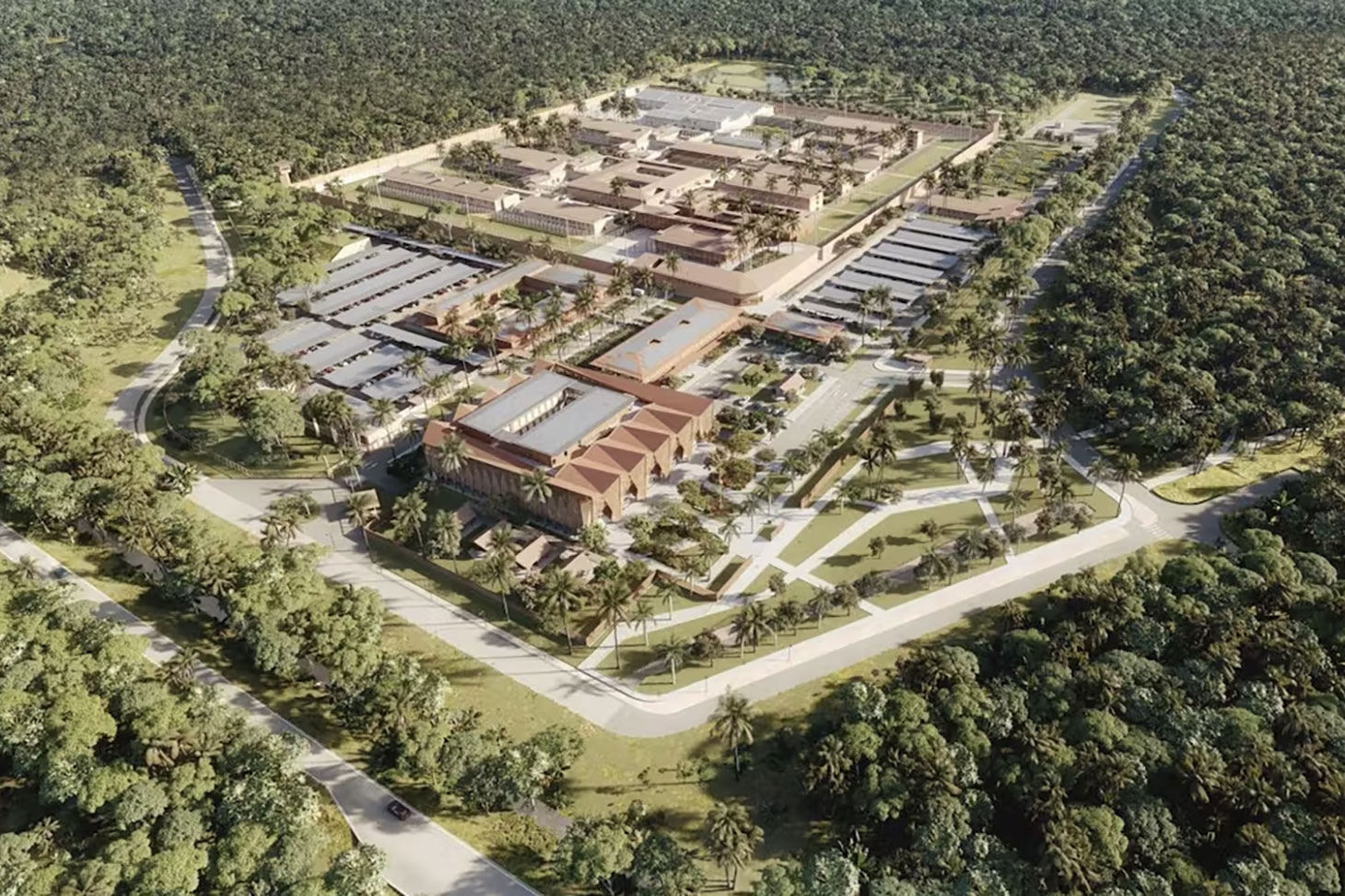
Not long ago, Gérard Darmanin announced a doubling of the number of places in open-prison facilities and the creation of high-security prisons for the most dangerous drug traffickers. Now the minister is proposing to open one of these prisons in the heart of the Guyanese jungle by 2028. At first glance, Gérard Darmanin appears to be tackling the prison system on all fronts. But there is nothing truly innovative about this announcement. It is part of a strategy to geographically relocate incarceration, which inevitably brings to mind the historical practices of colonial penal colonies, particularly in French Guiana.
What sets this project apart, however, is the broader context in which it is taking place. Indeed, it echoes other recent European policies, such as the agreement signed between Denmark and Kosovo to transfer 300 foreign detainees awaiting deportation to Kosovo, or the prison cooperation between Norway and the Netherlands, where prisons were temporarily leased.
In France, this relocation takes place within the national territory itself, in an overseas territory far from the mainland. They are kept at a distance while sovereignty is maintained. Darmanin is not the only one to have had this idea: Laurent Wauquiez proposed opening a detention center in Saint-Pierre-et-Miquelon, while Trump, across the Atlantic, is considering reopening Alcatraz Prison.
Two issues arise in this context: one concerns human rights, and the other calls into question the rationale behind the prison system and the use of extreme custodial sentences.
Human Rights Risks
From a human rights perspective, first of all, the relocation of prisoners raises serious concerns.Article 8 of the European Convention on Human Rights guarantees respect for private and family life. The European Court has already ruled that placing prisoners far from their loved ones, without proportionate justification, could constitute a violation of this right.
In French Guiana, this remoteness is compounded by a fragile public health system: the territory is regularly affected by dengue epidemics and suffers from a lack of hospital facilities (Santé publique France, 2025). However, Article 3 of the Convention prohibits inhuman or degrading treatment, which includes medically inadequate conditions of detention.
In this context, incarceration in French Guiana therefore amounts to making a high-risk security decision for the prison population. Thus, what is new compared to the penal colony is not the isolation itself, but the fact that it is now employed and justified within a legal framework that is supposed to guarantee human dignity.
Carry out the sentence in a showy manner against the enemy of the state
Second, the plan to reopen a prison in French Guiana reveals a shift in the logic of incarceration. Prisons no longer serve to discreetly erase state violence; rather, relocating them to a place of extreme exile makes it possible both to intensify the punishment of incarceration and to render it morally tolerable.
Authors such as Pieter Spierenburg and Michel Foucault have demonstrated the shift from a “spectacular” justice system—centered on the body and the visibility of punishment (public executions)—to a more discreet system, in which punishment becomes internalized through confinement and the discipline of the body and mind (the modern prison).
But what we see here goes even further. It is no longer a matter of concealing the violence of the punishment by making it “milder” or more disciplined, nor is it simply a matter of hiding the horror of execution.
What the political establishment is proposing with the reopening of a prison in French Guiana is, on the contrary, to embrace a form of penal brutality: that of extreme banishment—both geographical and moral—which casts unwanted bodies out of the national territory, and moreover, into a place historically associated with exile and abandonment. No longer hiding punishment and human suffering, but instead inflicting it ostentatiously.
Monday through Friday plus Sunday, receive free analyses and insights from our experts for a different perspective on current events. Subscribe today!
This extreme banishment helps construct a powerful security narrative centered on the prisoner’s dangerousness, portraying them at times as a degenerate and a hopeless case, and at other times as a pathogenic entity to be quarantined. Today, the prisoner used to justify this extreme ostracism is the drug trafficker, but it could just as easily be any other person deemed the enemy of the state at any given time.
The combination of these elements—the distancing of the incarcerated body, mass incarceration in a place of exile, and the rhetoric of dangerousness—produces, as I have shown in my work, a process of normalizing extreme prison sentences. My empirical research highlights a twofold process: on the one hand, a social desensitization to inhumane detention conditions, precisely because they are spatially distant; on the other, a discursive construction of the prisoner as a dangerous, quasi-biological figure, which legitimizes this distancing. What should be seen as unacceptable becomes tolerable, even necessary, in the name of collective security.
Ultimately, this is not to deny the real risks posed by certain drug traffickers in detention or the current flaws in the prison system, but the response—which would involve deporting them to a highly isolated prison in French Guiana—is less a solution than an admission of institutional failure. Unable to effectively control the flows of power and influence within prisons, the government is choosing to shift the problem outside the country—to a place steeped in colonial imagery—rather than rethinking security measures and prison governance in existing facilities.
Far from being a coherent security strategy, this ban on extremism masks a profound inability to reform, while normalizing an exceptional and inhumane punishment.