

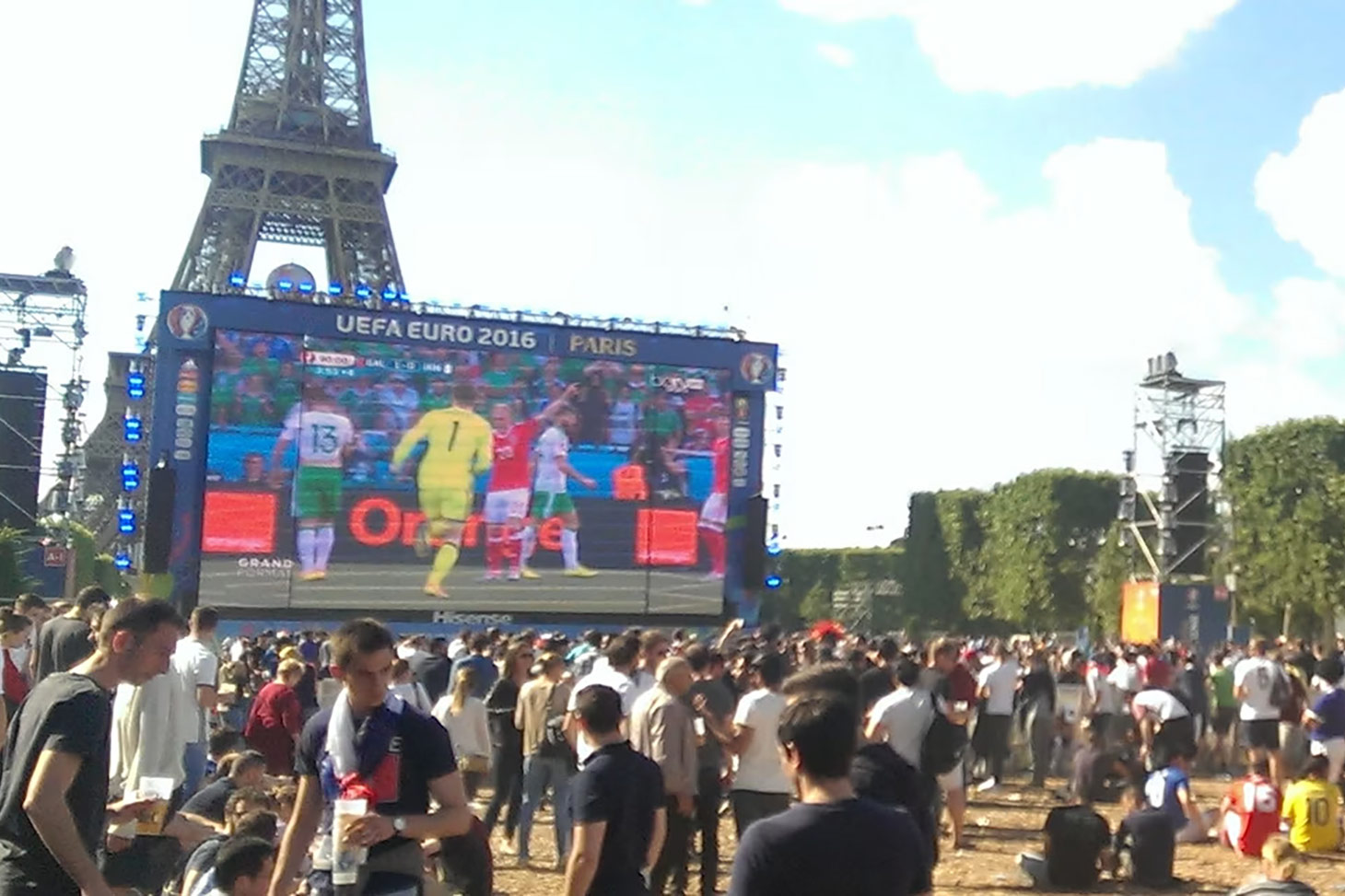
The concept of a “fan zone”— an Anglicism referring to an area reserved for fans—is relatively recent. It first appeared in the 1990s, during Formula 1 Grand Prix races (with the goal of enhancing the spectator experience) and the 1992 UEFA European Championship in Sweden (with a focus on security amid concerns about hooliganism). In 2008, during the European Championship, fan zones were incorporated into a broader security strategy, in which “enjoyment” became an organizational principle for maintaining order and reducing violent behavior.
The term has been used frequently in the public sphere since 2010, with a surge in 2016 during the European Soccer Championship held in France, followed by the World Cup in 2018. Its use is therefore strongly linked to specific sporting events.
A concept developed by the organizers of major international sporting events
The term “fan zone” was added to the dictionary in 2018. Its definition corresponds to what was established during Euro 2016: “A special, secure area reserved for fans or admirers of events.” It should be noted that the definitions provided by different dictionaries vary significantly.
Various scientific studies have identified four objectives underlying the establishment of these fan zones by organizers and/or host communities of major international sporting events (MISEs). The first is safety, as these spaces are designed to channel crowds and manage the flow of people. The second is marketing: for host communities, to boost their appeal and maximize the event’s visibility in their communication strategy; and for organizers, to enhance the spectator experience by extending it before and after the sporting event. The third objective may be commercial for organizers, generating additional revenue (merchandise, beverages, etc.). Finally, the fourth objective may be social, allowing people without tickets to enjoy the event at a lower cost, while also bringing a broader segment of the population together around the event.
Generally speaking, the fan zones set up by GESI organizers are viewed as a tool for managing a mega-sports event. They are part of the process of securing, commercializing, and transforming these major sporting events into festival-like experiences.
Fan Ownership
According to Wikipedia, “a fan zone is a special area reserved for fans or admirers during events. This area is as close as possible to the action”: here, security is not an issue, which reveals how the current use of the term “fan zone” has evolved and expanded.
In fact, our study shows that fans have recently adopted the term “fan zone” to describe gatherings other than those organized by event organizers.
The term has been adopted by fans to describe the arrangements they set up on their own to watch sporting events, and it’s linked to so-called “impromptu” gatherings of fans along the roadside (the famous “Virage Pinot” at the 2023 Tour de France, for example) and on trail runs (the fan zone set up by trail runner and influencer Clemquicourt in Vallorcine during the 2025 Ultra-Trail du Mont-Blanc). The fan zone breaks free from its institutional nature.
Toward the Commercialization of Fan Zones
The sharp increase in the use of the term “fan zone” also stems from the fact that this concept has been commercialized by numerous businesses: event agencies are developing an all-inclusive “Fan Zone” package, which they sell to local governments based on the traditional model of a secure area featuring a giant screen, food service, and optional amenities. Event equipment rental companies (marquees, screens, sound systems, etc.) offer tutorials such as “Create your event fan zone with all the necessary equipment” or “Organize a fan zone with…”.
Bars are also capitalizing on this trend and adopting the term “fan zone” to market what they were already doing—namely, broadcasting competitions on their screens or on screens set up specifically for major events. Recreation centers are setting up“kids’ fan zones” reserved for their members.
There is even an independent website that lists (for a fee) all the fan zones in France for the 2026 World Cup (it includes fan zones run by local governments, as well as bars, stadiums, cultural centers, and more).
Finally, brands, too, offer immersive spaces at events, which they call“fan experiences.”
So how should we define it?
This variety of uses for the term “fan zone” leads to terminological ambiguity, which is clearly evident in the interviews conducted as part of our qualitative study. In fact, when asked, respondents had difficulty defining exactly what a fan zone is.
The first image that came to mind was the rather traditional one of a simple space with a giant screen where people could watch the game or competition while standing. Thus, the Club France for the Paris 2024 Olympic and Paralympic Games, which offered numerous additional services (entertainment, etc.), was not instinctively viewed as a fan zone by the majority of respondents (even those who had visited it), even though the organization had clearly communicated its status as a fan zone (“Club France is the largest fan zone of the Games”) and this terminology had been widely reported in the media.
Our study thus reveals the difficulty of finding a precise and universally accepted definition of “fan zone.” Indeed, on the one hand, definitions of this term outside the academic context are quite varied and reflect a certain lack of clarity in explaining the concept; on the other hand, the scientific literature offers neither a precise definition nor a conceptualization of the notion of a fan zone. This can be explained by the fact that research on fan zones is closely tied to GESI events and therefore approaches the concept as it was conceived by the organizers. However, as we have seen above, the term, as it is currently used, encompasses a broader spectrum.
We therefore propose considering the concept of a fan zone in a broad sense—that is, as spaces where people can physically gather to experience major sporting events—so as not to exclude any practice or experience and to open the door to reflection on new forms of fan zones.
Classification of GESI Fan Zones
The fan zone thus encompasses several types of organizations with different structural forms and configurations. Our study has enabled us to develop a typology that clarifies this concept (see Table).

This classification initially divides fan zones into two categories: (1) institutional fan zones, whose main characteristic is their official status. These are set up by the event organizer or the host community. (2) Informal fan zones, which, by contrast, are neither set up nor managed by the event organizer. They are organized or improvised based on opportunities arising from the event’s popularity.
The segmentation of institutional fan zones was based on distance (a proximity-distance continuum) from the competition venue. As for the segmentation of informal fan zones, it was based on the status of the individuals who organized them.
Now you're all set for the 2026 World Cup: if someone suggests meeting up in the fan zone, make sure you know exactly what kind of place they're talking about!
Check out our video based on this article