

While the purpose of economic integration organizations (SIAE) is to support people who face difficulties entering the job market, their efforts are evaluated based on a single indicator: the “dynamic exit rate.” Not only does this rate reveal only part of what these organizations achieve, but it also overshadows “everything else.”
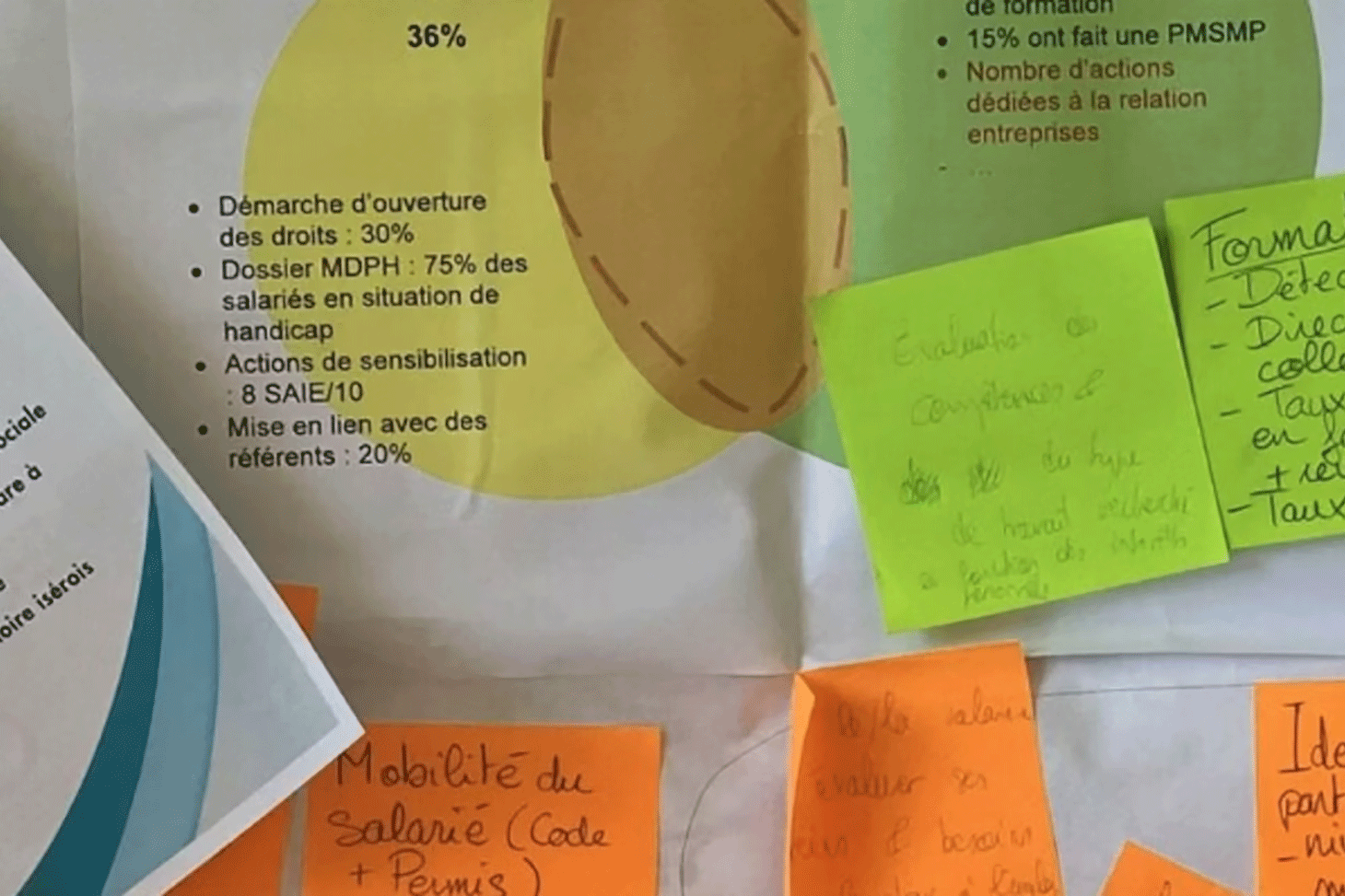
To shed light on what is often overlooked, TI38—a collective of community-based organizations focused on social integration in Isère—has proposed a collaborative initiative to address this sharedneed for knowledge: What do SIAEs accomplish? What do they contribute to society?
Evaluation Process in Isère
To quote the group spearheading this initiative, “This discussion arose from a shared observation: the core of the work carried out day in and day out by economic integration programs (IAE) is largely invisible, and existing indicators do not adequately reflect it.” These organizations are regularly under strain:
"The subsidies granted only partially offset the additional costs incurred as a result of their social mission and do not appear to constitute an economic advantage."
To shed light on and bring to light what is often overlooked, a working group formed by TI38 reached out to me because of my research on assessing realities that are not captured by traditional indicators.
Consequently, an evaluation process was developed to identify, assess, and explain the changes brought about among employees in work integration programs and in their local communities.
Evaluation of Job Placement Programs
Evaluation is much more than a single measurement—much more than a series of measurements. It is a way to report on actions taken, to reveal how they are implemented and the effects they produce, with a view, in particular, to putting their diversity and cross-cutting nature into perspective.
Sharing the approach taken in the Isère department and contributing to the discussion initiated at the national level by the General Inspectorate of Social Affairs (IGAS) can help highlight the value created by the SIAEs.
Step 1: Highlight the work across five dimensions
Based on questionnaires and interviews with the partners involved (SIAE, the State, the Department, and the Metropolis), the goal was to propose a shared vision of integration through economic activity and its evaluation; from this vision emerged the components of the SIAE’s social utility, referred to as “dimensions.”
Five dimensions were discussed, refined, and then approved by the group, with the aim of collectively translating them into indicators:
-
professional integration and support,
-
social support, addressing barriers, and combating poverty,
-
social connections, integration, and well-being,
-
economic and regional development,
-
environment.
Step 2: Collect data
The group then worked on each of the selected dimensions to propose metrics that would make them visible, as well as the questions needed to obtain those metrics.
The data collected helped bring the various aspects of social utility to life; this analysis was supplemented by group and individual interviews. The goal was not only to discuss and gain a better understanding of the information that emerged, but also to explore questions that arose during the data analysis process.

Step 3: The Added Value of Structures for Integration Through Economic Activity (SIAE)
A comprehensive analysis of numerical and textual data has highlighted the complexity of the work carried out by SIAE stakeholders—a complexity that a dynamic exit rate alone cannot reveal. Their initiatives are diverse and cross-cutting, as evidenced by the five key findings that emerged from the study conducted by TI38.
Serving audiences with a wide range of challenges
The people served face challenges—commonly referred to as “barriers to employment”—that are more numerous and diverse than in the past: language, transportation, health, and so on. According to professionals, this combination of challenges is transforming and complicating the work of providing support and guidance.
Support that is increasingly part of social services
Social and Professional Integration Counselors (CISP) work in various ways—connecting people, listening, providing follow-up, and assisting with administrative procedures—and across many areas—language, digital skills, housing, disabilities, addiction, etc.—to address social issues. This has led to increasing complexity in the social sphere, which is time-consuming and difficult to define and measure.
Professional development across various areas
The primary mission of social and professional integration counselors is to guide employees toward sustainable employment. This work takes place both within the integration program—through supported employment—and externally, by offering training, internships, or opportunities through fixed-term and temporary employment. The number of suspensions of integration contracts for this reason could be an indicator to include in future evaluations.
Employees who feel they are regaining their place in society
The employees interviewed highlight the program’s impact on their daily lives. They speak of regained confidence, motivation, and hope—factors that have a positive effect on their physical and mental health, as well as on their social lives. They feel as though they are “reclaiming their place” in society from the very start of the program—something that the active exit rate does not reveal.
Local Businesses Essential to the Isère Region
Organizations promoting integration through economic activity (SIAE) are economic actors with expertise and networks of suppliers (8 million euros in purchases) and customers (10,000 customers), generating more than 40 million euros in revenue in Isère by 2024. Meeting local needs and the wealth generated in the region contribute to regional development, which should be highlighted.
Highlighting the wealth created by SIAEs
The evaluation conducted encourages us to change our perspective on economic integration programs (SIAE) and to continue the discussion in order to highlight their impact on other policy areas—housing, health, and education. This could lead to moving away from a metrics-driven approach—one that is short-sighted and ill-suited to SIAEs, as it may conflict with the needs of the individuals receiving support and the very purpose of these organizations.
It's not the number that's the problem, but as the sociologist has shown Olivier Martin Building on the work of Alain Desrosière, it is the way it is used that suggests that measuring would be synonym for "to evaluate".
This article was co-authored with Magda Mokhbi, director of Ateliers Marianne (Le Pont-de-Claix), a work integration program.